



Cambodia has rejected fresh allegations from Thailand that its forces planted new landmines along the border, calling the claims “unfounded and misleading” and accusing Bangkok of violating ceasefire agreements by sending troops into well-documented mine-contaminated areas.
Government spokesperson Pen Bona on August 14 accused Thailand of using a recent landmine explosion to “portray itself as the victim and mislead the international community”, despite violating the current ceasefire agreement.
Addressing a daily press briefing, Bona said Thai forces moved troops, laid barbed wire and mobilised weapons in disputed areas where landmines remain, actions he described as “irrefutable proof” of non-compliance.
He cited the 13-point accord from the Cambodia–Thailand General Border Committee meeting on August 7, citing Point 2: “Both sides must maintain troop positions as of the July 28 midnight ceasefire, with no additional movement”, and Point 4: “Both sides must refrain from provocative actions, including building new military fortifications”.
“The landmine incident would not have happened if the Thai side had respected and implemented the ceasefire agreement,” Pen Bona said, calling on Bangkok to stop “deceiving the international community” and to uphold the truce in good faith.
In a statement yesterday, August 13, the Ministry of Foreign Affairs and International Cooperation noted that, irrespective of the sovereignty question over the exact locations, the recent incidents “could not have occurred had Thai military forces refrained from entering and conducting operations in well-known mine-contaminated areas, in violation of the Agreed Minutes of the Extraordinary GBC Meeting of 7 August 2025”.
The agreement, reached during the Cambodia–Thailand General Border Committee (GBC) meeting, reaffirmed a prohibition on troop movements or patrols beyond existing positions.
The ministry stressed that these areas have long been recorded by both domestic and international demining agencies as containing minefields which date back to Cambodia’s internal conflicts of the 1970s and 1980s.
The allegations, made in Thai press statements on August 10 and 12, claimed Cambodian troops had recently laid anti-personnel mines in Oddar Meanchey and Preah Vihear provinces, injuring Thai soldiers.
Phnom Penh insists the incidents occurred in long-contaminated battle zones within Cambodia’s territory and in disputed areas under the 1904 and 1907 boundary treaties.
“Cambodia reaffirms that these allegations are fabricated, devoid of credible evidence and serve only to deflect attention from Thailand’s own violations of the ceasefire and international law,” said the ministry.
The ministry rebuttal came after reports that Thai soldiers entered Chok Chey village, in Banteay Meanchey province’s O’Chrov district, on August 12 and 13, erecting barbed wire barricades and demolishing homes belonging to Cambodian residents.
Maly Socheata, spokesperson for the Ministry of National Defence, told an August 13 afternoon press conference that Thai para-military and border police laid barbed wire and placed car tyre barricades in those locations.
“Cambodia demands that Thailand immediately and unconditionally halt all activities which violate the ceasefire and the spirit of the agreement, particularly Points 2 and 4, which stipulate that both sides maintain their military forces at their current positions without moving beyond the locations they occupied when the ceasefire took effect at midnight on July 28,” she said.
Local residents reported that their homes — some occupied for more than 20 years — were surrounded by the newly erected barbed wire.
Four houses were reportedly destroyed, and a Cambodian border post was taken over by Thai forces.
The latest tensions follow a series of border provocations in recent weeks, including the laying of new barbed wire, the destruction of property and what Cambodia has described as an explicit threat from Boonsin Padklang, commander of Thailand’s Second Army Region, to occupy Cambodian territory by force.
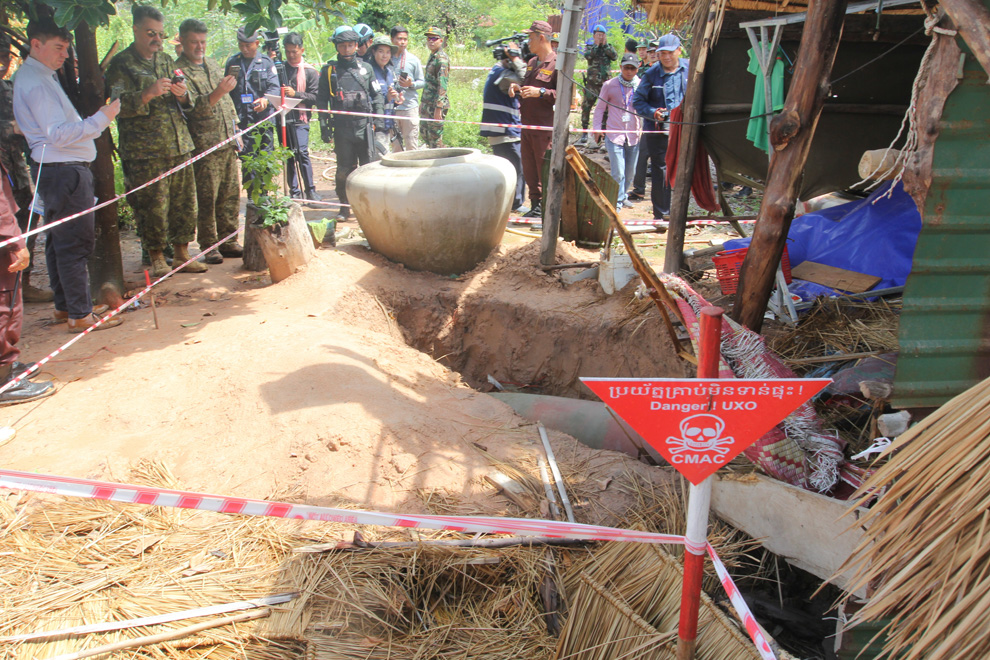
The Cambodian Mine Action Centre (CMAC) has also issued urgent warnings over the growing threat of unexploded ordnance.
During recent clashes, Thai forces fired 155mm artillery shells containing M-46 cluster munitions, many of which failed to detonate.
CMAC teams are now working in affected areas of Oddar Meanchey and Preah Vihear provinces to locate and clear the dangerous remnants.
Heng Ratana, CMAC’s director-general, reported that Thai forces dropped 1,549 bombs on Oddar Meanchey province during the conflict, including ten MK-84 bombs — six of which failed to explode.
Clearance teams are marking and securing the sites, but authorities warn that unexploded devices may remain a hazard for years.
The MFAIC urged the international community — especially the countries involved in brokering the current ceasefire — to press Thailand to honour its commitments “not only in words but in concrete actions”, and to ensure the immediate removal of all illegally placed barbed wire from Cambodian territory.
Cambodia has appealed to Malaysia, as ASEAN chair, and other ceasefire co-facilitators to fast-track the creation of an independent monitoring mechanism to uphold the fragile truce with Thailand.
Phnom Penh also reaffirmed its call for Bangkok to accept the jurisdiction of the International Court of Justice to resolve border disputes, saying it would demonstrate “good faith” and commitment to lasting peace.
