



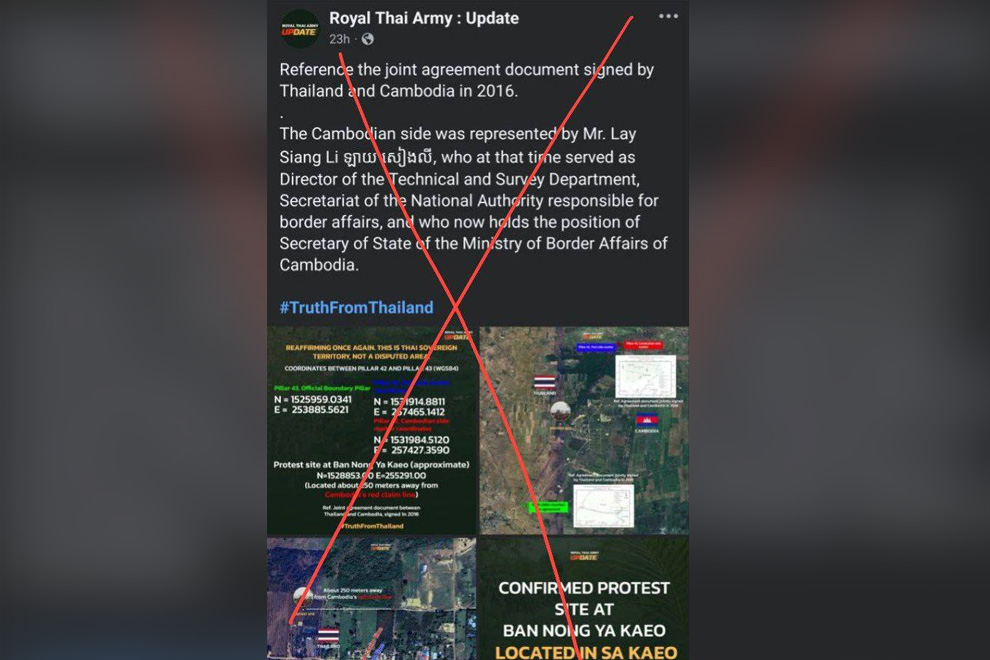
The State Secretariat of Border Affairs (SSBA) has strongly rejected information posted by a Facebook page named “Royal Thai Army: Update” on September 19, accusing it of spreading fabricated claims about the Cambodia–Thailand border in Banteay Meanchey province’s Prey Chan village.
In a September 20 press statement, the SSBA clarified that the post misused field documents and distorted facts, causing public misunderstanding and wrongly suggesting that Cambodian authorities had recognised a boundary line between Boundary Pillar No. 42 and No. 43.
“We officially reject and completely dismiss this false, unprofessional and malicious information,” the statement said, adding that the post had “the clear intention of misleading both domestic and international public opinion”.
The page “Royal Thai Army: Update” is an unofficial platform with no institutional affiliation. It appears to have been created to spread fake news and target Cambodia, particularly its leaders.
The statement explained that the disputed materials cited by the Facebook page were annexes to the reports of fact-finding missions conducted by the Cambodia–Thailand Joint Survey Teams in 2016 and 2017.
According to the SSBA, these annexes only showed the terrain and exact location of boundary pillars but are not official maps or documents defining the boundary line.
The statement outlined three key points:
1. The documents shown were results of survey missions regarding the condition and location of Boundary Pillars No. 42 and 43, installed during the French colonial period. They do not represent an official boundary demarcation.
2. The Facebook page administrator misused the survey data to fabricate a boundary line on satellite imagery, misleading the public into believing it was officially recognised.
3. The Prey Chan area between the two boundary pillars remains undemarcated, with no mutual agreement reached by both sides. Only the Cambodia–Thailand Joint Boundary Commission (JBC) has the mandate to resolve such matters.
The SSBA urged both the Cambodian public and international community not to believe or share false information that is posted online.
It further encouraged widespread dissemination of the official clarification “for a better understanding of the general public while promoting the truth over this matter”.
