



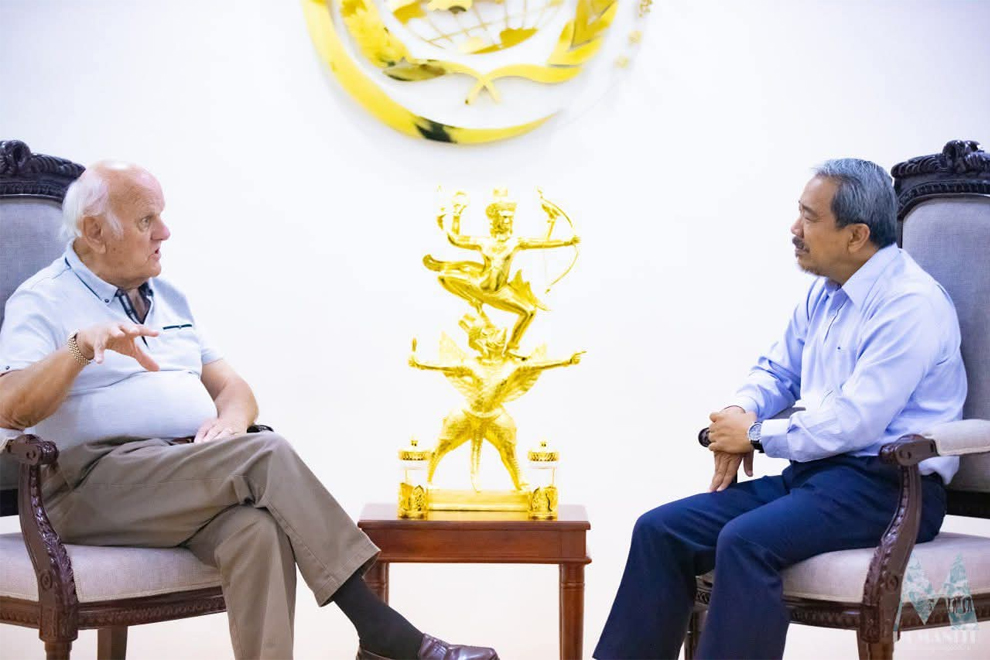
Cambodia has stepped up efforts to frame its border dispute with Thailand within the framework of international law and human rights, as Senior Minister Keo Remy met with a senior US judge and outlined what he described as serious violations committed by Thai forces despite an existing ceasefire.
Remy, president of the Cambodian Human Rights Commission (CHRC), held February 5 talks with John C. Coughenour, senior US district judge of the United States District Court for the Western District of Washington, at the commission’s hearing room in Phnom Penh.
The meeting focused on the ongoing Cambodia–Thailand border dispute, with Cambodia emphasising its reliance on international law and peaceful mechanisms to resolve the conflict.
During the meeting, Remy briefed the judge on the historical and legal basis of Cambodia’s border claims, explaining that Cambodia has consistently respected and implemented the 1904 and 1907 Franco–Siamese Conventions and Treaties, which are recognised under international law.
He noted that Thailand, particularly extremist groups and some politicians, continues to rely on a unilaterally drawn map that contradicts internationally accepted legal frameworks.
The senior minister further accused the Thai military of carrying out large-scale military operations inside Cambodian territory, including the use of heavy weapons, cluster munitions, poison gas and fighter jets such as F-16s, Gripens and T-50 aircraft.
He said Thai forces penetrated more than 90 kilometres into Cambodian territory, launching indiscriminate attacks on civilian villages, infrastructure and ancient temples, including the Preah Vihear Temple, a UNESCO World Heritage Site.
“These actions constitute serious violations of international law, including international human rights law and international humanitarian law, particularly the 1949 Geneva Conventions,” said Remy.
He also raised concerns that Thailand continues to engage in provocative activities despite a ceasefire agreement and the Kuala Lumpur Joint Statement dated October 26, 2025, witnessed by US President Donald Trump and Malaysian Prime Minister Anwar Ibrahim, who was serving as ASEAN chair at the time.
According to Remy, these actions include the use of high-frequency sound waves to psychologically disturb civilians, demolition of homes, destruction of religious statues, theft of property and the construction of new buildings inside Cambodian territory which aim to erase Cambodian national identity.
The CHRC president added that Thai authorities have deployed barbed wire and container structures to block more than 100,000 Cambodian refugees from returning to their homes, exacerbating the humanitarian situation along the border.
Despite these accusations, Remy reiterated that Cambodia does not seek war.
“Cambodia is a peace-loving country and has no intention of starting a war with any nation,” he said, noting that the country’s long history of conflict has made it fully aware of the devastating consequences of war.
However, he stressed that Cambodia has a duty to protect its sovereignty and territorial integrity, in accordance with international law.
He reaffirmed Cambodia’s position that the dispute must be resolved peacefully, in line with the UN Charter, the ASEAN Charter, relevant international conventions and treaties, and existing bilateral and multilateral mechanisms.
He emphasised that lasting stability can only be achieved through dialogue and the honest application of international law, not through military pressure.
Judge Coughenour reiterated that Trump and the American people have expressed full support for the government of Cambodia’s restraint and its commitment to resolving the dispute peacefully and lawfully, according to the CHRC.
He reportedly voiced disappointment over what he described as the Thai military’s aggressive actions and said these had caused serious harm to Cambodian civilians.
The judge also praised Cambodia’s broader development efforts, citing progress in infrastructure, construction and human rights, including the abolition of the death penalty, religious harmony, the absence of racial discrimination and the promotion and protection of LGBTQ rights.
The meeting concluded in what both sides described as a friendly and constructive atmosphere, with Cambodian officials viewing the exchange as an important step in bringing international legal and human rights attention to the border dispute.
