



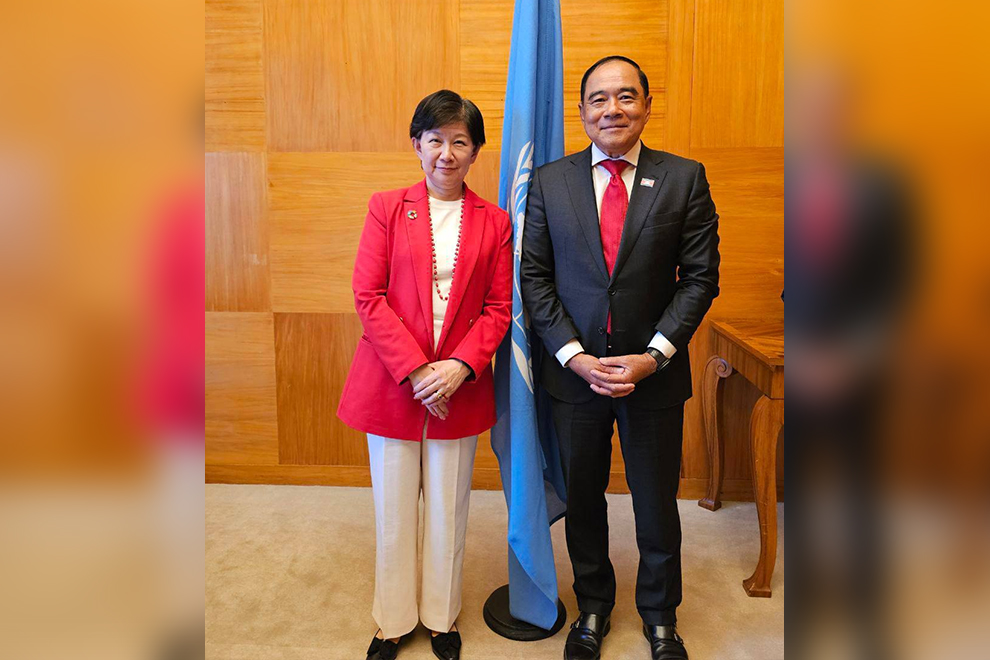
A senior Cambodian official raised the complexities and challenges of the landmine issue along the Cambodia-Thailand border with Izumi Nakamitsu, the UN undersecretary-general, who encouraged Cambodia and Thailand to resolve the issue peacefully.
Senior Minister Ly Thuch, first-vice president of The Cambodian Mine Action and Victim Assistance Authority (CMAA), met with Izumi, who serves as the UN High Representative for Disarmament Affairs, to discuss cooperation on mine action on December 1.
Thuch explained that the landmine problem along the Cambodia-Thailand border is complex and challenging, posing a danger to both civilians and military forces, and will require significant time and resources to resolve, according to the CMAA.
“Nevertheless, Cambodia will continue to address these challenges through cooperation, dialogue and a technical approach with neighbouring countries to ensure safety and security,” Thuch affirmed to Izumi.
He also highlighted Cambodia’s efforts in clearing landmines and unexploded ordnance (UXO) from war for over 30 years. Cambodia has transformed from one of the most heavily mine-affected countries into a global leader in mine clearance, information management and victim support for survivors.
He stated that the Kingdom continues to contribute to mine clearance under the UN peacekeeping framework, and national and international operators in Cambodia have shared their experience and expertise globally through training, study visits and cooperation with other mine-affected countries.
He added that Cambodia has achieved success in the mine action sector due to the full support and strong commitment its government, as well as contributions from friendly countries, development partners, the private sector and other relevant parties.
“Izumi acknowledged Cambodia’s efforts in bringing peace and national development, and considered mine clearance a major burden for Cambodia to address. Regarding the conflict between Cambodia and Thailand, [she] appealed to both sides to resolve the issue peacefully,” said the CMAA.
