



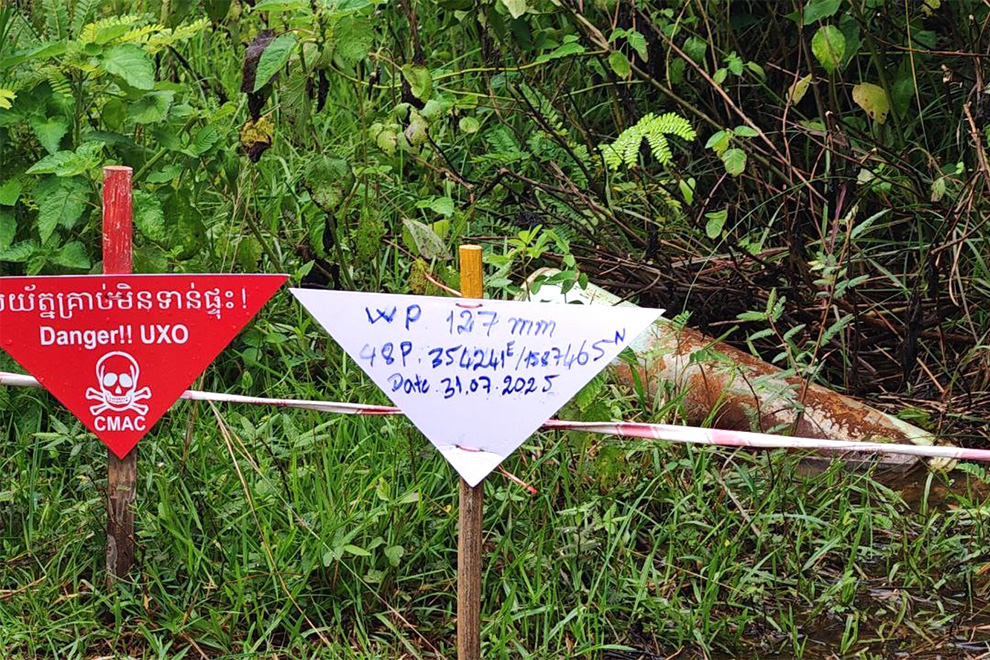
Cambodia has reiterated its longstanding commitment to humanitarian demining efforts, recalling more than three decades of work that has drastically reduced mine casualties and restored vast areas of land for development.
On the morning of September 24, the Joint Coordinating Task Force (JCTF) held its first meeting via video conference, following the agreement reached during the First Special Meeting of the General Border Committee (GBC) in Koh Kong Province earlier this month.
The JCTF will coordinate demining work in priority areas along the Cambodia-Thailand border, as agreed by both sides.
Maly Socheata, spokesperson of the Ministry of National Defence, underlined that the initiative builds upon Cambodia’s long and difficult journey in addressing the deadly legacy of landmines and unexploded ordnance (UXO).
“As a reminder, in regard to the work of humanitarian demining, the Kingdom of Cambodia has made efforts in implementing mine and unexploded ordnance clearance since 1992,” she noted.
She explained that over the past 33 years, Cambodia has cleared about 3,307 square kilometres of contaminated land, destroying more than 4.3 million landmines and UXOs.
Casualties have fallen dramatically, from an estimated 4,000 people per year in the 1990s to fewer than 100 per annum by 2020.
Socheata stated this progress has not only improved safety and livelihoods at home but has also allowed Cambodia to play an active role in global peace and security.
The country has contributed troops to UN peacekeeping missions and deployed mine clearance experts to assist other conflict-affected nations.
“Cambodia has transformed itself from a war-torn country affected by landmines into one which actively participates in peacekeeping missions under the UN umbrella. We are also engaged in mine clearance in other war-torn countries,” said Socheata.
