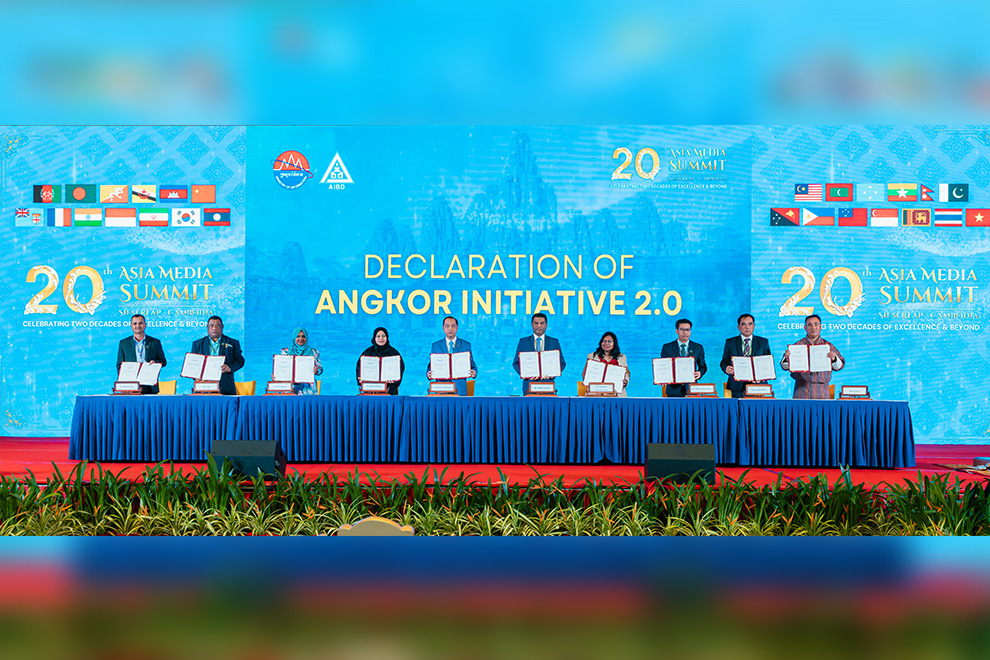
As a major step towards media integrity, Cambodia officially launched the Angkor Declaration Against Fake News 2.0 at the 20th Asia Media Summit, hosted this week in Siem Reap.
The declaration, unveiled by Minister of Information Neth Pheaktra, marks a renewed regional commitment to combating disinformation, strengthening media ethics and rebuilding public trust in an era increasingly shaped by digital disruption.
“We are no longer in an age where we can passively observe. The time to act is now,” Pheaktra said, in his keynote address to media leaders, government officials and communication specialists from across the Asia-Pacific region.
He declared that from the stone-carved truths of ancient Angkor to today’s algorithm-driven realities, Cambodia stands firmly on the side of knowledge, resilience and digital responsibility.
Building upon the original 2019 Angkor Declaration, this enhanced version — dubbed Angkor 2.0 — responds directly to emerging threats such as AI-generated misinformation, algorithmic content manipulation and deepfakes.
It also broadens the scope of regional cooperation by proposing a Regional Code of Practice on Disinformation in the Media to be voluntarily endorsed by national broadcasters across Asia.
“This is not just a renewal. It is a reinvention,” Pheaktra explained.
“We are turning a historic platform into a living mechanism for regional media resilience,” he added.
The declaration outlines nine core commitments by Cambodia, including the promotion of media and information literacy (MIL), the creation of a regional training hub for ethical journalism and the launch of regular workshops on digital media ethics and fact-checking.
Among the most ambitious initiatives is the establishment of a monitoring and evaluation mechanism, under the “Angkor Initiative” umbrella.
This body will track progress since 2019, share best practices and issue annual reports on the state of disinformation in the region.
The Kingdom also pledged support for the development of regional standards for AI content transparency and algorithmic accountability, in collaboration with the Asia-Pacific Institute for Broadcasting Development (AIBD).
Pheaktra said Cambodia’s leadership in information integrity was first solidified under former Prime Minister Hun Sen, who prioritised the fight against fake news as both a national and regional challenge.
He noted that that vision continues under the current administration of Prime Minister Hun Manet, with the information ministry embracing “information diplomacy” as a new soft-power strategy for regional influence.
Through its active engagement, Cambodia now positions itself not just as a host nation, but as a convener of critical dialogue and a guardian of regional trust.
“This declaration is more than words — it is our roadmap for the future,” said Pheaktra.
“Let Angkor be remembered not only as the heart of an ancient empire, but as the birthplace of Asia’s modern information integrity movement,” he added.
The 20th Asia Media Summit, themed “Trust, Truth and Transformation in the Digital Age”, concludes this week with a broad consensus among participants that regional unity and decisive action are essential to safeguarding the credibility of public information.
As Asia grapples with the complexities of digital misinformation and AI’s growing influence, Cambodia’s Angkor Declaration 2.0 offers a timely and ambitious framework — one rooted in ethics, innovation and cross-border cooperation — to guide the way forward.