



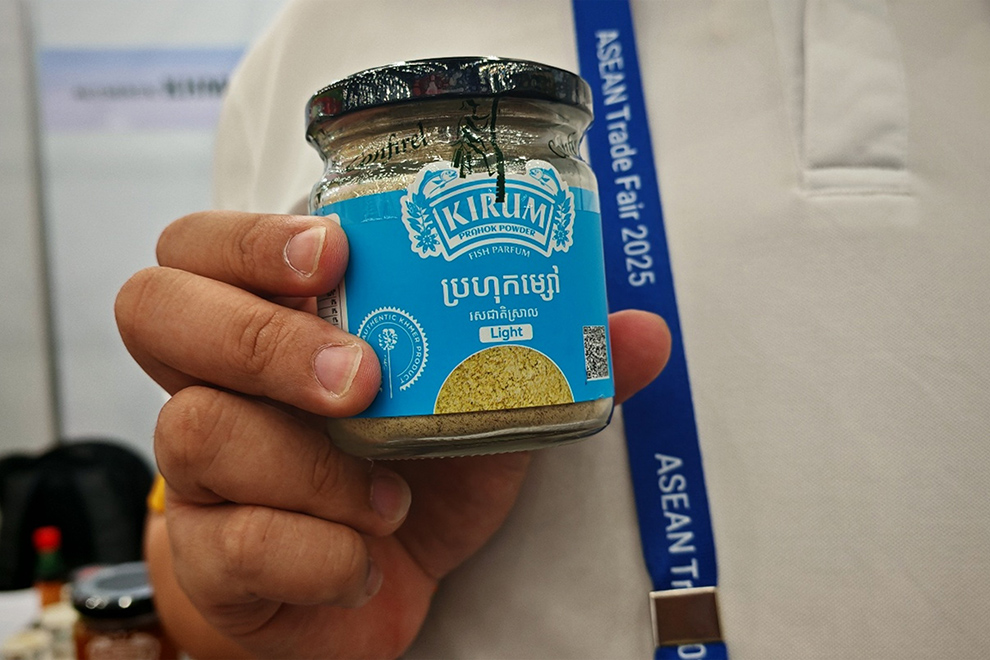
Cambodia is using this year’s ASEAN Trade Fair to intensify its push into the South Korean market, banking on rising consumer interest in high-quality agricultural goods and a deepening ASEAN–Korea economic partnership that officials say is entering a “new, forward-looking phase”.
The fair, held in Ilsan from November 13 to 16, opened Friday, as part of ASEAN Week 2025 and gathered more than 70 food and beverage companies from across the region.
Organised by the ASEAN-Korea Centre, the annual exhibition aims to help ASEAN SMEs build connections with Korean buyers and expand their market presence through both B2B and B2C platforms.
Singaporean ambassador to Korea and chair of the ASEAN Committee in Seoul, Wong Kai Jiun, praised the fair as “a positive development in ASEAN–ROK relations”, noting that talks to upgrade the ASEAN-Korea Free Trade Area will begin early next year.
“We elevated our ties to a Comprehensive Strategic Partnership last year. This Trade Fair reflects that commitment and strengthens our economic collaboration,” he said.
The economic backdrop is strong. Two-way ASEAN–Korea trade exceeded $200 billion in 2024, rising 5.9 per cent from the previous year. Korea alone traded $192.8 billion with ASEAN member states.
With ASEAN’s food and beverage market projected to reach nearly $900 billion by 2028, the sector has become a key driver of regional growth and a core focus of this year’s fair.
Cambodia showcases high-value agricultural goods
Cambodia’s presence at the exhibition was marked by a strategic push behind products with geographical indications and rising global appeal — including Kampong Speu palm sugar, Kampot pepper and new processed goods which target overseas Cambodian communities.
Confirel trade marketing manager Ear Chhayheng explained that his company has more than 200 locally made products, including GI palm sugar, pepper flower tea and a new powdered prahok, developed to international standards.
“This powdered prahok is mainly focused on the market of Cambodians working and living in Korea, who have difficulty finding key Khmer food ingredients,” he told The Post.
“We came to this exhibition to find partners and discuss importing powdered prahok. We will have good news by the end of this year or early next year,” he said.
Confirel has already managed to get over 30 of its products into Korea, despite a challenging import environment.
Chhayheng acknowledged the obstacles.
“Importing Cambodian products into Korea is difficult, but with experience, our products are gaining a foothold. Cambodian products are of very high quality, but we still lack strong packaging and production scale. Still, the direction is moving forward,” he added.
Another major exhibitor, Angkor Export, sees Korea as a diversification opportunity for Cambodia’s pepper sector.
General manager Vann Rithy said Cambodia exports 17,000–20,000 tonnes of pepper annually, but domestic consumption remains just five per cent.
About 80 per cent of Cambodian pepper is currently exported to Vietnam, which then re-exports globally as one of the world’s largest pepper suppliers.
“Under the guidance of the agriculture ministry, pepper farmers are trying to expand into other markets, including Korea, to increase quantity and added value,” Rithy explained.
“We are working hard to create a variety of products such as red pepper, white pepper, black pepper, pickled pepper and dried pepper. These will provide more options for overseas buyers,” he noted.
Rising Cambodia–Korea trade adds momentum
The fair comes as bilateral trade between Cambodia and South Korea rose 11.49 per cent to $762 million in 2024, according to the Ministry of Commerce.
Cambodia shipped $288 million worth of goods — mainly garments, footwear, electronics, agriculture and pharmaceuticals — while Korean imports totalled $474 million.
Commerce minister Cham Nimul has reiterated the need for Cambodia to “maximise the benefits” of existing trade agreements, especially the Cambodia–Korea Free Trade Agreement (CKFTA), and push into new markets to sustain export growth.
A platform for stronger ASEAN–Korea ties
Secretary-General of the ASEAN-Korea Centre (AKC) Kim Jae-shin, in his opening remarks, highlighted the long-running success of the fair since 2014, calling it a “vital bridge” connecting ASEAN SMEs with Korean consumers.
This year’s focus on F&B, he said, aligns with a sector that contributes about 17 per cent of ASEAN’s total GDP.
“I sincerely hope this event will inspire Korean consumers to discover the rich diversity and flavours of ASEAN cuisine,” he said.
For Cambodia, the event is more than a promotional showcase — it is a crucial step toward strengthening market access, upgrading product competitiveness and securing long-term partnerships in one of Asia’s most demanding consumer markets.
As exhibitors wrapped up the first day, the message was clear: Cambodian producers are ready to expand abroad, and Korea is emerging as one of their most promising destinations.
