



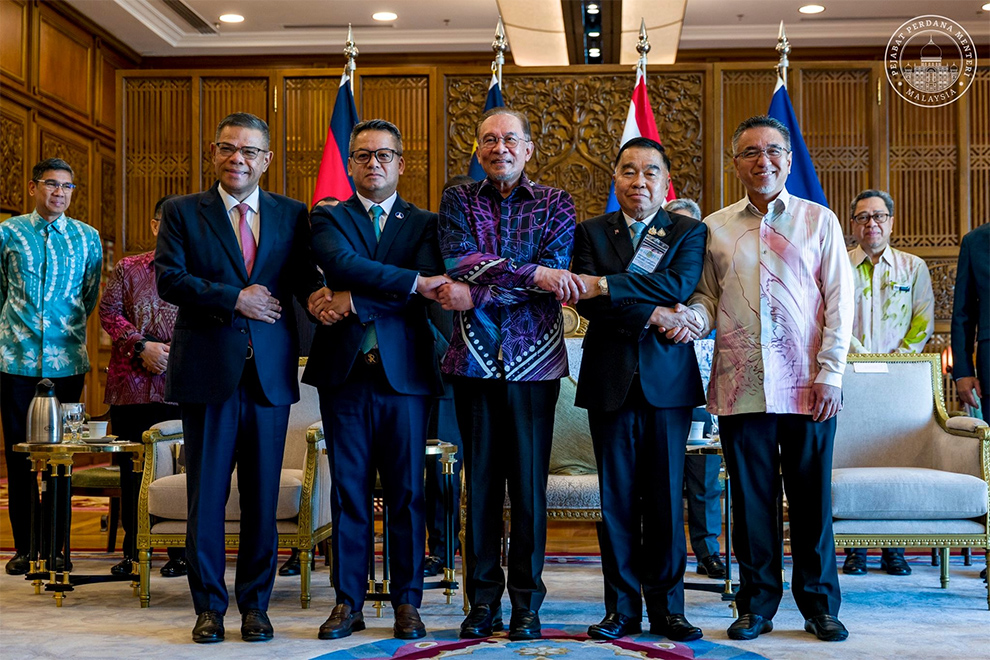
Cambodia and Thailand reached detailed terms of a ceasefire agreement during the four-day General Border Committee (GBC) Meeting in Kuala Lumpur, Malaysia, which ended today, August 7, under the eyes of the US, China and Malaysia.
Under the agreement, signed by Cambodian Minister of National Defence Tea Seiha and Thai acting defence minister Nattaphon Narkphanit, both countries agree to a ceasefire involving all types of weapons, including attacks on civilians and civilian objects and military objectives of either side, in all cases and all areas.
Both sides must avoid unprovoked firing towards the other side’s positions or troops. This agreement must not be violated under any circumstances. They agree to maintain current troop deployments without further movement as was at the time of the July 28 ceasefire. No troop movements including patrols towards the other side’s positions should be made.
“Both sides agree not to increase forces along the entire Cambodia-Thailand border. Any reinforcement would heighten tensions and negatively affect long-term efforts to resolve the situation,” the agreement said.
They pledged not to undertake provocative actions that may escalate tensions, which includes military activities, to enter the other side’s air space and territory or positions as of the July 28 ceasefire. They will also refrain from constructing or enhancing any military infrastructure or fortifications beyond their own side.
“Both sides agree not to use any kind of force against civilians and civilian objects in all circumstances. Such actions would not only endanger communities in the border areas but also violate international law and tarnish the global image of the non-compliant side,” the agreement added.
According to the agreement, international humanitarian law must be complied by both sides, especially in the treatment of captured soldiers, including their living conditions, shelter, food and medical care in case of injury.
Captured soldiers shall be immediately released and repatriated after the cessation of active hostilities in accordance with Article 118 of the Third Geneva Convention of 1949 and Rule 128 (A) of the Customary International Humanitarian Law. Cambodia requested the release of the 18 soldiers currently in Thai custody.
The two neighbouring kingdoms also agreed to maintain regular communications between all army areas and military regions and units along the border of both sides and strive to solve all issues peacefully and avoid clashes.
The two militaries will hold a Regional Border Committee (RBC) meeting in the next two weeks. Regular and direct lines of communication between defence ministers and chiefs of all defence forces should also be maintained.
With both sides accusing the other of sharing fake news, the agreement also holds them to refrain from disseminating false information or fake news, in order to de-escalate tensions, mitigate negative public sentiment and foster an environment conducive to peaceful dialogue.
An Interim Observer Team (IOT) comprising defence attaches from ASEAN member states, led by the defence attaché of Malaysia, will be established separately and independently in each country, Cambodia and Thailand. The aim is to observe, on each side, the implementations of the ceasefire on a regular basis, according to the agreement.
The defence ministries of both nations will hold the next GBC Meeting within a month, or one can be called immediately, should it be necessary.
