As Cambodia prepares to reopen classrooms for the 2025–2026 academic year this November, the Ministry of Education, Youth and Sport, with support from UNICEF, has launched two national public campaigns aimed at tackling persistent school dropout rates and ensuring that every child stays in school.
The two initiatives — “Caring Parents, Smart Kids” and “Your Choice, Your Future” — will work hand in hand to address the root causes of school dropout.
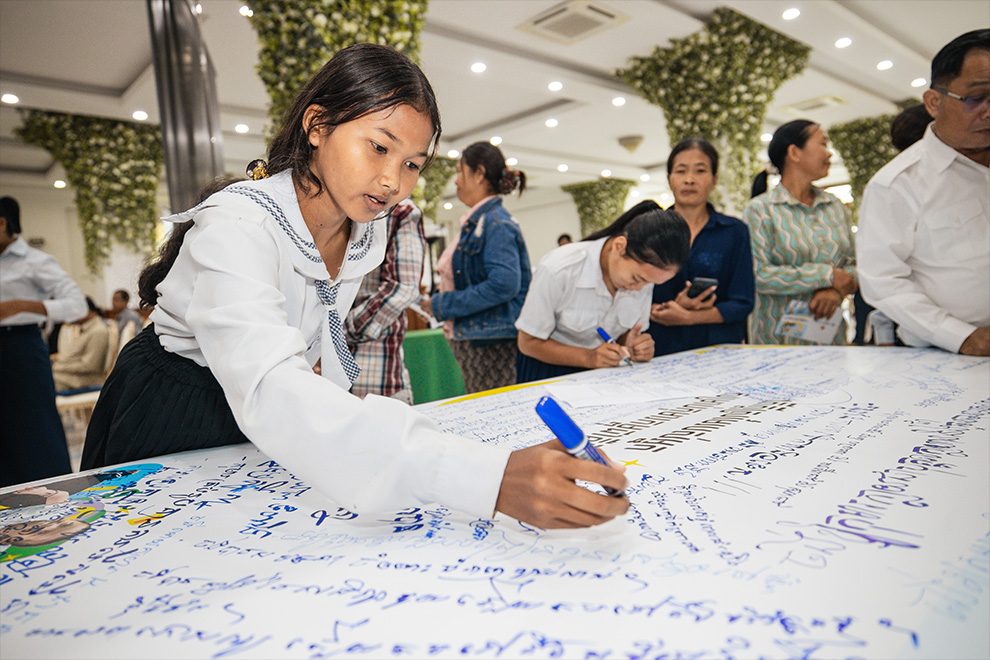
The launch, held in Kampong Cham province on October 13, marked a renewed national effort to keep children — especially those from vulnerable communities — in school from early childhood through adolescence.
Despite steady progress in access to education, dropout rates remain a major challenge, particularly at the lower secondary level.
According to the ministry, around 300,000 children and adolescents in Cambodia are currently out of school.
“In 2024, 15.5 per cent of lower secondary students left school prematurely, while only 43 per cent of children aged 3–5 were enrolled in preschool,” it explained.
Education minister Hang Chuon Naron said the new campaigns reflect the government’s ongoing commitment to ensuring inclusive and equitable education for all.
“Improving learning outcomes and reducing dropouts remain central priorities of our Education Strategic Plan,” he said.
“While Cambodia has made significant progress in expanding access to education, we must ensure that every child not only enters school but also completes it with the skills needed for life and work,” he added.
Naron added that the campaigns — developed in collaboration with UNICEF and other partners — will focus on early childhood care, inclusive learning environments and practical support for families.
“Together, we are working to build an education system that is equitable, resilient and responsive to the needs of every learner across Cambodia,” he said.
UNICEF representative to Cambodia Will Parks emphasised that urgent action is needed to reach children who remain excluded from learning opportunities.
“Quality education is not a dream; it is a duty. And the future of our children cannot wait,” he said.
“We must act now to ensure that every child is seen, supported and given a fair chance,” he noted.
The “Caring Parents, Smart Kids” campaign promotes early childhood care and development by equipping caregivers with knowledge on growth, nutrition and play-based learning to prepare young children for school.
Meanwhile, “Your Choice, Your Future” targets adolescents who are at risk of leaving school, encouraging them to continue their education while addressing pressures such as early marriage, child labour and lack of motivation.
The campaigns will begin in Ratanakiri, Siem Reap and Kampong Cham, the provinces with the highest dropout rates and deepest inequalities, before expanding nationwide.
To support implementation, the education ministry and UNICEF have developed educational materials — including videos, radio spots, posters and online resources — which will be made available to schools, families and communities across the country.
Children from poor families, rural areas, ethnic minority communities and those with disabilities remain most at risk of missing out on education. Ministry data also highlights that children with disabilities are twice as likely to never attend school as their peers.
UNICEF and the ministry have called on government partners, civil society and media outlets to support the campaigns and amplify their reach through social media, television and community networks.
Parks said such collective action is essential to closing Cambodia’s education gaps.
“Every child has the right to learn,” he said.
“By investing in early childhood and keeping adolescents in school, we are investing in Cambodia’s future,” he added.
As the school year approaches, the ministry’s message is clear: education must not only begin — it must continue. With these nationwide campaigns, Cambodia is taking another step toward ensuring that no child is left behind.