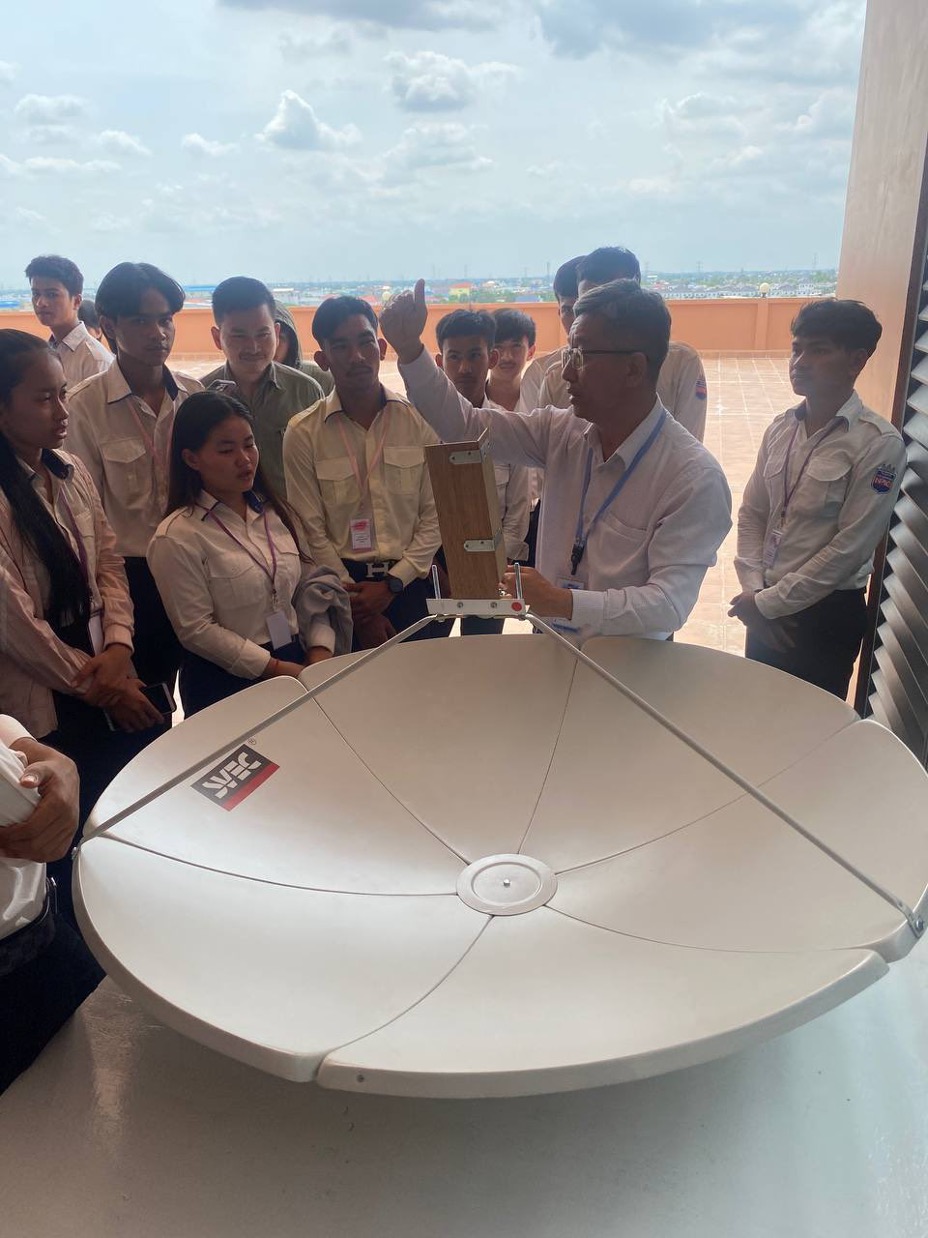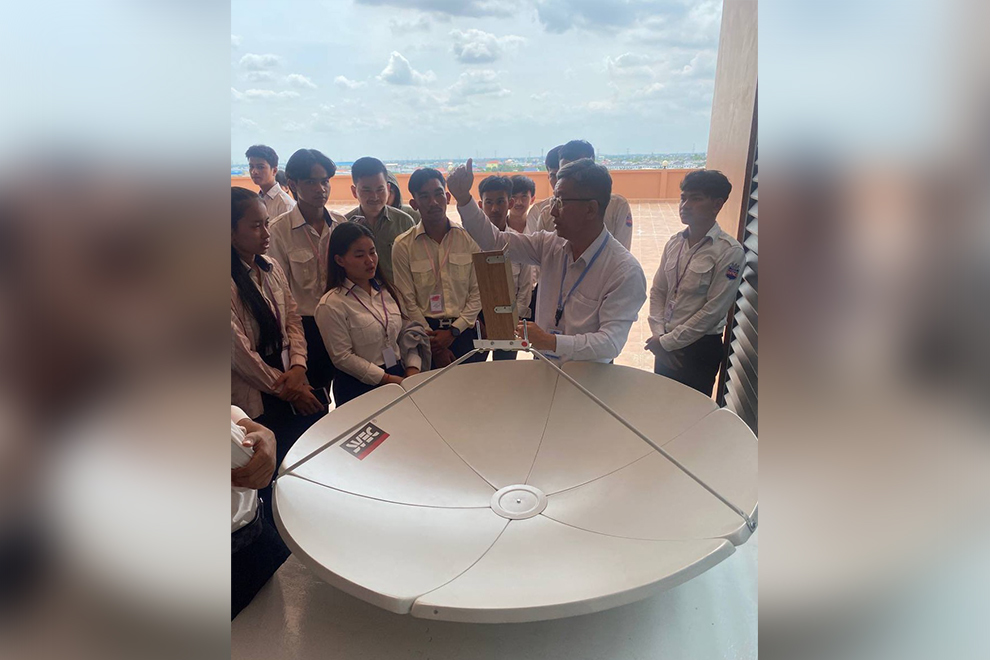
Although space technology may have not been officially introduced into the Kingdom’s standard syllabus, the topic is taking centre stage at the National Polytechnic Institute of Cambodia (NPIC), at the 2nd Session of the NPIC SCT Event: QO-100 and LEO Satellite Training, igniting a passion for space communication among students.
The training, from February 26 to March 3, is transforming the campus into a hub of innovation.
Building on their past success of a 12,076-kilometre transmission to Antarctica via the QO-100 satellite, this year’s training elevates the challenge by focusing on Low Earth Orbit (LEO) satellites.
Students are expected to be actively engaging in hands-on learning, constructing and utilising homemade antenna systems to track these fast-moving satellites across the sky, according to organisers.
International specialists from Japan, France and Australia are providing mentorship, guiding students through the complexities of installing ground stations and communicating with a variety of satellites, including the geostationary QO-100 and LEO satellites like RS-44 and SO-50.
“I wanted to show Cambodian students that space technology is accessible. Watching them successfully track an LEO satellite today proves that our youth are ready for the future,” said Jorge Paulo, a French Marine Electronics and Telecommunications System expert.
Mori Mikio, an amateur radio satellite technician from Japan, emphasised the event’s impact, highlighting how the real success is not just in the technical milestones, but in witnessing the passion of the participants.
“Seeing students successfully track LEO satellites with homemade antennas is a powerful reminder of why this event exists,” he said.
Reth Sengvisoth, one of the organising committee members, shared his satisfaction with their efforts. He said the months of planning and coordination went into bringing this international training to life.
“The true payoff is watching the students’ faces light up as they make their first successful transmission,” he said.
Chrin Bunnaren, an NPIC telecommunications student, shared her transformative experience.
She said that before joining the training, communicating with space, for her, felt like something out of a movie.
“Now, I understand the mechanics behind ground stations and the QO-100. This event has completely opened my eyes to career possibilities in radio communication and space technology!” he said.
According to Sengvisoth, this dynamic training enables Cambodian students not just to learn about space; they are actively connecting with it.