Cambodia is no longer just training ICT students. It is producing globally competitive digital talent with measurable results, as local students backed by Huawei’s talent cultivation programs secure regional and international victories and feed directly into the country’s digital transformation agenda.
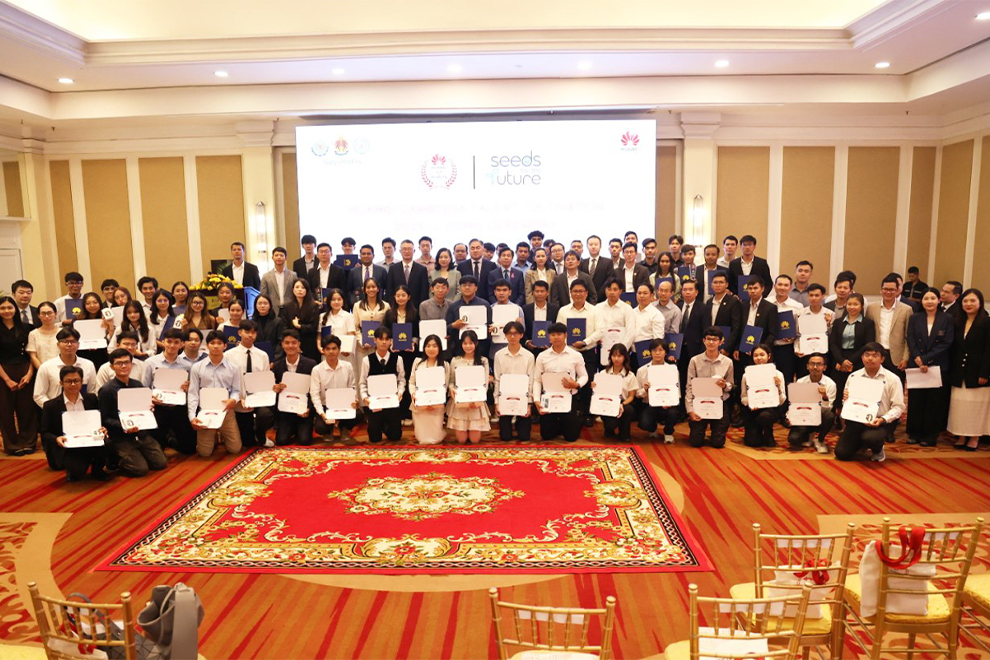
This progress was on full display at the Huawei Cambodia ICT Talent Cultivation Closing Ceremony 2025, where students, educators and policymakers gathered to mark the conclusion of the 2024–2025 programs on December 18.
The outcomes underscored a shift from capacity-building rhetoric to tangible achievements.
One of the clearest signals came from Seeds for the Future Global Ambassador Hut Meilang, a business student whose team captured the Tech for Good Regional Championship in China in September 2024, defeating teams from 19 Asia-Pacific countries.
The victory propelled the Cambodian team to the global round in April 2025 in Beijing and Shenzhen.
“Seeds for the Future showed me that innovation isn’t only about writing code, but about understanding real problems, the people behind them and the impact we want to create,” Meilang said, reflecting on a journey that began outside her academic comfort zone and ended on the global stage.
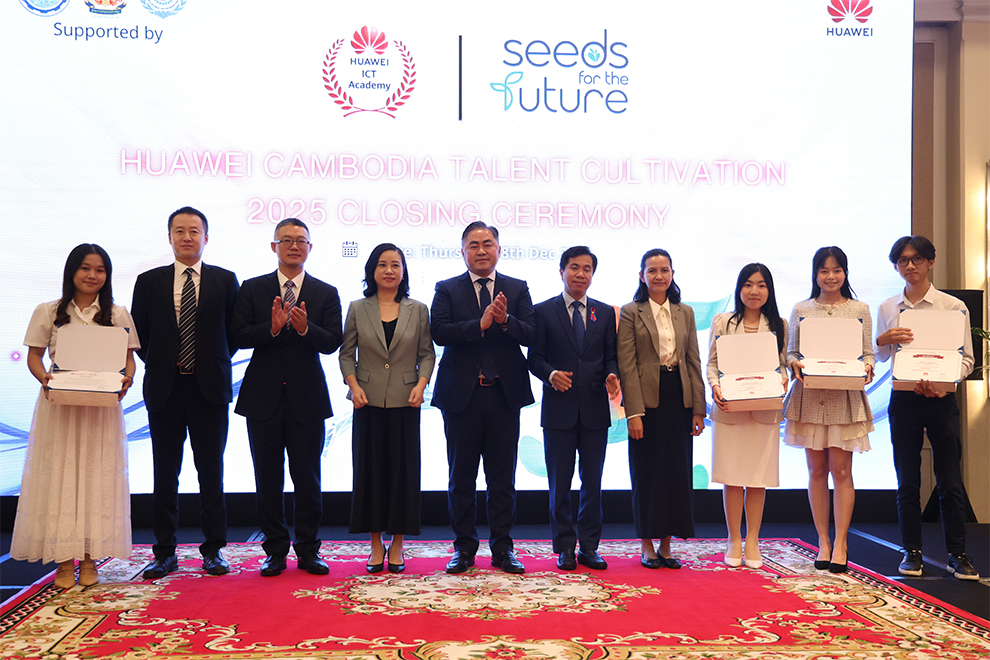

She said the innovation track, which encourages the application of technology to real-world challenges, enabled her team to transform ideas into solutions, supported by international mentors who continue to advise them.
“That victory was a historic moment for us and for Cambodia,” she said.
Government officials framed these successes as proof that digital talent development is becoming a pillar of national strategy rather than an isolated initiative.
So Visothy, secretary of state at the Ministry of Post and Telecommunications, said digital transformation is no longer optional and requires sustained investment in human capital.
“Your success today reflects not only your personal effort, but also the strong collaboration between Cambodia and China in building the next generation of digital talent,” he said.
Visothy noted that more than 500 students and 60 instructors applied to join the competition programs, with over 300 students competing at the national level.
According to the ministry, nine Cambodian students advanced to the regional round in Malaysia, while three secured the Grand Prize in the AI track and went on to win third prize at the global finals in Shenzhen.
Visothy said these outcomes align with phase one of the government’s Pentagonal Strategy, which places digital human capital at the centre of national development.
He outlined ongoing efforts ranging from digital classrooms in primary schools and planned community tech centres nationwide to university-level scholarships and large-scale upskilling of civil servants.
“Our goal is simple: to equip the next generation with the skills needed to power Cambodia’s digital transformation,” he said.
From the private sector perspective, Huawei Cambodia CEO Tao Guangyao said the results achieved by Cambodian students stood out against a highly competitive global backdrop.
The competition attracted more than 210,000 participants from over 2,000 universities in more than 100 countries, with only 179 finalist teams reaching the global stage.
“For Cambodia, this year set a new participation record,” Tao said, adding that a team from the Institute of Technology of Cambodia won the only Grand Prize at the regional level before taking third prize globally in the AI track.
He highlighted their project — an agriculture robot capable of recognising pests and conducting targeted cleansing — as an example of technology rooted in local needs with global relevance.
Tao also said Cambodia’s Seeds for the Future team won the Asia-Pacific Tech4Good Championship with the “WeSync” project, while Hut Meilang was elected as the 2025 Seeds Ambassador, representing the entire Asia-Pacific region.
“These achievements show the daring spirit of Cambodia’s younger generation, who are driving the future of all sectors,” he said.
Beyond students, the programme has expanded its focus to educators through its first offline Train-the-Trainer program, which trained more than 60 instructors from 10 partner universities in Cambodia and Laos in areas such as AI and cloud computing.
Tao described the initiative as part of Huawei’s long-term commitment under the principle of “In Cambodia, For Cambodia”.
Zhong Jie, minister counsellor at the Chinese embassy in Cambodia, said the results reflected the broader trajectory of China–Cambodia cooperation, which increasingly emphasises digital connectivity and human capital alongside infrastructure.
She said Chinese enterprises such as Huawei have played a significant role in cultivating localised, high-quality ICT talent.
“What the youth strive for, the nation strives for,” Zhong said, adding that the embassy would continue to support deeper digital-era cooperation between the two countries.