



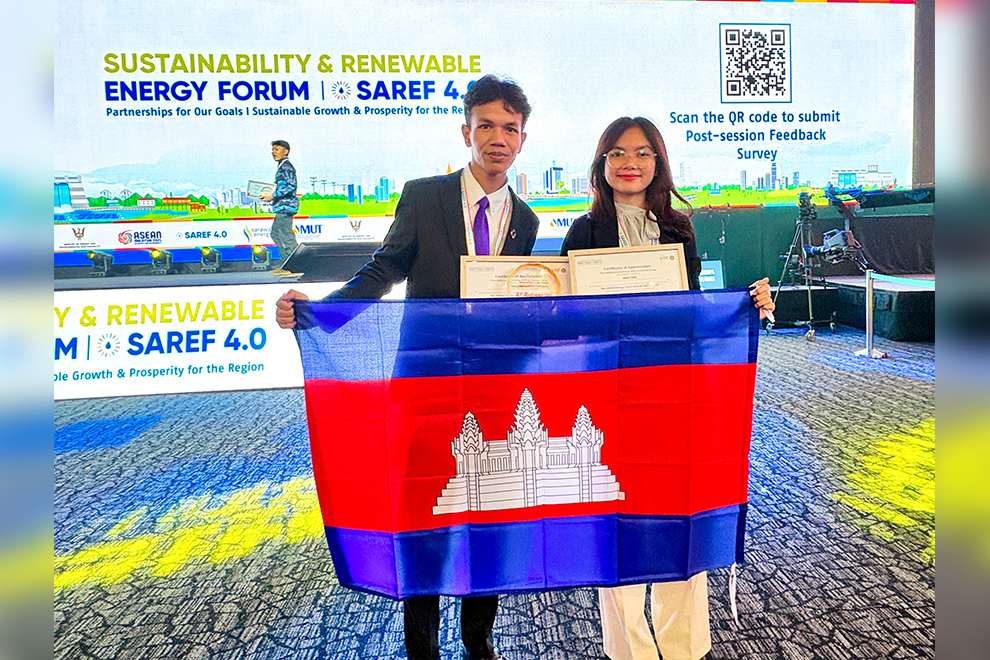
In a region where energy security and climate change are pressing concerns, young Cambodian innovators are demonstrating that youth can be at the heart of the solution.
Cambodian students Toch Ensophea and Chhit Helen from the ACLEDA University of Business were awarded the 5th ASEAN Energy Youth Award in the Innovation Lab Track – Policy category at the Sustainability and Renewable Energy Forum (SAREF 4.0), held in Kuching, Malaysia, on September 3-4.
A senior computer science student at ACLEDA University of Business and Lead Data Scientist at ECI Distribution, Ensophea has just been awarded the ASEAN Energy Youth Award for developing an AI-powered solution to optimise cross-border hydropower trading among ASEAN nations.
The award was presented by Malaysian Deputy Prime Minister Dato’ Sri Haji Fadhillah bin Haji Yusof, with Cambodian Senior Minister Othsman Hassan also in attendance, alongside ASEAN leaders and delegates.
This year’s competition drew nearly 700 youth from 384 teams across all 10 ASEAN member states. It recognised innovation and leadership in advancing sustainability and renewable energy.
“Standing on that stage, I felt immense pride not only for myself but for Cambodia,” said Ensophea.
He explained that his inspiration came from witnessing Cambodia’s growing need for sustainable energy alongside the transformative potential of technology.
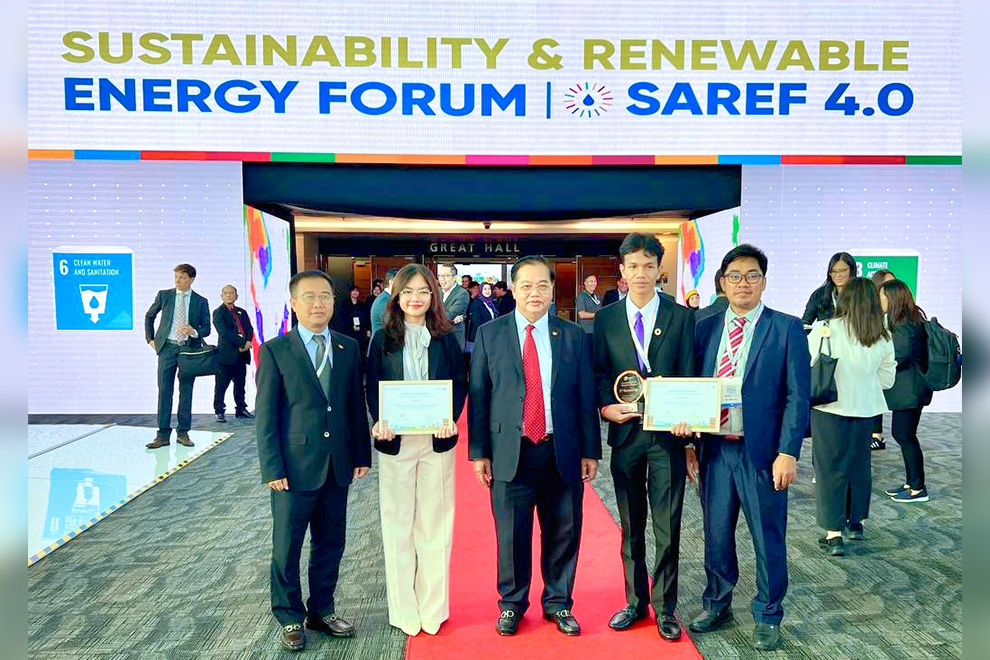
He believed that applying data science to renewable energy could create smarter systems that both improve lives and protect the planet.
Ensophea added that balancing work and study had been challenging but ultimately rewarding.
Rather than viewing his job and university commitments as competing priorities, he treated them as complementary — applying classroom theories to his professional projects and using work challenges to enrich his academic learning.
“This recognition was a symbol that Cambodian youth can compete, contribute and lead in shaping the region’s sustainable future,” he said.
“Cambodia needs clean energy — and technology can make it happen. Data science lets us turn complex problems into real solutions that improve lives and protect the planet.
“I didn’t see my job and studies as competing — they worked together. Every challenge became fuel to push me forward and prove that hard work creates real impact,” he added.
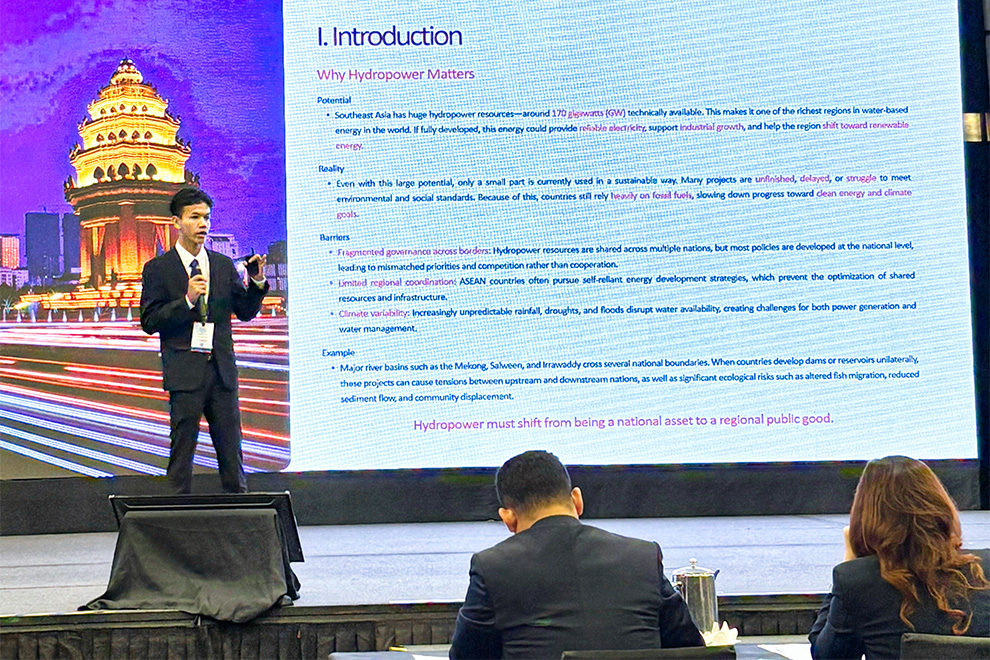
Bridging technology and sustainability
His journey began with an observation of two parallel realities in Cambodia: communities facing limited access to energy and growing environmental challenges, and the rise of data science as a transformative tool.
“I saw how data and artificial intelligence could turn complex problems into actionable solutions,” he explained.
“That dual perspective inspired me to dedicate my work to bridging technology and sustainability,” Ensophea told The Post.
Balancing two demanding roles — full-time work as Lead Data Scientist during the day and senior-level studies in the evening — was no small feat.
He recalled moments when deadlines for university assignments collided with high-pressure client projects.
“The algorithms I studied in class could be applied directly to my projects at work, and the challenges I faced at work enriched my academic learning,” he reiterated.
This unique synergy allowed him to design innovative solutions that merged theory with real-world application, earning recognition from competitions such as Tech4Good Asia and culminating in the recent ASEAN award.
AI-powered hydropower trading
The solution that won him the regional prize was both ambitious and practical.
Ensophea team developed an AI-driven predictive model capable of analysing water inflows, seasonal demand and electricity market trends.
This forecasting capability enables ASEAN nations to trade hydropower more efficiently, reducing waste and mitigating financial and environmental risks.
“We showed that AI is not just a futuristic idea — it can deliver immediate benefits to regional energy trade,” he said.
“Our model supports ASEAN’s renewable energy targets while making energy more reliable and affordable,” he added.
One of 384 teams competing from across the region, the judges praised the project for its combination of innovation, strong data modelling and real-world feasibility.
Looking ahead: AI governance and clean energy
Despite his success, he is already thinking about the next frontier — AI governance.
Ensophea plans to study AI Law to ensure that technologies driving sustainability remain transparent, accountable and fair.
“Technology moves faster than regulation, and that can create ethical and legal challenges,” he said.
“Strong AI governance will ensure that innovation scales responsibly while maintaining public trust,” he explained.
In the context of clean energy, this means developing legal frameworks that safeguard communities while enabling advanced predictive systems to accelerate the transition to renewable power.
Inspiring the next generation
Ensophea hoped his journey would motivate other Cambodian youth to step forward and compete on international platforms.
“Opportunities are not limited by geography or background,” he said.
“What matters most is passion, preparation and persistence. I always ask myself, ‘What if I apply and fail? But more importantly, what if I apply and succeed?’,” he continued.
Through his innovation projects — including KhashChat, BinBrain and PherkSaat — he has shown that Cambodian youth can deliver solutions with global relevance. His message is clear: courage is the starting point for innovation.
“Innovation begins with courage,” he told The Post.
“Failure is not the opposite of success — it is part of the path toward it,” he noted.
Shaping ASEAN’s future
With Cambodia pursuing ambitious green energy goals, his story represents more than individual achievement.
It is a blueprint for how young Cambodians can drive the country’s digital and sustainable future.
“Our generation is uniquely positioned to localise innovation — to adapt global technological advancements to ASEAN’s needs,” he said.
“Whether it is AI-driven energy forecasting or community sustainability projects, we can play a central role in building a greener, smarter and more inclusive region,” he added.
His achievement is not just a personal milestone — it is a reminder that Cambodia’s youth are ready to take their place in solving some of the most urgent challenges of the 21st century.
