



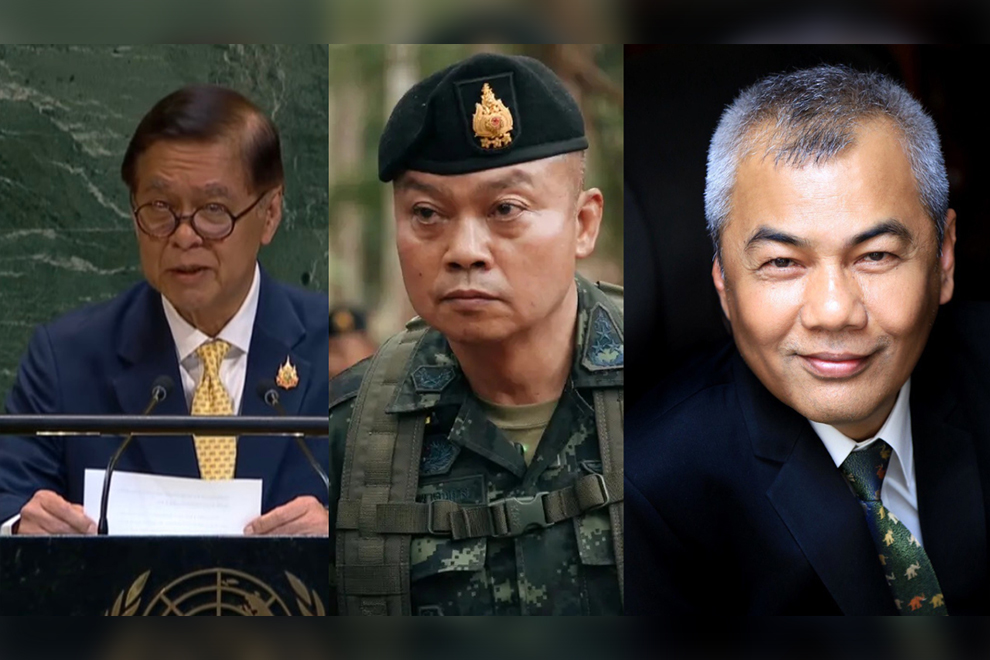
The Thai military is exercising a type of strategy called “strategic provocation”. This message is a reminder for Thai Lieutenant General Boonsin Padklang and Thai foreign minister Sihasak Phuangketkeow that we can see what they are trying to accomplish.
A military analyst made an excellent point recently, noting that the Thai military is exercising a type of strategy called “strategic provocation” with respect to its relationship with Cambodia. In essence, the strategy centres on the objective of shifting the narrative and claiming “victimhood” by way of well-coordinated threats, attacks and other actions to provoke Cambodia to attack first.
I agree with this assessment and the recommendation that Cambodia must not be lured into a war. Cambodia holds the high ground.
Cambodia’s sovereignty over the border areas that Thailand seeks to control is recognised internationally and to a certain extent through an International Court of Justice (ICJ) ruling.
Figuratively speaking, Cambodia should also have a superior claim over the truth of what is happening along the border, even if the Thai military has been very skilled in suggesting otherwise (this week’s addresses at the UN General Assembly are an excellent example of this).
The conflict along the border is one that Cambodia can only lose if it plays into the Thai military’s strategic provocations.
But simply rejecting an opposing party’s strategy is not a strategy on its own. Cambodia must pursue an opposing policy of strategic cooperation and competition. When neighbours act peacefully, appropriately and in accordance with international law, then we should be cooperative.
When countries do not act appropriately, we should be prepared for competition and even confrontation, while avoiding large-scale conflict. Strategic provocation is intended to disrupt Cambodia’s advancement and its internal development, and we must not fall into this trap.
Rather, it is imperative that we seek to resolve this conflict along the border quickly, peacefully and through legal means that involve third-party observers to prevent any distortion of the facts.
Consistent with this strategy, we must ensure the return of the detained Cambodian soldiers that Thailand describes as prisoners of war (POWs). The 18 prisoners must be returned immediately and every day they are held Thailand should be called out for their non-compliance with international law. We should not be surprised that it will be exceedingly difficult to have the men returned for the simple fact that as long as they are detained, Thailand has another opportunity to influence Cambodia’s political environment using them as pawns.
Cambodia again has the high ground because the longer they are held, particularly in the face of Cambodia’s lack of a military response to Thailand’s provocations, the less legitimate their continued detention by the Thai government appears.
The future of Cambodia and the ASEAN region will not be easy and conflict-free, but it can be relatively peaceful, stable and prosperous if we rise above the petty squabbles, immaturity and ignorance of the past.
Though Cambodia is still a developing nation in the region and world, we can exercise the leadership of a first-class nation. We can set an example for other nations of the 21st century by pursuing peaceful strategic competition and not falling victim to strategic provocation.
Youk Chhang is director of the Documentation Center of Cambodia (DC-Cam). The views and opinions expressed are his own.
