



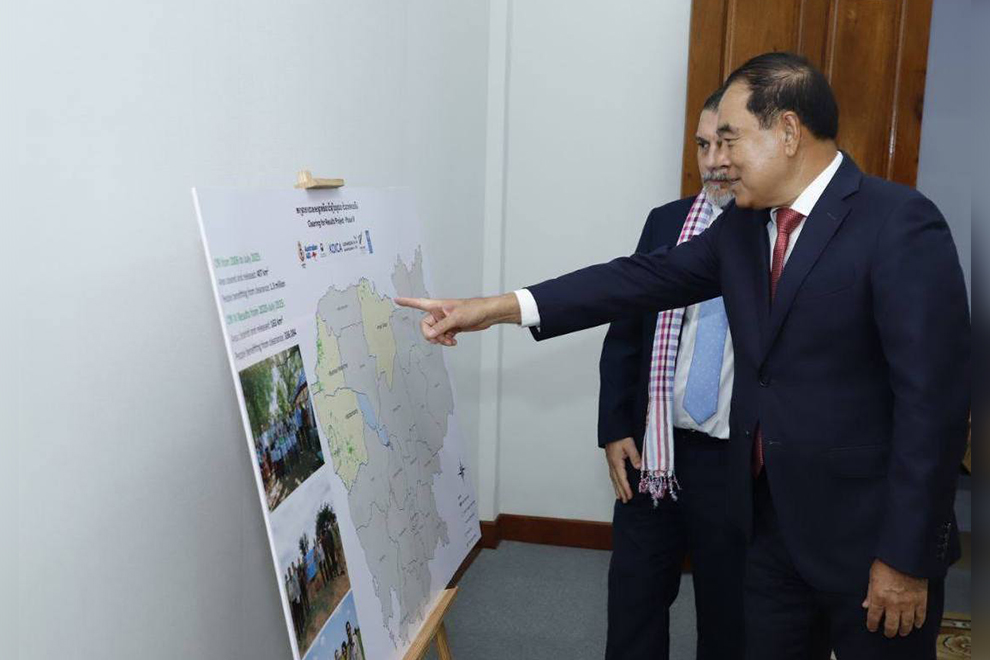
Senior Minister Ly Thuch has highlighted the urgent need for clearing the explosive remnants of war (ERW) left from the recent five-day armed conflict between Cambodia and Thailand, in a meeting with the new UNDP representative. These remnants include air-dropped bombs, cluster bombs and artillery shells, among others.
Thuch, who serves as first vice-president of the Cambodian Mine Action and Victim Assistance Authority (CMAA) met with Enrico Gaveglia, the new UNDP resident representative in Cambodia, on August 29.
“Thuch requested that the UNDP consider mobilising additional resources to support impact assessments and the clearance of these ERWs, carried out by CMAC in priority areas such as temples, schools, health centres, villages and agricultural fields,” noted a CMAA press release.
He informed the UNDP that these areas have been affected by explosive ordnance from the Thai military, and must be cleared to ensure the safety of displaced citizens returning to their villages.
He noted that the mine authority is currently developing an emergency response programme to seek support and mobilise resources from friendly countries, development partners, the private sector and philanthropists to clear the affected areas, to contribute to enhancing safety and improved livelihoods for citizens.
Thuch expressed gratitude to the UNDP for its contributions to Cambodia’s development and its collaboration with the Royal Government of Cambodia in supporting humanitarian mine action. This includes mine clearance, mine risk education, victim assistance, gender mainstreaming in mine action and capacity building, undertaken in partnership with Australia, South Korea, New Zealand and Luxembourg.
He told the UNDP representative that Cambodia adheres to legal and humanitarian principles, particularly aiming to transform border areas into zones of peace, friendship, cooperation and development, in line with the country’s leadership policies.
“Prime Minister Hun Manet has launched a new initiative for humanitarian mine clearance along the border, prioritising clearly demarcated areas, populated regions and locations which are critical to socio-economic activities,” he said.
Currently, the UNDP is preparing a new project to follow the fourth phase of the Clearing for Results program, set to conclude by the end of 2025.
According to Gaveglia, the UNDP is continuing efforts to secure additional support and resources from development partners to address remaining mine issues and help Cambodia achieve its goal of becoming mine-free by 2030.
