



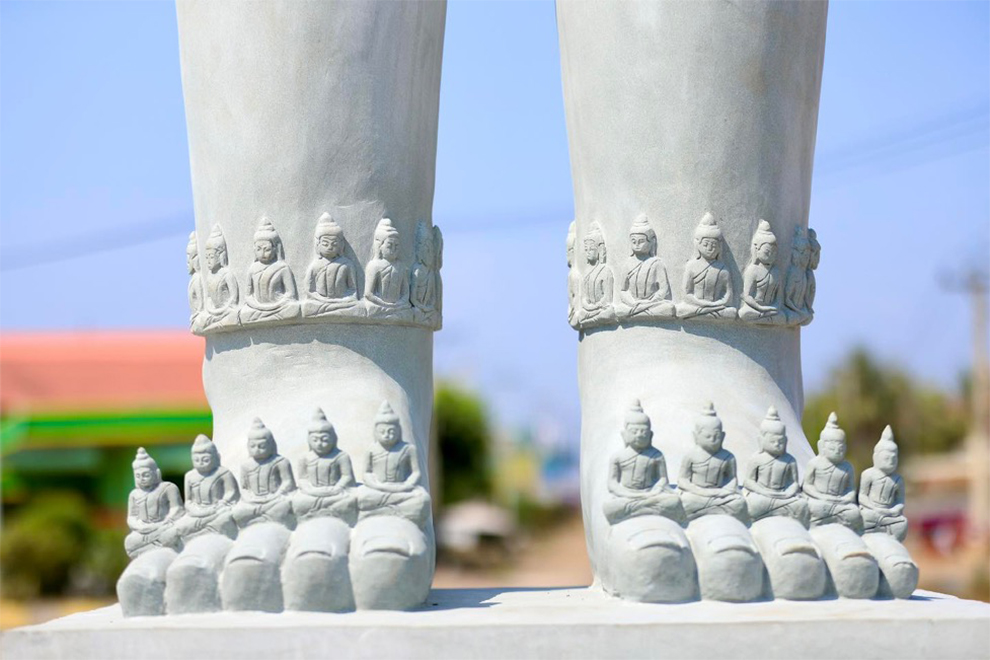
The Oddar Meanchey Provincial Department of Culture and Fine Arts has clarified a misunderstanding among social media users who believed that the Oddar Meanchey Provincial administration had constructed a statue of Vishnu with an image of the Buddha on its leg, which they viewed as discrediting Buddhism, the state religion.
On January 11, provincial governor Mean Chanyada posted a photo of the completed sculpture, saying that after several months, the Eight-Handed Roundabout in Oddar Meanchey provincial town is now complete, “even though this province has passed through the flames of war”.
“This statue was built with the aim of enhancing the aesthetics of the provincial town and preserving the glorious cultural identity of the northern territory,” he said.
He explained that the provincial administration has renovated the statue of Lokesvara, the “Eight-Handed Roundabout”, a symbol of the province, to make it more prominent, in order to welcome tourists and serve as a source of pride for the citizens of the province as well.
Those traveling through Oddar Meanchey will note that the Eight-Handed Roundabout has become a significant landmark.
But the picture, which bears a resemblance to Vishnu, earned criticism from some social media users. Some of them claimed that it was a sculpture of Vishnu or Lord Narayana with a small carving of Buddhas placed low on his leg. The critics viewed such placement an insult and a degradation of Buddhism.
The provincial culture department issued a January 12 press statement explaining that the statue is modeled after ancient forms displayed at the National Museum of Cambodia that date back to the Angkor period, in the Bayon style of the late 12th to early 13th centuries.
The Bodhisattva Lokesvara is made of sandstone, with eight arms holding various attributes, and featuring small Buddha images carved on the body and feet.
The department noted that Bodhisattva Lokesvara is respected in Mahayana Buddhism, which has been strongly revered and influential in Khmer society since ancient times, particularly during the reign of King Jayavarman VII, when many temples were enshrined and displayed carvings of it on their walls.
