



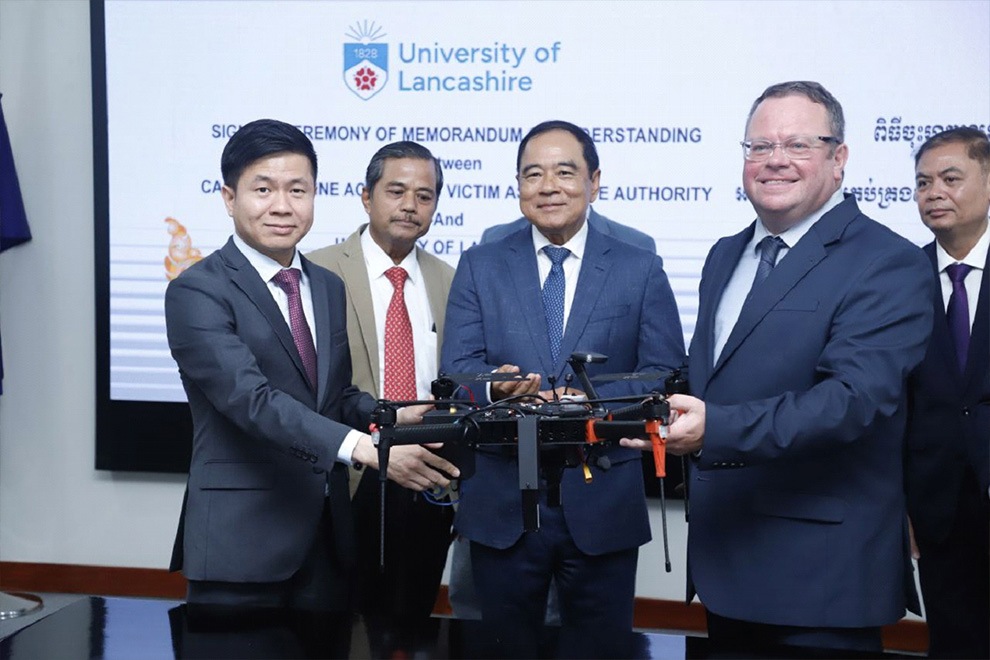
As pert of ongoing efforts towards a mine-free Cambodia, the Cambodian Mine Action and Victim Assistance Authority (CMAA) and the University of Central Lancashire signed a memorandum of understanding (MoU), marking a collaboration to combat the persistent threat of landmines and explosive remnants of war (ERW).
The July 22 signing ceremony was attended by CMAA first vice-president Ly Thuch, university representatives professors Darren Anzell and David Jones, and distinguished guests from Cambodia’s development and diplomatic communities.
According to the MoU, the university will donate a state-of-the-art drone, equipped with advanced imaging and sensing capabilities, to support the CMAA’s survey and clearance efforts. In return, the university will use data from the drone to conduct further research into developing demining technology solutions, reducing human exposure to the danger of mines and ERWs.
Thuch highlighted the significance of the partnership, describing it as “a shared commitment — a solemn promise — to work together in pursuit of a higher goal: a Cambodia free from the scourge of landmines”.
He noted that the devastating legacy of war still endangered lives and hindered development, with over 1,000 square kilometres of Cambodian land still contaminated by landmines and ERWs. Despite this, he underscord the Kingdom’s progress and commitment to make the nation mine-free by 2030.
Professor Anzell noted that the drone is designed to improve situational awareness and operational efficiency, complementing the bravery of Cambodian deminers.
“This is not just about technology. It’s about protecting lives, restoring communities and unlocking a future for families across Cambodia,” he said.
Also included in the partnership are capacity-building initiatives, with training programmes already completed last week, and plans for joint research with Cambodian academic institutions.
Thuch praised the university’s commitment to walking “side by side” with Cambodia, emphasising that the collaboration will strengthen national expertise and bring global attention to Cambodia’s leadership in mine action.
He explained that the initiative aligns with Cambodia’s human-centred approach, ensuring that technology empowers deminers while prioritising safety, accountability and transparency.
Founded in 1828, the University of Lancashire has grown into one of the UK’s largest institutions, renowned for its engineering and research excellence. Its new aerospace engineering facility will further support the development of drone technologies for humanitarian purposes, including demining and agriculture.
Anzell highlighted the university’s ethos of combining academic innovation with real-world impact, a principle reflected in its longstanding partnership with the CMAA and the Royal Cambodian Armed Forces (RCAF), which dates back to 2015.
Thuch expressed his hopes from this cooperation.“No child should lose their future to a forgotten war. Together, we will turn fields of fear into fields of hope,” he said.
