



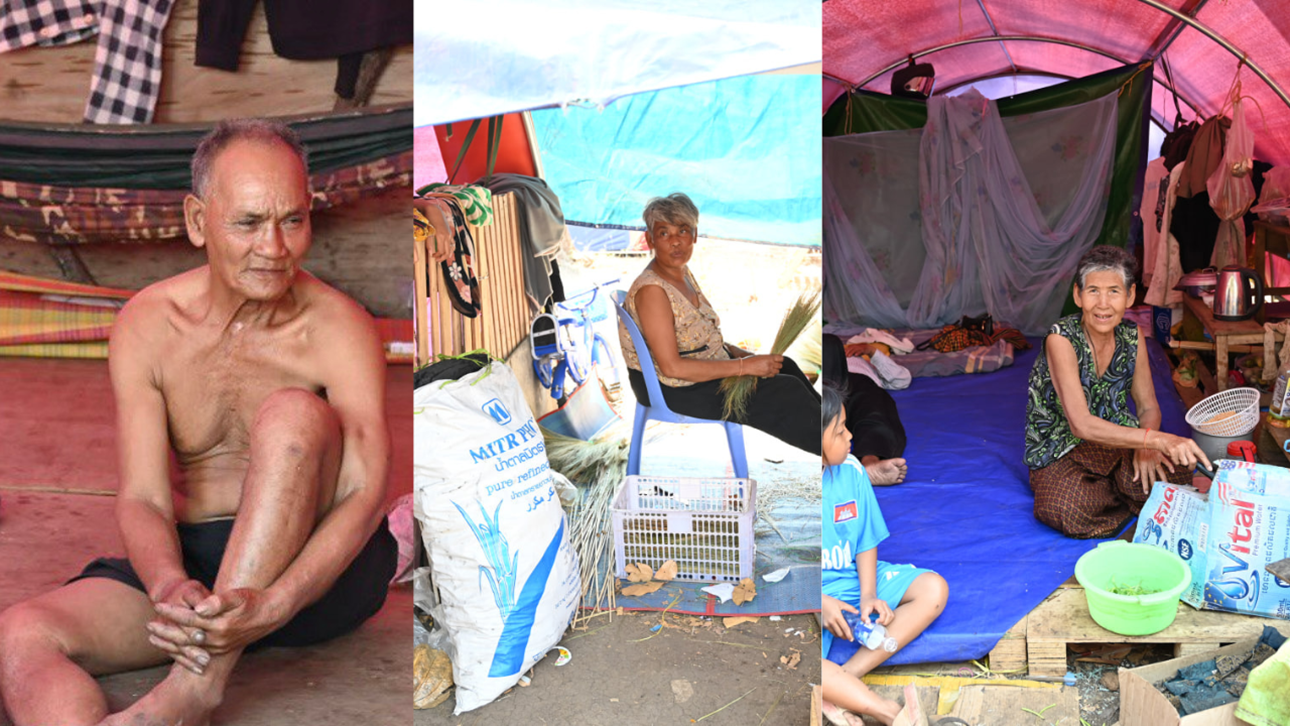
Residents from O’ Suo Sdei and Sangkum Thmey villages in Thma Da commune, Veal Veng district, Pursat province, continue to live in uncertainty, despair and fear, fearful of returning to their homes, which are now surrounded by Thai barricades of shipping containers and razor wire.
One 74-year-old Ouk Meun, from O’Suo Sdei village, cannot return. His home, located approximately 300 metres from the border, is currently considered a red zone. He does not dare to go back because Thai soldiers have occupied and cleared land and homes of Cambodian people in that area, and he personally fears being shot by Thai soldiers.
“Thai soldiers cleared people’s houses, set up light poles, placed containers. I dare not go, I fear the Thai soldiers. Before the conflict, I would go fish and sleep in Thai territory, and it would be fine,” he said.
He fled his home during both outbreaks of armed conflict in 2025. In July, he fled for a week, but the second time, he left on December 8 and not been able to return.
He noted that those living far from the red zone have returned. He tried to go back to check on his house but saw the Thais clearing land to build roads, became frightened and returned.
“I dare not return to live there. I don’t trust the Thai soldiers. Those whose houses are four to ten kilometres from the Thai border have gone home. But I live so close, I am afraid to go in and out. Only if the road was arranged as clear as before would I dare to stay. While it is blocked, I cannot go and live there,” he said.
Another displaced person,65-year-old Yos Phally, lives in Sangkum Thmey village, Thma Da commune. Her daughter died during their desperate escape. Shortly after giving birth, she died during a Thai attack, which killed a Cambodian soldier.
Like Meun, she left her home on December 8, more than two months ago. Her house is located about 300 metres from the Thai barricades, but she does not dare return home. The Thai soldiers will not even allow Cambodian soldiers to go near the area.
“I used to go see my house and stay for one or two nights, but at that time I was still restless with fear. Because of my livelihood, I used to go into the forest near the village, and I saw Thai soldiers and Thai Surin soldiers, and they told me, ‘You’ve already gone, what are you doing back here? Soon they will attack Thma Da again’,” she added.
“When I think about Thailand invading Cambodia, I am really hurt, because Thailand invaded and took the homes of innocent people living along the border, by surrounding them with barbed wire, taking over more than 10 families in my area. Because my house is in a red zone, the local authorities told me to evacuate to a safe place,” she continued.
Since the death of her daughter, she is responsible for caring for her grandchild. Despite her anger at Thailand’s actions, she wishes for peace.
Another resident of the sanctuary, 75-year-old Kin Theary, is from Sangkum Thmey Thmey village, Thma Da commune. She recounted that in both July and December, Thai soldiers mobilised heavy weapons and deployed troops to the Thma Da border. Her family did not want to evacuate because they were concerned for the chickens and ducks they had raised, but the village chief told them to evacuate immediately, fearing that Thai soldiers might begin shelling the village.
She stayed with relatives in Kampong Speu province for 25 days. Later, she returned to Thma Da commune but was afraid to live in her home because Thai soldiers continued to encroach on the land by clearing roads, laying barbed wire and placing containers. The village chief suggested that she stay in a temporary refugee camp.
“Every day I sit and wish to be able to return to my home, to take care of the crops I used to plant and to raise my chickens and ducks again,” she said.
Currently, 65 families from both villages remain in refugee centres at Hun Sen Pramuoy High School and Pramuoy Pagoda. Some of them lived in homes that have been cut off by Thai barricades, while others live so close to the barriers that they are afraid to go home.
This article is based on interviews conducted by the Veal Veng Reconciliation Center team of the Documentation Center of Cambodia (DC-Cam) on February 10.
