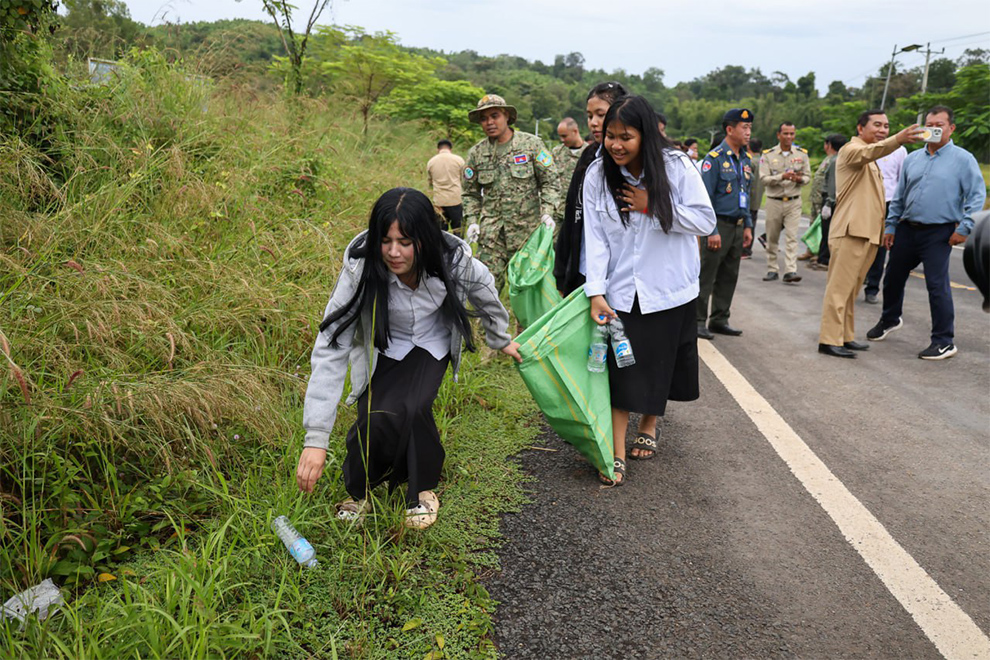
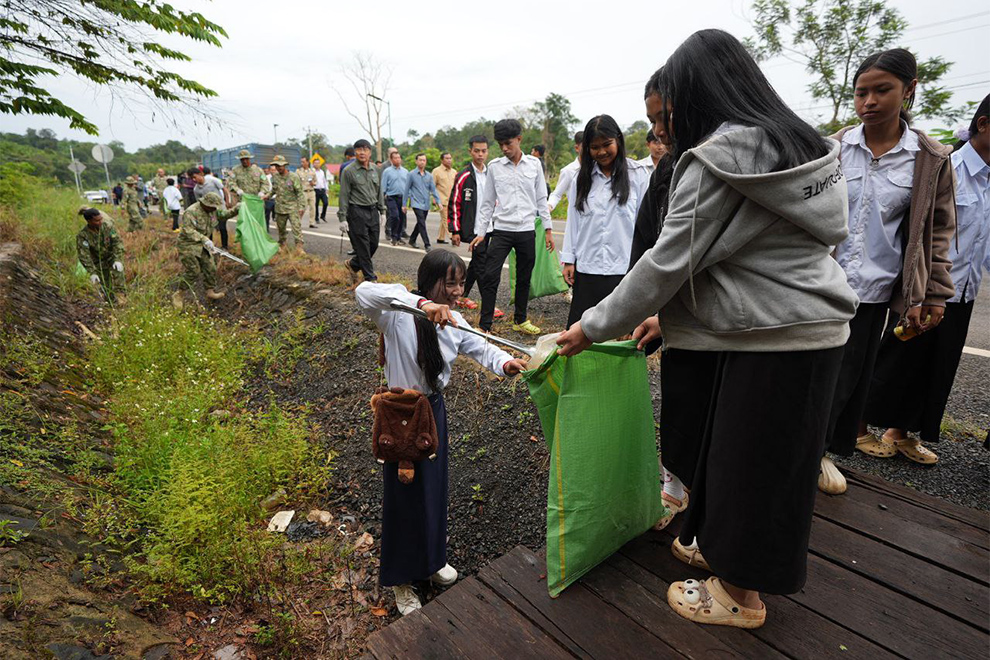
The ‘Eco-School’ programme is being expanded into indigenous minority communities through nine primary schools, with the goal of increasing children’s participation in “clean” and “green” activities — including waste management, tree planting and biodiversity conservation.
This programme has been implemented under the Keo Seima REDD+ Project in Mondulkiri province since January 2022, in collaboration with partner organisations. It is now run through nine primary schools within the Keo Seima Wildlife Sanctuary.
The educational activities run through the programme focuses on waste management, composting, environmental and forest education, and raising awareness of wildlife protection. The participating schools are Pu Trom Thmey, Pu Tang, Sre I, Pu La, Pu Haim, Pu Chu, O’Am, Sre Preah and Sre Chhouk.
Chuop Paris, Ministry of Environment secretary of state, explained that the main objective is to educate and inspire behavioural change, particularly among schoolchildren — who can, in turn, help extend environmental knowledge to their families and broader communities.
“Environmental protection is not just a duty — it is an act of love and honesty that starts with all of us. By doing so, we make Cambodia cleaner, more liveable and healthier, with communities that are beautiful and prosperous,” he said.
Paris encouraged indigenous students in Keo Seima district to nurture their love and care for the environment, reduce plastic use in daily life, and maintain clean and green surroundings. This, he said, would help make the province more attractive to tourists, while also encouraging students to plant and protect trees, thus contributing to environmental balance and climate change mitigation.

Alistair Mould, country director of WCS Cambodia, which implements the Keo Seima REDD+ Project, said the organisation works closely with government and community partners to strengthen environmental awareness — from classrooms to indigenous villages.
He explained that the REDD+ project is not only about protecting trees, but also about protecting people, their livelihoods and indigenous cultures, while fostering a sustainable, conservation-based economy.
The Keo Seima REDD+ Project, launched in 2010, covers 166,983 hectares of forest within the over 300,000-hectare Keo Seima Wildlife Sanctuary. It is Cambodia’s first project to generate funding through the sale of carbon credits on the international market. The revenues are used to support natural resource conservation and community development within the sanctuary, under the leadership of the environment ministry.
As part of its environmental outreach, WCS Cambodia distributed 36 waste bins, 9 incinerators and eco-friendly educational materials to students and teachers in the nine participating schools.
Within the sanctuary, the project also collaborates with STEM Education Cambodia to implement a “Clean” Campaign in five communities — Pu Kong, Pu Trom, Pu Char, Sre Ouy and Andoung Kraloeng.
About 35 community members joined this campaign to develop creative solutions for maintaining clean villages, improving waste management, and reducing plastic pollution. Community members have also led their own awareness campaigns and distributed waste bins at key sites.
So far, three incinerators and 35 waste bins have been built and installed in the participating communities — all results of the “Clean” Campaign.
In addition to these initiatives, the Keo Seima REDD+ Project is also partnering with the Mondulkiri provincial Department of Environment to raise public awareness about cleanliness and environmental protection across sanctuary communities.
To date, outreach activities on waste management, composting and plastic reduction have reached approximately 1,350 people in 14 villages within the Keo Seima Wildlife Sanctuary.
The environment ministry reaffirmed its commitment to the “Clean Cambodia” strategy, which includes gradual reduction of plastic bag use, proper solid and liquid waste management, and the planting of at least one million trees each year, aiming to expand forest cover by 2050.