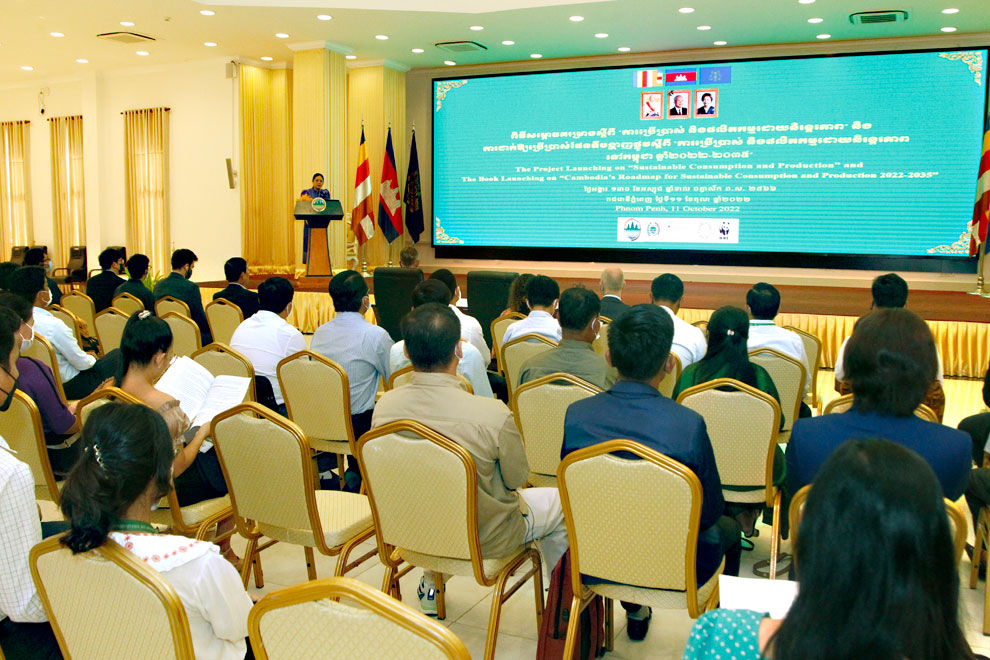
A senior Ministry of Environment official on October 11 called on those implementing “Sustainable Consumption and Production (SCP)” to ensure the viability of the project, one key to the Kingdom’s economic and social development.
Tin Ponlok, secretary of state of Ministry of Environment, who is also the Second Vice President of the National Council for Sustainable Development, was speaking at the launch of both the SCP and the “Sustainable Consumption and Production in Cambodia 2022-2035 ” roadmap at the Ministry of Environment.
“The sustainability of this project is very important. I would like you to provide the full results of the implementation of this project, not just at the report or pilot level.
“I would like you to make sure that at the end of the pilot project, institutions of the government’s sub-national authorities can accept it and continue to expand on the practices.
“The SCP project is an important part of Cambodia’s long-term green economic and social development, which is included in the “National Strategic Plan on Green Growth 2013-2030”.
“I would like to urge key stakeholders, including relevant ministries, institutions, the private sector, producers, civil society organisations and especially the community, to support the implementation of this SCP project as a contribution to the government’s efforts in achieving the goal of sustainable development,” Ponlok said.
The SCP is also an opportunity to encourage the contribution of all sectors in the promotion of Cambodia’s social welfare and its green economy, he added.
The Ministry of Environment on October 11 said the IKI SCP Asia Phase II will mobilise stakeholder involvement and focus on promoting production areas in Mondulkiri and major towns including Phnom Penh.
It would link sustainable production and responsible consumption in order to change attitudes toward food systems in agriculture and the environment.
Seng Teak, WWF-Cambodia country director, said the launch of the project and the roadmap would promote sustainable production in line with responsible consumption in the food system in agriculture.
This would be achieved by implementing sustainability standards ranging from the supply chain and production to final use between key stakeholders such as local communities, producers, retailers, consumers, government and private institutions.
“The [SCP] – a joint project with Thailand – has been ongoing for four years. The first phase was implemented in Thailand, with the second phase a joint focus on Cambodia, taking the experience of successful implementation in Thailand in relation to sustainable consumption and production,” Teak said.