



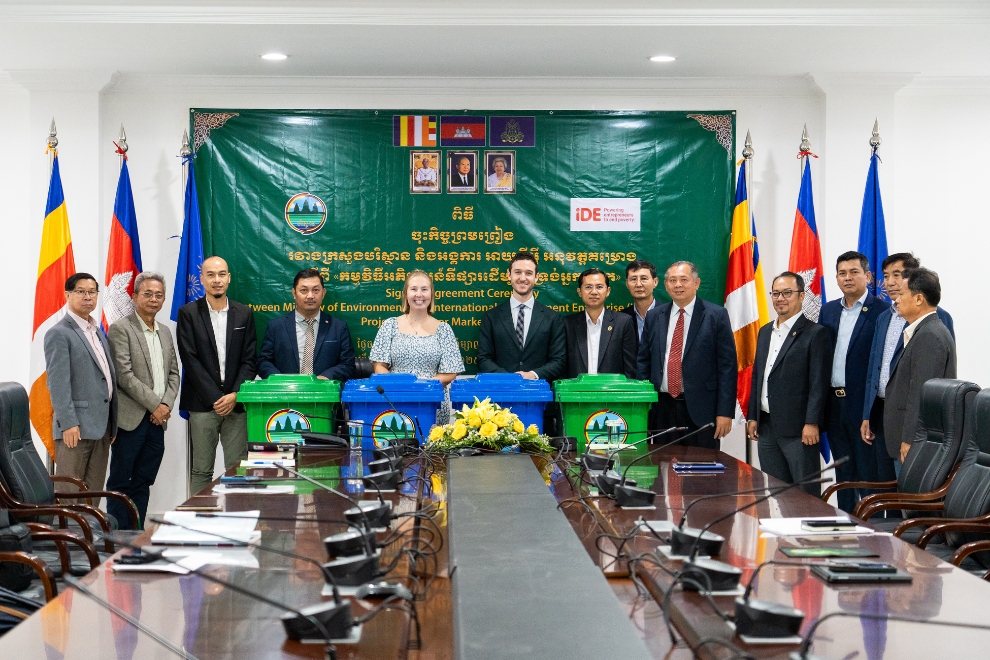
As part of continued efforts towards tackling environmental and public health challenges, iDE Cambodia and the Ministry of Environment have signed a new project agreement aimed at expanding solid waste management services across Cambodia’s rural communities.
The agreement, signed on June 30 by Sabo Ojano, ministry secretary of state and Hour Chansokun, officer-in-charge of iDE Cambodia, establishes a national partnership designed to scale sustainable waste solutions in underserved areas.
The initiative aligns with the government’s Environmental Protection Strategic Plan 2024–2028 and its National Carbon Neutral Strategy Framework.
“This agreement reflects our shared commitment to environmentally sound waste management that improves health, livelihoods and dignity for Cambodian families, while safeguarding ecosystems,” said Tyler Kozole, director of Water, Sanitation and Hygiene at iDE Cambodia.
The environment ministry has led numerous nationwide campaigns such as “Today I Will Not Use Plastic”, “Clean Cambodia, Khmer Can Do” and “National Roads Without Plastic” in an effort to reduce plastic pollution.
Under the new agreement, iDE will support the ministry in extending these programmes to rural areas that remain largely unserved by formal waste collection systems.
Through its Waste Management Market Acceleration (WaMA) project, iDE has already demonstrated the success of localised waste service models.
In Boribour district of Kampong Chhnang province, local service provider Lam Samnang expanded his waste collection service from several hundred to over 2,000 households and businesses in just six months.
His efforts have significantly reduced plastic waste flowing into the Tonle Sap Lake, a vital biosphere that supports over 3 million Cambodians.
“Market research conducted under the project found that 70 per cent of rural residents are willing to pay 10,000 riel per month for weekly waste collection,” according to iDE Cambodia.
“Despite this demand, the majority of rural communities still lack access to waste services. The agreement signed this week lays the groundwork for a scalable model that aims to close this critical service gap,” it added.
The project will be extended to other districts in Kampong Chhnang and Siem Reap province. Although this new project will conclude early next year, the organisation hopes to continue expanding to other areas across the country.
This initiative prevents waste from reaching the Tonle Sap Lake.
The lake, home to over three million families and providing 60 per cent of the Kingdom’s protein intake, is threatened by pollution from nearby communities.
Around 75 per cent of Cambodia’s population lives in rural areas without waste collection services. With only 4 per cent of waste being recycled, rural households often resort to unsafe disposal methods, like burning or open dumping.
“Expanding solid waste management in rural areas is crucial to protect the lake, human health and the environment,” said Kozole.
Operating in Cambodia since 1994, iDE implements market-based and socially inclusive solutions to improve livelihoods and environmental outcomes.
Its broader initiatives span climate-smart agriculture, clean cooking technologies and plastic reduction alternatives — all geared toward improving both human and ecosystem health.
“At iDE, we take a systems-wide approach — from waste management and sanitation to clean energy and climate-smart agriculture — to improve both human and ecosystem health,” Kozole added.
The new partnership marks a key moment in Cambodia’s pursuit of inclusive, sustainable development — bringing essential services to the country’s rural heartlands while protecting the environment for future generations.
