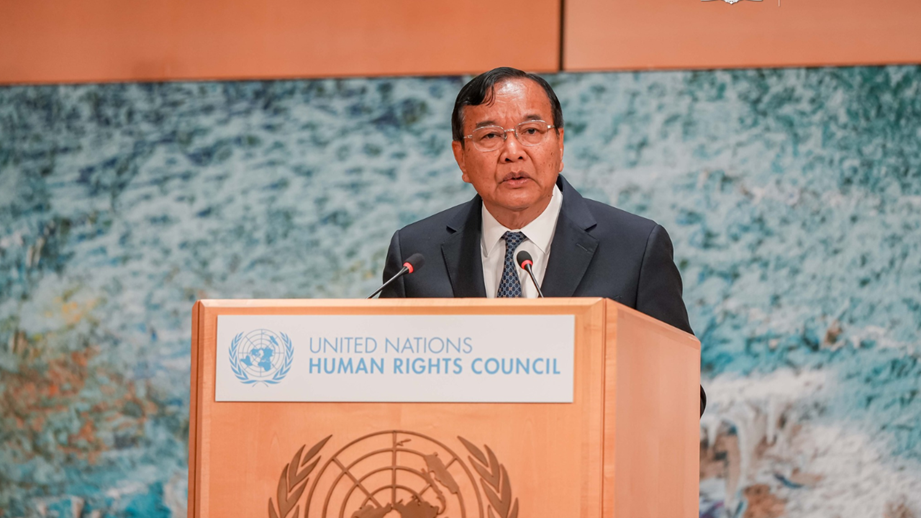
Prak Sokhonn, Minister of Foreign Affairs and International Relations, has informed the UN Human Rights Council that combatting scams should not be used as a pretext for “masked acts of aggression and occupation”. He was referring to Thai claims that the initial factor driving the launch of military aggression on Cambodia, was a “war against the scam army”.
Addressing the council in Geneva, Switzerland on February 24, Sokhonn noted that Cambodia is stepping up actions to combat transnational crimes, particularly online scams and human trafficking.
“Online scams are a worldwide problem that affects people beyond their borders. A national task force created by our prime minister and the authorities has brought down several networks, saved thousands of victims, and arrested countless criminals,” he said.
He also outlined updated legal instruments, explaining that Cambodia is in the process of introducing a specific law to combat online scams, another part of the Kingdom’s strong commitment to meeting this challenge and eradicating these crimes.
“Cambodia has taken on commitments at national, bilateral and multilateral levels. This calls for cooperation not simply police and military action, which can sometimes be misused as masked acts of aggression and occupation,” he said.
During the second round of armed clashes in December, Thailand launched airstrikes as deep as over one hundred kilometres inside Cambodia, while claiming to combat scam. An analysis by the US Center for Strategic and International Studies (CSIS) determined that the assaults served political objectives.
In a January report, the CSIS suggested that the Thai anti-scam campaign aimed to deflect criticism of official complicity, such as Thai Prime Minister Anutin Charnvirakul taking photos with alleged transnational scam financier “Ben Smith”, or inaction against scam networks while advancing domestic political objectives and attempting to legitimise its actions abroad.
Scott Schelble, deputy assistant director of the International Operations Division of the Federal Bureau of Investigation (FBI), told a recent press conference that he visited Cambodia in early February where he had discussed mutual interest in combating scam operations.
“The FBI has partnered with the Cambodian National Police in a task force setting in the past, and my hope is to leverage the success from those investigations towards these scam compounds,” he said.
While answering journalists’ questions, Schelble noted that combatting scam does not mean simply focus on their locations.
“I’d like to emphasise that unfortunately it’s not as simple as one location or another. This is very much a regional issue that no one country can combat alone. When we look at Southeast Asia, this is not a Cambodian problem, this is not a problem – a Vietnamese problem or a Thai problem. This is regional and it will require a partnered aspect and a coordinated aspect if we’re going to properly take care of it. And that’s why partnership is the key,” he said.
According to Schelble, in 2025, the FBI’s Internet Crime Complaint Center saw over 80,000 complaints with monetary losses exceeding $2.9 billion in US currency.
“Scam compounds are not unique to Thailand; they’re not unique to Cambodia, not unique to Vietnam or Malaysia. These are regional problems, and these criminal groups are not bound by laws or geographical borders, and they operate with a degree of impunity because they take advantage of countries’ respective laws,” he added.