



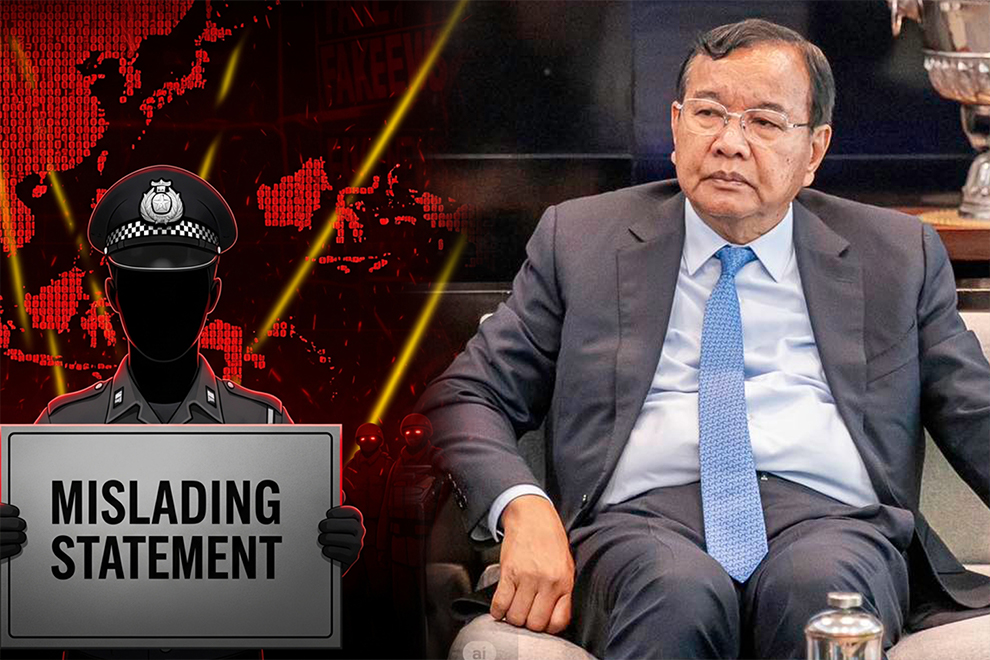
Cambodia’s Ministry of Foreign Affairs and International Cooperation has issued a formal clarification in response to what it described as a “misleading statement” from the Thai Ministry of Foreign Affairs concerning the ongoing Cambodian-Thai border disputes and the 2000 memorandum of understanding (MoU) on boundary demarcation.
In a July 7 statement, the Cambodian government reaffirmed its “unwavering commitment to the peaceful settlement of border disputes”, citing adherence to international law, the UN Charter, the ASEAN Charter and the terms of the MoU signed by both nations on June 14, 2000.
“Cambodia’s conduct in this matter is grounded in its good faith adherence to treaty obligations and the principles of sovereign equality and peaceful dispute resolution as enshrined in the UN Charter,” said the ministry.
The ministry criticized Thailand for what it described as repeated failures to fulfill core obligations under the MoU, particularly Article 1, which recognises maps produced by the Franco-Siamese Commissions as the official basis for demarcating the boundary between Indochina and Siam.
“Contrary to this binding commitment, Thailand has persistently imposed and applied unilaterally drawn maps to assert territorial claims and to carry out encroachments into Cambodian territory,” said the statement.
“These actions constitute a material breach of international law and the 2000 MoU, which remains legally binding on both states,” it added.
In response to what it called “continued violations”, including the use of armed force and other provocations, Cambodia has decided to refer the matter to the International Court of Justice (ICJ).
The ministry described this move as a “measured, rule-based and peaceful response,” noting the ICJ’s role as the principal judicial organ of the UN and a recognised authority for resolving international legal disputes, including boundary disagreements.
“Cambodia therefore calls upon Thailand to comply in good faith with its treaty obligations,” the statement concluded, urging Thailand to cease all unilateral actions on the ground and re-engage in peaceful negotiations under international legal mechanisms, including the ICJ.
On July 6, the Thai foreign ministry reiterated its commitment to peaceful resolution in line with the 2000 MoU, which it claimed mandates that all border issues be addressed exclusively through the bilateral JBC framework.
The Thai government rejected Cambodia’s decision to involve the ICJ, stating that the MoU does not authorise any external mechanisms for dispute resolution.
“There is nothing in the MOU that identifies the use of any other mechanism, including the International Court of Justice (ICJ), to address such issues instead and Thailand has strictly adhered to all obligations contained within this MoU,” said the Thai ministry.
The Cambodian foreign ministry statement described their Thai counterpart’s remarks as “misleading” and accused Thailand of persistently imposing and applying unilaterally drawn maps to assert territorial claims and carry out encroachments into Cambodian territory.
