



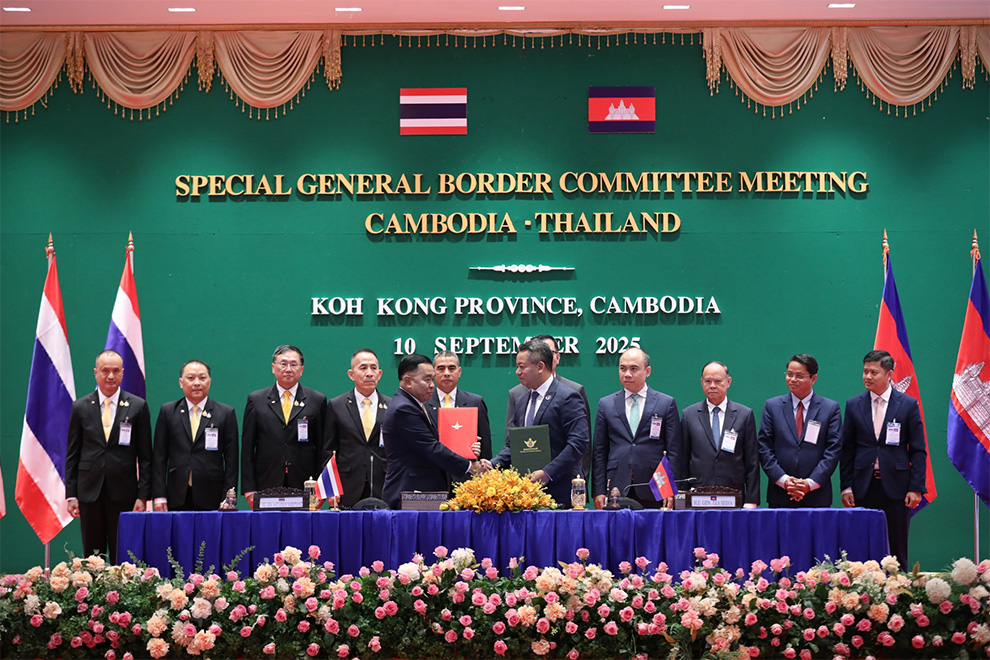
Senior Cambodian and Thai defence officials have discussed de-escalation measures and the release of the 18 Cambodian soldiers who remain in Thai custody. They also examined a Japanese proposal for limited border crossing openings, as part of bilateral efforts to restore order and bring peace to the border.
The General Boundary Committee (GBC) held its first special meeting today, September 10, in Koh Kong province.
The Cambodian delegation was led by Minister of National Defence Tea Seiha, while the Thais were led by acting defence minister Nattaphon Narkphanit.
Speaking after the meeting, Seiha explained that it aimed to review the positive outcomes of the August 7 GBC extraordinary meeting in Kuala Lumpur and outline the concrete steps which are necessary for fully and effectively implementing the current ceasefire.
“Both sides agreed on the urgent need to de-escalate tensions through the removal of heavy weapons back to their respective peace-time military installations. To achieve this, both teams will meet within three weeks to develop a detailed, practical and step-by-step action plan,” he said.
He added that the plan will be implemented under the observation and verification of the ASEAN Observer Team (AOT). Both sides also agreed in principle on the Terms of Reference (TOR) for the establishment of the AOT, while awaiting approval from their respective governments.
According to Seiha, both parties agreed that avoiding the spread of misinformation, false news, accusations and inflammatory rhetoric in any form is crucial to reducing tensions and fostering a conducive environment for peaceful dialogue.
“The meeting also discussed the case of the detained soldiers, aiming for their swift release at an appropriate time, based on humanitarian grounds and in accordance with Article 118 of the Third Geneva Convention of 1949 and Rule 128(A) of customary international humanitarian law,” added Seiha.
He also noted that the meeting considered Japan’s request for both countries to explore opening selected border crossings to facilitate the transport of essential goods and ensure supply chain stability.
In addition, a joint coordination working group will be established within one week to address humanitarian demining, led by the secretariats of the GBC of both countries, with participation from the Cambodia Mine Action Centre (CMAC) and the Thailand Mine Action Centre (TMAC). The group will identify priority areas and coordinate the planning and implementation of these efforts.
Within one month, both sides will develop standard operating procedures to begin identifying pilot areas for demining operations.
According to Seiha, the meeting addressed cooperation in preventing and combating cross-border crimes, including online scams, arms trafficking, drug trafficking, human trafficking, forced labour and illegal border crossings.
“In managing the border, both sides acknowledged that the Joint Border Committee (JBC) is the mechanism for border demarcation and delimitation, and agreed to resolve border issues peacefully to promote harmony between the peoples of both nations,” he added.
The next GBC meeting will take place in Thailand within 30 days.
