Prime Minister Hun Manet has reiterated Cambodia’s commitment to resolving the ongoing border disputes with Thailand through peaceful dialogue and legal mechanisms, stressing that ongoing disagreements should not undermine the centuries-old ties between the two countries.
In a social media message, Manet emphasised that Cambodia and Thailand “have been neighbours for centuries and will continue to be so for centuries to come”.
While acknowledging that border demarcation remains incomplete in some areas, he stated that disputes must be addressed through established frameworks rather than unilateral claims.
“People on both sides have lived on and cultivated the lands for decades in many un-demarcated areas,” he said.
This has given rise to disputes or differences that both sides have been able to amicably address through the General Border Committee (GBC) and have agreed to refer the complicated boundary issues to the Joint Commission for Demarcation of Land Boundary (JBC) for settlement, he added.
At the centre of Cambodia’s position is a 2000 memorandum of understanding (MoU 2000) on the survey and demarcation of land boundaries, signed by both governments and registered with the UN.
Manet explained that the MoU provides the only legitimate basis for settling boundary issues, as it outlines a clear five-step process — from refixation of boundary pillars to the emplacement of new markers — before any final demarcation can be ratified.
“According to the MoU, both sides agreed to maintain the status quo until the demarcation work is completed,” he said.

The Terms of Reference (TOR) of 2003 stipulate the five stages of the demarcation process, before any outcomes can be ratified.
- Step 1: Refixation, Repair and Replacement of the Boundary Pillars (BP)
- Step 2: Production of Orthophoto maps
- Step 3: Plotting the line to be surveyed
- Step 4: Terrain inspection
- Step 5: Placement of Boundary Pillars
Manet noted that it therefore misleading to claim that disputed areas have already been settled, based on partial or unilateral surveys.
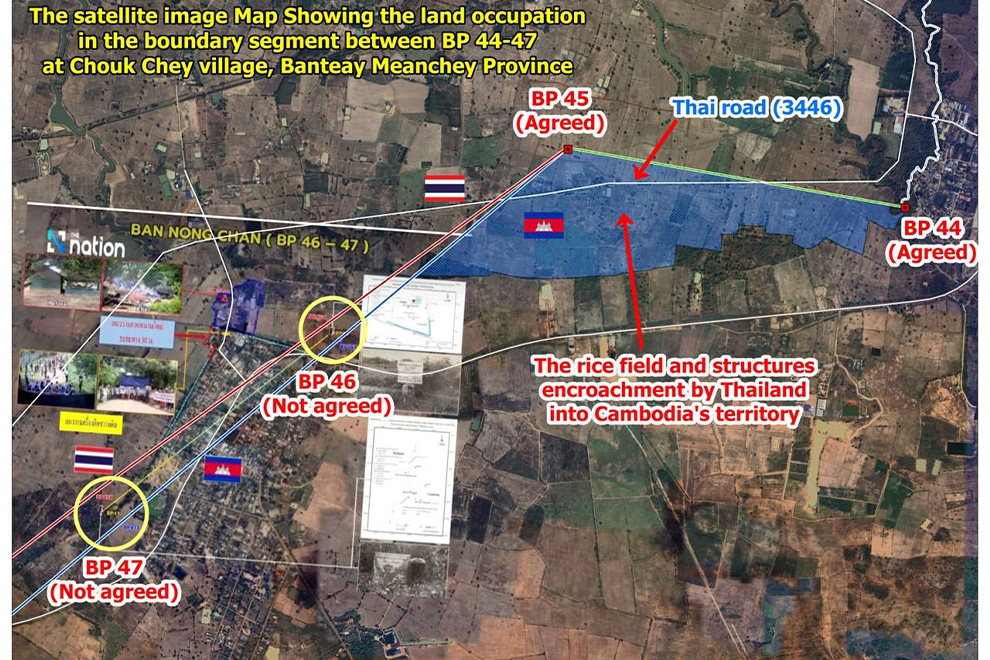
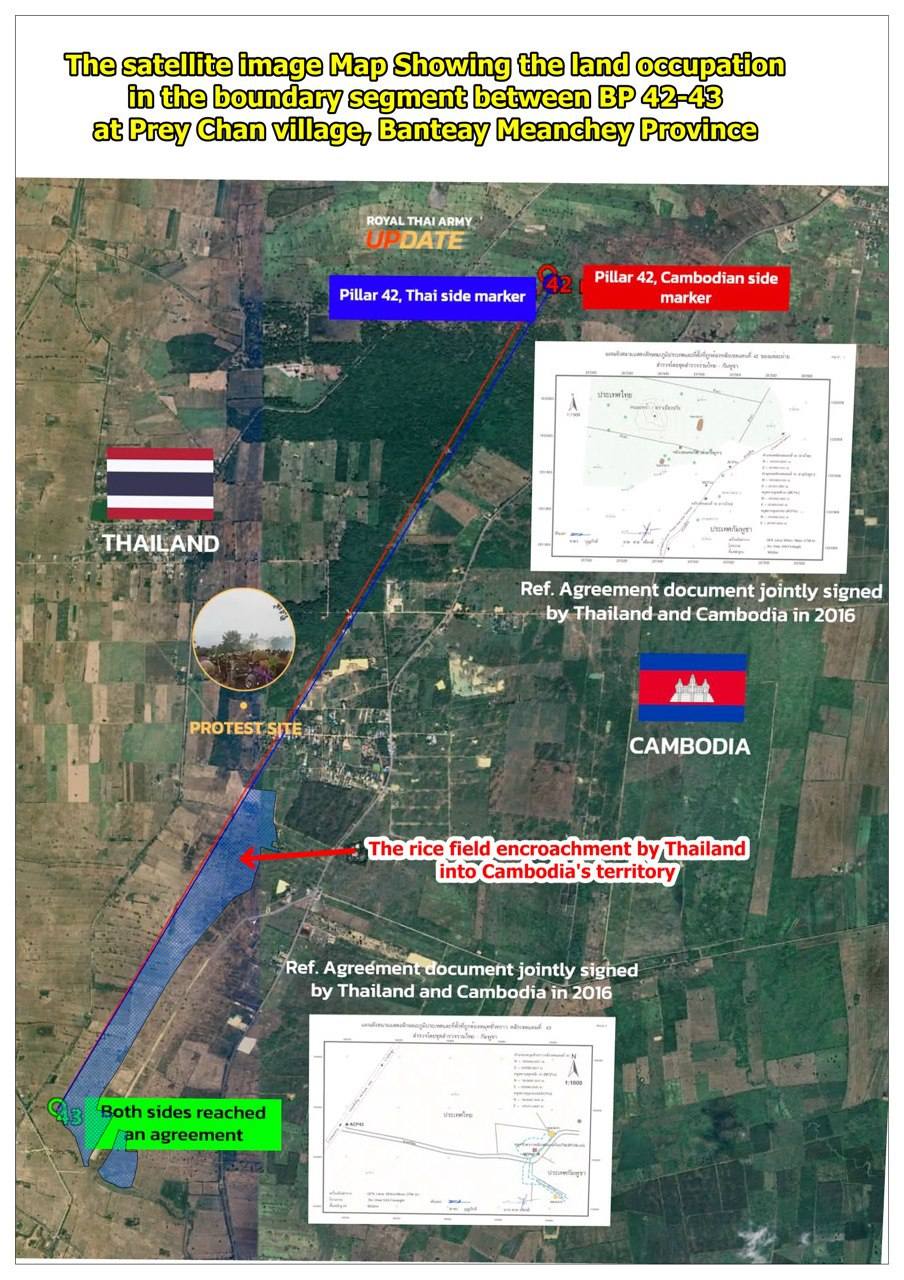
His remarks were in response to recent public statements by Thai military officials and the governor of Sa Kaeo province, who presented satellite maps and records of boundary pillar surveys in Prey Chan and Chouk Chey villages which suggested that certain stretches of the border had been resolved.
Manet dismissed these claims as inaccurate, noting that survey teams from both sides had agreed only on the location of a single pillar (of border marker 43, not 42), and that they have “neither the mandate nor the authority to decide on the borderline”.
The Cambodian leader pointed out that, despite unofficial Thai maps suggesting otherwise, “the reality on the ground is that Thai people have been occupying and farming for years many hectares of land situated well within Cambodian territory”.
This, he said, demonstrated both the complexity of the issue and the need to pursue resolutions through the Joint Commission for Demarcation of Land Boundary (JBC), the bilateral mechanism established under the MoU.
Manet stressed that Cambodia respects the sovereignty and territorial integrity of all its neighbours but expects the same in return.
“The Royal Government of Cambodia is committed to seeking an amicable and fair resolution to all boundary disputes with Thailand, as with all its neighbours, through peaceful means in accordance with international law, while remaining resolute in upholding its principled position that borders must not be changed by force,” he said.