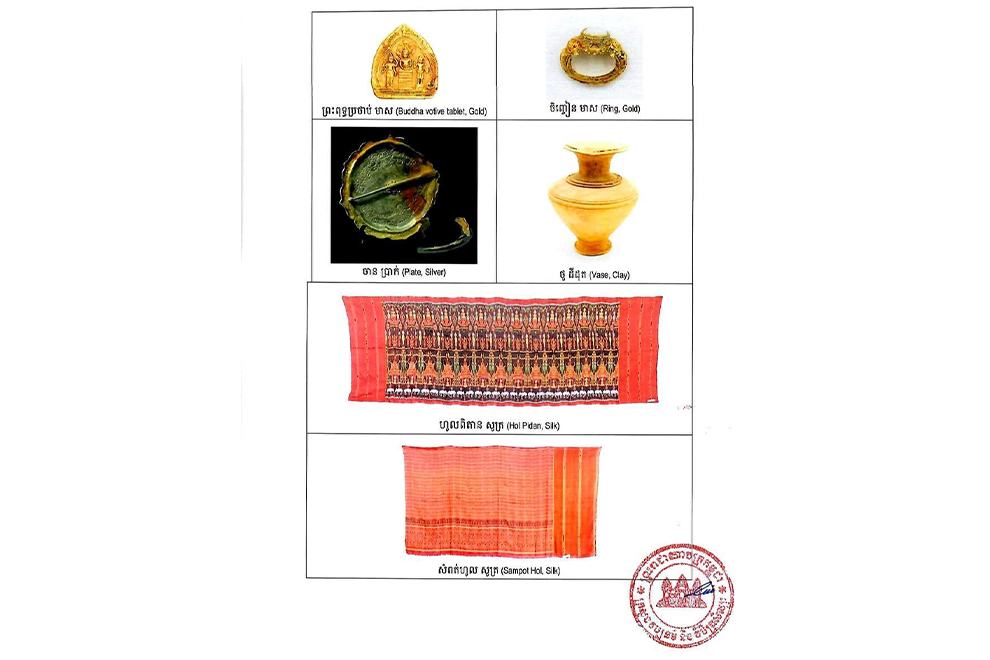
István Zelnik, a Hungarian national, has voluntarily returned several Khmer antiquities he has possessed for many years. The pieces include fine Khmer silks, as well as sculptures which date back to the prehistoric era, according to the Ministry of Culture and Fine Arts.
A ministry press release explained that the agreement to return the items was the culmination of years of negotiations and was part of the ministry’s continuous efforts to search for and reclaim lost Khmer cultural assets.
Zelnik is a private collector who has collected art objects from across the Asian region, including Khmer art, for several decades.
He established the Hungarian Southeast Asian Institute in the early 2000s. Under the framework of this institute, significant scientific research was carried out in the Angkor and Koh Ker areas. Funded by Zelnik, the work included archaeological surveys, technological research (LIDAR) and historical studies. These efforts also contributed to the preparation of the documentation required to inscribe the Koh Ker temple site on the UNESCO World Heritage List, according to the ministry.
The significant objects which will be returned at this time include 183 individual Khmer silk textiles, which will serve as exquisite examples for the National Museum of Cambodia’s textile collection. Additionally, there are prehistoric objects such as coins, beads, jewellery and utensils, made from precious metals, bronze, stone and pottery.
Most of the items were looted and exported from Cambodia during the civil war era several decades ago.
According to the ministry, the returned items also include other important pieces, such as stone and bronze objects from the Pre-Angkor and Angkor periods.
“The culture ministry expresses our gratitude and highly appreciates the correct decision of Zelnik — who is over 70 years old — to return all Khmer art objects to Cambodia,” said the release.
In the past, Zelnik has returned a number other of Khmer art objects to Cambodia and has made significant contributions to archaeological research projects and the publication of numerous scientific research works related to cultural heritage, inscriptions, and modern Khmer art, noted the ministry.
“This voluntary return of Khmer antiquities to Cambodia is a gesture that serves as a model. The culture ministry appeals to and encourages all private collectors, as well as institutions around the world that currently hold Cambodian antiquities, to cooperate with the Royal Government of Cambodia — through the ministry or Cambodian embassies in their respective countries — to facilitate the return of Khmer cultural assets to Cambodia,” said the release.