



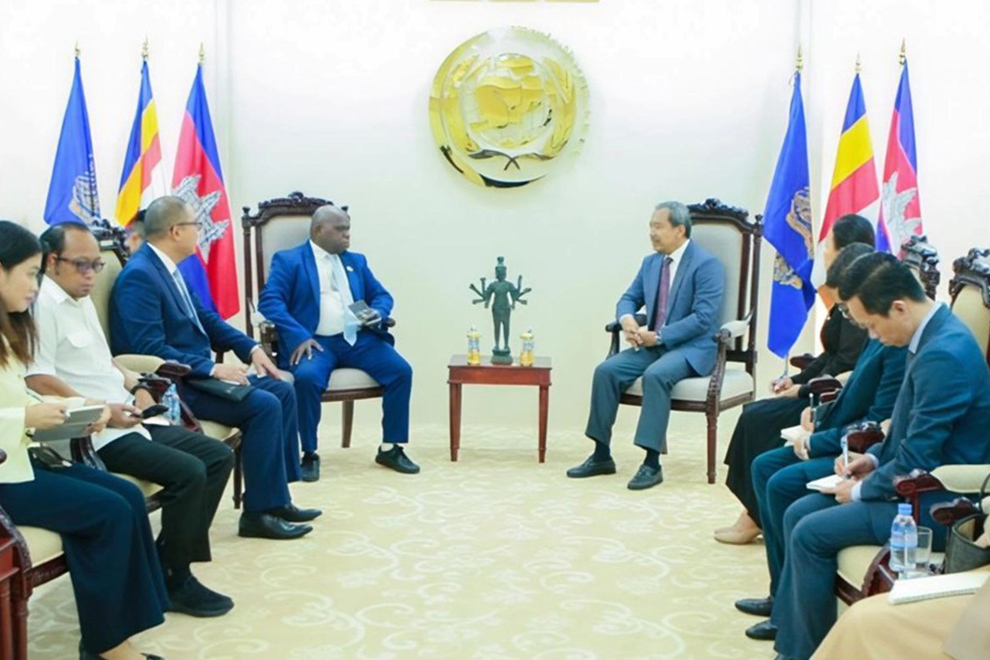
Indonesia has formally asked Cambodia to support its bid for the 2026 presidency of the UN Human Rights Council. During a bilateral meeting in Phnom Penh yesterday, November 24, an Indonesian delegation outlined a broader regional vision aimed at strengthening cooperation on human rights across the Asia-Pacific.
The delegation was led by Natalius Pigai, Indonesian Minister of Human Rights, and met with Keo Remy, senior minister for human rights and chair of the Cambodian Human Rights Committee (CHRC).
The meeting marked a renewed push by Jakarta to expand its regional and global human rights diplomacy.
Pigai said Indonesia’s candidacy reflected “a commitment to contribute more significantly to the advancement of human rights issues globally”, stressing that the support of regional partners — including Cambodia — would be essential.
He also introduced Indonesia’s plan to host a high-level Asia-Pacific Human Rights Forum in 2026, describing it as a major initiative to shape common understanding and strengthen institutional capacity across the region.
“This forum was initiated as a space for Asia-Pacific countries to build shared understanding, improve the quality of cooperation and strengthen institutional capacity in addressing human rights issues,” he explained.
Remy thanked the Indonesian side for the invitation and confirmed that he will attend the forum in 2026.
On the request for Cambodia’s support for Indonesia’s UNHRC presidency bid, he said he would report the matter to the hHead of the Royal Government for review.
Remy also welcomed Indonesia’s offer of technical assistance, particularly in training and capacity building for Cambodian officials. He proposed the establishment of a bilateral focal point between the two countries to coordinate human rights cooperation, moving forward.
During the talks, Remy further asked Indonesia to help encourage Thailand to respect the Joint Declaration on Peace and International Law, noting Cambodia’s expectation that all sides commit to resolving bilateral issues peacefully.
The two sides also addressed the rights and welfare of migrant workers —an issue of growing relevance as labour mobility between both countries increases.
“We also hope for cooperation in providing protection for workers, both Indonesian workers in Cambodia and vice versa,” Pigai said, stressing that Indonesia places a high priority on ensuring that its citizens working abroad receive proper protection and access to their rights.
Remy briefed his counterpart on recent developments in Cambodia’s human rights landscape, including institutional reforms and ongoing cooperation with international partners.
The meeting concluded with both ministers reaffirming their commitment to deepen human rights collaboration, expand training programmes and advance a collective agenda for rights protection in the region.
The outcome signals a stronger Indonesia–Cambodia partnership ahead of Indonesia’s regional diplomacy push in 2026.
