Cambodia’s fisheries sector is charting a new course toward innovation and global competitiveness as the EU and UN Industrial Development Organization (UNIDO) concluded the CAPFish-Capture project with an October 7 technical workshop on innovation and research in Phnom Penh.
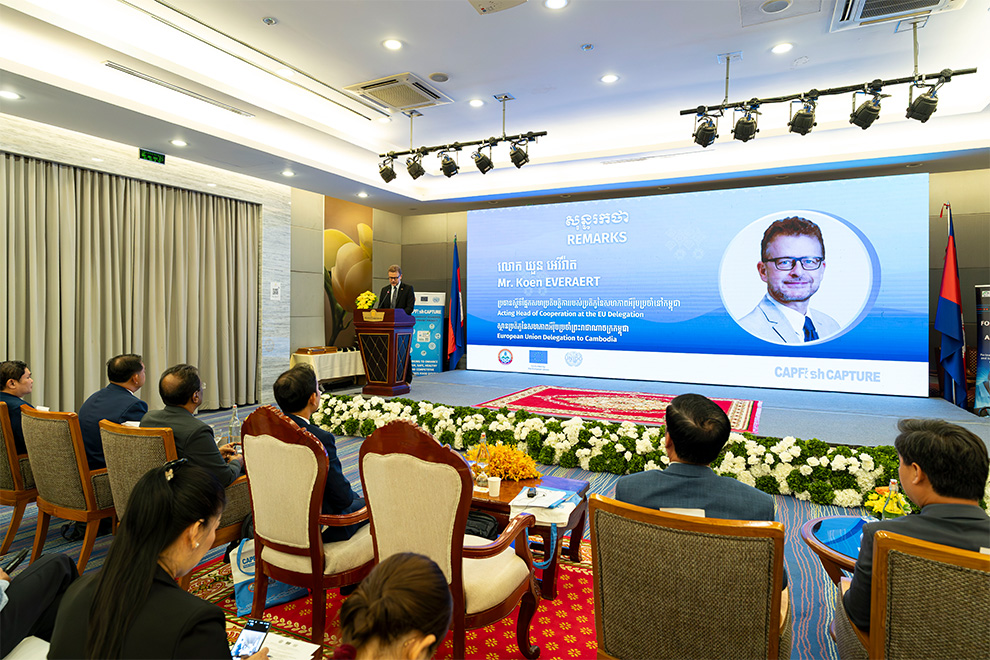
The “Innovation and R&D for Enhancing Fisheries Competitiveness: Achievements, Lessons Learned, Challenges, and the Way Forward” workshop brought together government officials, development partners, private-sector representatives and academic institutions to review five years of progress under the EU-funded initiative, which has transformed Cambodia’s post-harvest fisheries and agri-food industries through technology, research and institutional strengthening.
Speaking at the event, Chhuon Chamnan from the Fisheries Administration (FiA) explained that the project had been pivotal in developing a more inclusive and competitive fisheries value chain.
“We are proud to see the achievements under Output 3: the establishment of the Food Technology Research and Innovation Platform, the creation of the Cambodia Packaging Centre, the development of a national model of university IP policy, the registration of Prahok Siem Reap as a Geographical Indication and the introduction of the Cambodia Enterprise Innovation Index Guideline,” he said.
“These initiatives have laid strong foundations for the long-term competitiveness of Cambodia’s food and fisheries sector,” he added, emphasising the importance of connecting universities, industries and government to ensure that research is market-driven and benefits producers and consumers alike.
From research to market impact
Over the past five years, the CAPFish-Capture project — implemented jointly by the EU, UNIDO, and FiA under the Ministry of Agriculture, Forestry and Fisheries — has supported the modernisation of Cambodia’s post-harvest fisheries, focusing on innovation, safety and sustainability.
Under its innovation-focused component, known as Output 3, the project established platforms that are already yielding tangible benefits for local producers and researchers.
The Food Technology Research and Innovation Platform (FTRIP) connects universities, research centres, and small and medium enterprises (SMEs) to solve real-world challenges through applied research.
According to Shetty Seetharama Thombathu, UNIDO’s chief technical advisor, FTRIP’s success illustrates how science and enterprise can work hand in hand to drive industrial transformation.
“The progress of FTRIP plays a significant role in promoting innovation and R&D in the fisheries sector in Cambodia, highlighting its relevance and potential for scaling up in other agri-food industries,” he said.
Meanwhile, the Cambodia Packaging Development Center (CPC), another flagship outcome, has improved local producers’ access to resources and technology related to packaging design and quality.
This initiative is helping Cambodian products become more appealing and competitive in both domestic and international markets, while reducing post-harvest losses and waste.
The project also guided universities in developing a national model of intellectual property policy, strengthening the role of academia in innovation management.
Complementing this, the successful registration of Siem Reap Prahok as a Geographical Indication (GI) marked a milestone in protecting local heritage products and linking traditional knowledge with modern value-chain competitiveness.
EU support for an innovation-driven economy
Koen Everaert, first secretary and deputy head of cooperation at the EU delegation to Cambodia, described the CAPFish-Capture initiative as “a clear example of the EU’s commitment to sustainable and inclusive growth”.
“The EU has a long-standing commitment to sustainable and inclusive growth in Cambodia. We believe that a strong, prosperous Cambodia is one that is built on a foundation of sound policy, a robust private sector and a skilled workforce,” he said.
Everaert added that the outcomes of Output 3 align closely with EU priorities on food safety, traceability, SME upgrading and greener, more resilient value chains.
“By strengthening compliance and branding, Cambodia expands its options in regional and global markets and moves further up the value ladder,” he said.
He urged the Cambodian government to embed these new tools — such as FTRIP, CPC and the IP model — into national policies, budgets and procurement systems, and encouraged higher education institutions to make industry-linked research and intellectual property management a standard practice.
Building for the Future
As the CAPFish-Capture project concludes, stakeholders are looking to the future with a shared commitment to sustain and scale up the progress achieved.
The workshop participants agreed that continued coordination between the government, research institutions and the private sector will be essential to ensure lasting impact.
“By continuing to work together, we can make Cambodia’s fisheries products not only safe and compliant, but also competitive and recognised in regional and international markets,” Chamnan said.
The CAPFish-Capture project is part of the EU’s broader support to Cambodia’s sustainable fisheries development, complementing efforts to improve livelihoods, enhance food safety, and open higher-value export markets for Cambodian producers.
Both UNIDO and the EU reaffirmed their readiness to continue supporting Cambodia’s transition toward a knowledge-based, innovation-led agri-food economy.