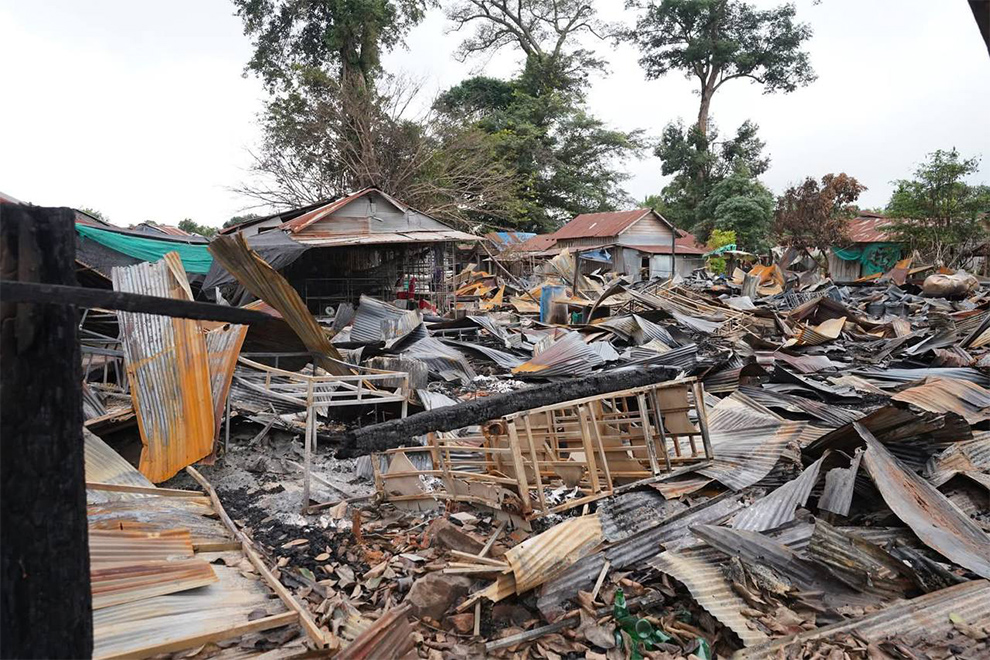
Although the political leaders of the Cambodian and Thai governments agreed to a ceasefire that officially came into effect at midnight on July 28, a Ministry of Interior statement has suggested that the Thai military has continued to provoke incidents, seemingly in an attempt to reignite the conflict.
Eight days after the ceasefire agreement — brokered in Malaysia under the mediation of Malaysian Prime Minister Anwar Ibrahim, the ASEAN chair, and with the participation of representatives from the US and China — the ministry sees no indication of the Thai military showing any intention of ending the fighting or withdrawing from Cambodian territory.
In fact, it noted that they have continued entering Cambodian territory to capture troops, brought up additional forces and moved additional weapons to conflict zones, provoked issues, illegally encroached on Cambodian land and flown drones drones deep into Cambodian territory.
In response, the Cambodian government — firmly committed to ending the war and ambitiously aiming to transform all border areas (with Thailand, Vietnam and Laos) into zones of peace and development — has consistently urged the Thai side to fully implement the July 28 ceasefire agreement.
Due to these what it called ongoing provocations, the ministry’s published a social media statement this afternoon, August 4.
“Thailand is increasingly falling into the trap of international law,” it said.
It stated that the deployment of fully armed troops and military equipment into the An Ses area and other regions, along with illegal incursions into Cambodia’s sovereign land at 11.00am this morning — despite strong protests by Cambodian forces — illustrates that Thailand is pushing itself into the trap of international law.
The ministry highlighted five key points.
1. Thailand is increasingly entangled in a legal trap, akin to a strategic advantage for Cambodia in international court. Cambodia is implementing a strategy of “extending the fishing line to catch the big fish”. Thailand is the fish; Cambodia sits patiently with the rod in hand, waiting to strike.
2. Thailand faces accusations of violating the sovereignty of another state under international law. It must be remembered that any military operation on another country’s territorial integrity without consent constitutes an act of aggression. This incident is clear evidence of Thailand’s difficulty in defending itself legally and will be remembered in history as the act of a state committing international aggression — a grave international crime.
3. Thailand continues to violate the ceasefire agreement reached on July 28, which required an unconditional cessation of hostilities, a prohibition on troop movements and a freeze on military build-up. This act undermines the efforts of the US, China, Malaysia, military alliances and several diplomatic observers who have visited the area to monitor compliance with the ceasefire.
4. Thailand’s military operations on Cambodia’s sovereign territory amount to provocation, risking the outbreak of war, and pose a severe threat to peace and security along the shared border.
5. These actions also reveal Thailand’s true intention to place itself first — a “ Thai Attacked First” approach — blatantly initiating conflict while attempting to shift the narrative.
“Cambodia reaffirms that on July 30, a delegation of foreign military attachés based in Cambodia visited the An Ses area, which lies within Cambodian territory. Cambodia remains patient, refusing to fall into hostile traps. Instead, we gather solid evidence to support our case before international legal institutions,” explained Touch Sokhack, interior ministry spokesperson.
“We remain calm and collected, ‘calm like a snake, waiting for the fatal strike’, as previously stated by the prime minister,” he added.