The president of the Cambodia Chamber of Commerce (CCC) has called on representatives of provincial and municipal chambers of commerce, as well as overseas representative offices, to work together to fulfil their mission as a bridge between the business community and the Royal Government’s strategic vision, with the goal of accelerating Cambodia’s economic growth. Cambodia’s economy in 2026 is forecast to grow by 5.0%.
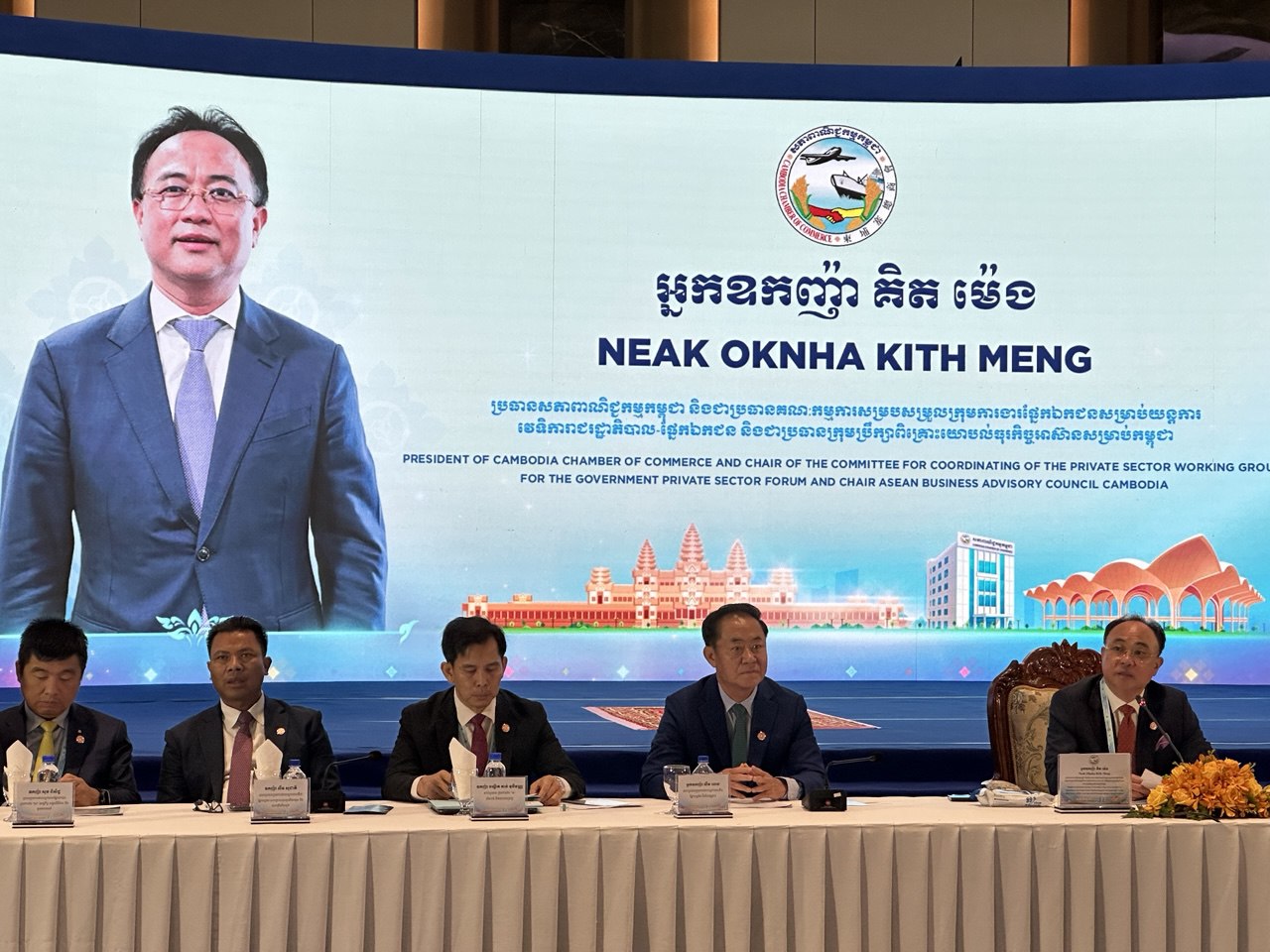
Kith Meng, CCC president and chair of the ASEAN Business Advisory Council for Cambodia, addressed the CCC AGM on January 28.
He explained that the gathering of CCC members — representing Cambodia’s private sector—was critically important for sharing information, experience and discussions in order to work with the government to promote national economic growth.
This will be achieved through strengthening and expanding domestic production, as well as attracting more foreign investors to invest in and trade with Cambodia. He noted that in 2026, Cambodia’s economy is expected to grow at around 5%.
Meng noted that the CCC has expanded beyond national borders, with eight representative offices worldwide, including in Canada, Japan, Australia, the US and New Zealand. These representative offices serve as strategic gateways to ensure that the “Made in Cambodia” brand becomes a symbol of quality and reliability in international markets.
“The year 2026 will be a year of accelerating economic momentum. With national economic growth projected at 5.0%, the CCCC must encourage the private sector to align with and implement the Royal Government’s policies,” he said.
“It is not merely an ordinary institution; it is a partner of the Royal Government. Under the Law on Chambers of Commerce, its core mission is to serve as a bridge between the business community and the Royal Government’s strategic vision,” he added.
He advised provincial and municipal chambers of commerce to work closely with local authorities and micro, small and medium enterprises (MSMEs) to enhance production capacity and help them maximise the benefits of the Kingdom’s various trade agreements. CCC representatives abroad are tasked with serving as frontline business connectors by organising business-to-business (B2B) matchmaking that leads to the signing of memoranda of understanding (MOUs) between foreign technology companies and Cambodian operators.
“We must use our platforms to reshape international perceptions and demonstrate that Cambodia is a business-friendly gateway to the ASEAN region,” said Meng.
According to the latest report from the National Bank of Cambodia (NBC), Cambodia’s economic outlook for 2026 is projected to achieve growth of 5%, the same as 2025.
The NBC noted that this growth is mainly supported by growth in the manufacturing sector, driven by external demand from trading partners, particularly the US, as well as growth in the tourism sector, supported by government tourism promotion policies such as visa exemptions for Chinese nationals, diversification of tourism destinations and continued promotion of tourism cooperation both regionally and internationally.
It also noted how growth in the agricultural sector, backed by government policies and support measures, and the gradual recovery of the construction and real estate sectors are expected to support growth.
The NBC issued a sharp warning of potential threats to economic growth, however.
“Cambodia’s economy may continue to face several risks, particularly external risks such as geopolitical tensions that disrupt supply chains, the impacts of climate change and online fraud. Internal risks include weaknesses in the construction and real estate sectors, the effects of prolonged Cambodia–Thailand border disputes and rising non-performing loans,” it noted