



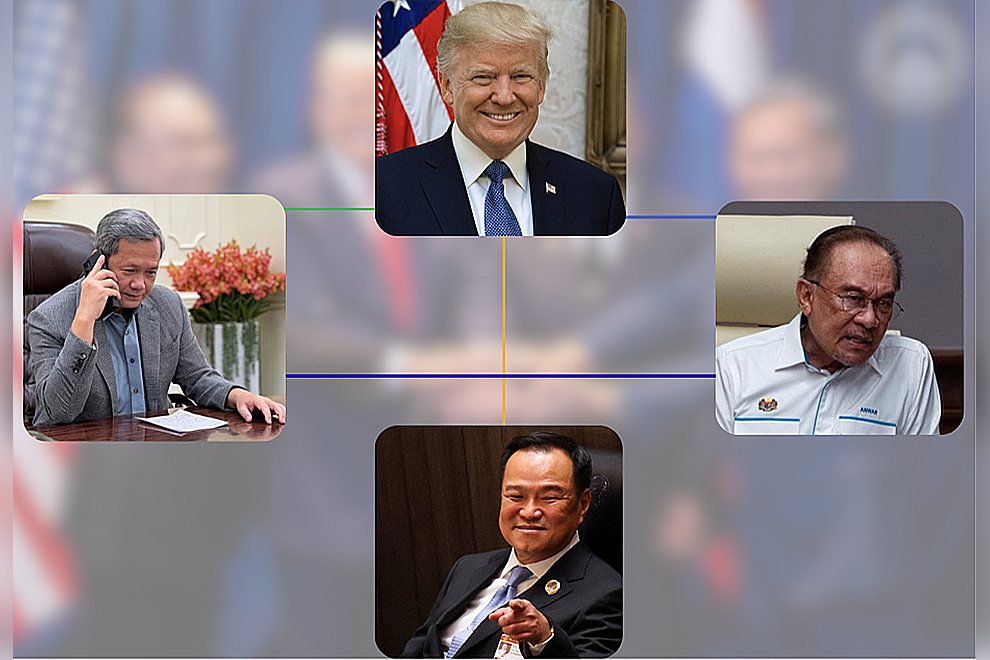
Malaysia will convene a Special ASEAN Foreign Ministers’ Meeting in the coming days as regional diplomats race to contain rising tensions between Cambodia and Thailand, following a week of deadly cross-border clashes.
The move was announced late Friday December 12 by Malaysian Prime Minister Anwar Ibrahim, who said he had spoken directly with US President Donald Trump and Cambodian Prime Minister Hun Manet to urge restraint and a return to peaceful mechanisms under ASEAN and the Kuala Lumpur Joint Declaration.
Anwar said Malaysia, as ASEAN chair, stands ready to coordinate de-escalation efforts and protect civilians.
“Malaysia remains ready to support efforts to de-escalate the situation, protect civilians, and help restore regional stability, in line with ASEAN’s spirit of good neighbourliness,” he explained.
Anwar added that the Special Foreign Ministers’ Meeting will be used “to assess the situation and support de-escalation measures”.
His announcement followed Trump’s December 13 claim on social media that both Cambodia and Thailand had agreed to a ceasefire “effective this evening” and return to the original peace accord that Washington and Kuala Lumpur helped negotiate.
“They have agreed to CEASE all shooting effective this evening, and go back to the original Peace Accord made with me, and them, with the help of the Great Prime Minister of Malaysia, Anwar Ibrahim,” Trump posted.
The US president described his conversations with Anutin and Hun Manet as “very good”, praising the two countries’ stated commitment to peace and continued cooperation with the US.
Manet explained via his own social media that the phone calls were aimed at finding ways to return to the implementation of Kuala Lumpur Joint Declaration between Cambodia and Thailand.
Conflicting narratives emerge
Thailand maintains that Cambodia initiated the December 7 incident that set off the latest bout of violence.
Thai Prime Minister Anutin told reporters that Bangkok had fully complied with the joint declaration and only responded after “Cambodia violated first”.
He claimed Thailand acted solely to defend its sovereignty and insisted that any ceasefire announcement must clearly state that Cambodia is the party that must halt its operations.
“Don’t just say ceasefire — tell the world that Cambodia will stop firing, withdraw its forces and remove all the explosives they planted,” Anutin said, adding that Thailand “has never wanted anything belonging to Cambodia”.
Cambodia strongly rejects the claim. In a public statement, Hun Manet said he has asked both Malaysia and the US to use their intelligence platforms — including satellite imagery from the hours surrounding the clash — to independently verify which side opened fire first.
He said Cambodia is fully prepared to cooperate in any transparent verification process.
Hun Manet underscored that Cambodia has consistently adhered to peaceful dispute-resolution mechanisms under ASEAN and the KL Joint Declaration, saying he “thanks both leaders for their continuous efforts to achieve a long-lasting peace”.
Thai fire hits Koh Kong hours after Trump–Anutin call on ceasefire
Local authorities in Koh Kong province reported that Thai forces fired into Cambodian territory at around 3am this morning, December 13, just hours after phone calls had reportedly secured a ceasefire.
The strikes sent residents fleeing their homes in search of safety, officials said.
Thai F-16 strikes hit key locations in Thma Da and Victory Bridge areas
Also this morning, Thai airstrikes targeted several strategic locations in Cambodia, according to the Ministry of National Defence.
Just before 6am, two “hotel buildings” in the Thma Da area were destroyed. Shortly after, the Victory Bridge was hit multiple times, with strikes recorded at 6.02, 6.07 and 6.12, damaging the old section of the bridge.
