



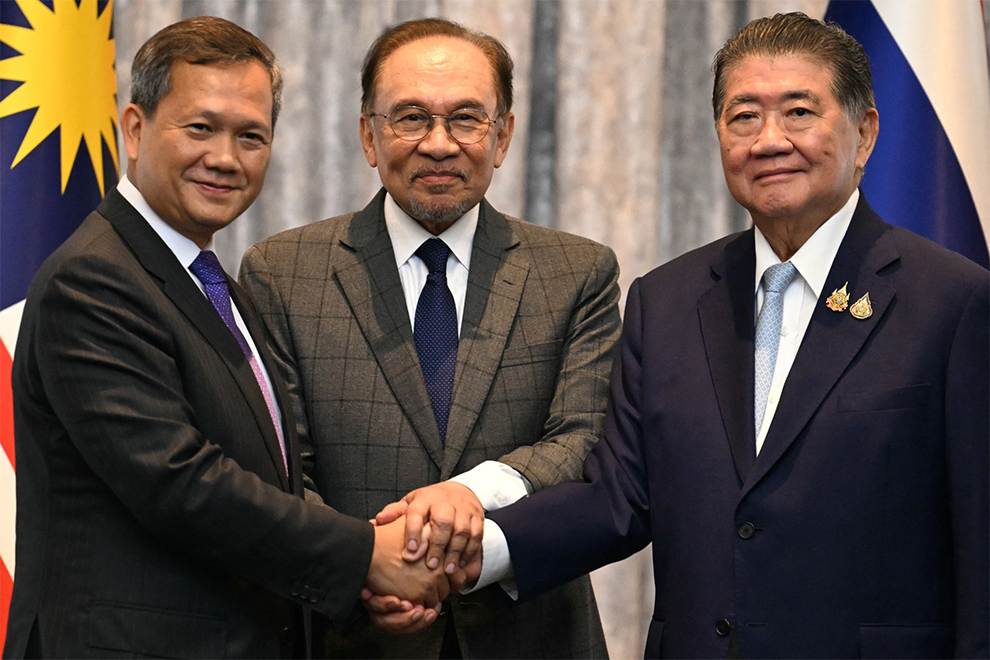
Prime Minister Hun Manet has expressed his gratitude for the proactive support of Malaysian Prime Minister Anwar Ibrahim in facilitating the ceasefire between Cambodia and Thailand.
In a congratulatory letter to Anwar, the Malaysian government, and its people ahead of the 68th celebrations of Malaysian Independence Day on August 31, Manet thanked Anwar for Malaysia’s continuous and proactive support in resolving the Cambodia-Thailand border dispute during his tenure as the 2025 ASEAN chair.
“I take this opportunity to express my deepest gratitude for Malaysia’s steadfast support and proactive engagement in addressing the Cambodia-Thailand border conflict. Under Your Excellency’s valuable contribution, the Extraordinary Meeting of the General Border Committee, held on August 7, 2025, in Kuala Lumpur, brought new hope for lasting peace in our region,” Manet said, in the August 26 letter, released today.
“Cambodia remains firmly committed to positive peace and regional harmony, continuing to seek resolutions for all border disputes with neighbouring countries through peaceful means and full respect for international law,” he added.
Manet praised Malaysia as a culturally diverse and progressive society, a model for national unity and regional harmony, saying it plays a significant role both regionally and on the wider international stage.
Regarding bilateral relations, Manet noted that Cambodia and Malaysia have enjoyed close and cooperative ties for decades. The relationship and partnership between the two nations, rooted in mutual respect, trust and long-standing traditional cooperation, continue to grow through joint efforts.
“With shared vision and mutual interests, the relationship between Cambodia and Malaysia will continue to strengthen, bringing significant benefits to the people of both nations and contributing to the progress of building the ASEAN Community,” he said.
Anwar played a key role in pushing for the ceasefire between Cambodia and Thailand. While Cambodia agreed to the ceasefire from the outset, Thai leaders initially hesitated and later refused to negotiate until a phone call from US President Donald Trump facilitated an agreement, leading to the ceasefire on July 28.
