The manufacturing sector remains a key pillar supporting Cambodia’s economic growth. According to estimates for 2025, the sector is expected to grow by more than 8%, while overall economic growth is projected at around 5%.
“The manufacturing sector continues to be a very important pillar in supporting Cambodia’s economic growth and is estimated to record solid growth of 8.5%, although this is lower than in 2024, when growth reached 11.6%,” noted National Bank of Cambodia (NBC).
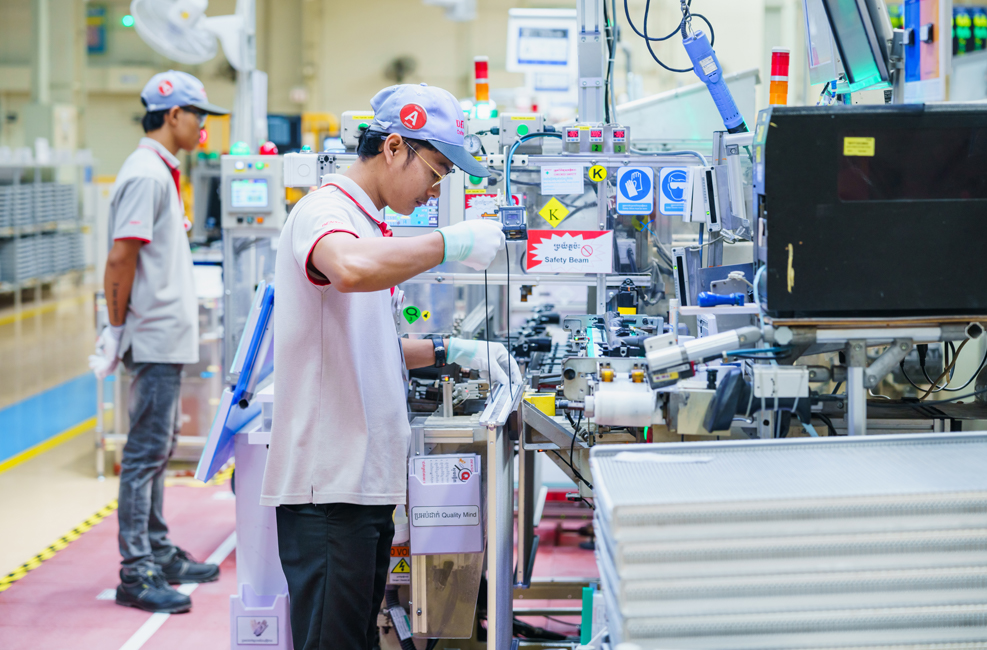
According to the NBC, garment manufacturing output is estimated to grow by 7.1% (15.8% in 2024), while non-garment manufacturing is projected to expand by 10% (6.9% in 2024). Several products are experiencing strong growth, including automobile tires, light bulbs, wood products, and electrical wires and cable assemblies.
“The continued increase in exports of non-garment manufactured products reflects the efforts and results of the Royal Government of Cambodia’s economic diversification strategy,” said the NBC.
However, the NBC also pointed out that armed clashes along the Cambodia–Thailand border have had negative impacts on factories and enterprises located near the border. At the same time, these developments have helped stimulate domestic production, particularly among small and medium enterprises (SMEs), which are expected to become a new source of support for economic growth and help accelerate Cambodia’s economic diversification.
Based on the NBC report, Cambodia’s economy in 2025 is projected to achieve growth of about 5%, mainly supported by increased exports of manufactured goods.
This includes an acceleration of exports in the first half of the year, ahead of the implementation of US reciprocal tariffs, which were initially announced in April at a rate of 49% and scheduled to take effect in the early second half of 2025. However, thanks to government negotiation efforts, the reciprocal tariff rate was gradually reduced to 36% on July 7 and further to 19% on August 1, 2025.
Hong Vanak, an economist at the Royal Academy of Cambodia, told The Post on February 3 that, based on reports from the Council for the Development of Cambodia (CDC), Cambodia has attracted many new investment projects and production expansion projects over the past two years. These new investments span a wide range of sectors, unlike more than a decade ago when most were concentrated in garment manufacturing.
He added that improvements to investment laws to make them more attractive, abundant labor, strong foreign market demand and the entry into force of various bilateral and multilateral free trade agreements have been key factors driving export growth and broader economic development.
“Progress in the manufacturing sector will provide strength and stability to Cambodia’s economy. Increased production capacity will help boost Cambodia’s exports to international markets in the future,” he said.
The NBC highlighted several factors that it expects to drive economic growth in 2026.
It cited growth in the manufacturing sector, driven by external demand from trading partners — especially the US — maintaining competitiveness due to the 19% reciprocal tariff rate, which is comparable to competitors, along with product and market diversification.
It also tipped increased tourism, supported by government tourism-promotion policies such as visa exemptions for Chinese tourists starting in mid-June 2026, diversification of tourism destinations and continued promotion of tourism cooperation, both regionally and internationally.
The agriculture sector was also identified as a source of growth, through tax incentives and the development of modern agricultural communities. If the Cambodian agriculture can transform from family-based farming into strong agricultural enterprises with high integration, economies of scale, and competitiveness in both quantity and quality, it should increase its contribution to the economy.
A gradual recovery in the construction and real estate sectors was also predicted.
It also warned of several potential risks, both external and internal.
External risks were identified as geopolitical tensions affecting supply chains, climate change and the perception of online scams. Internal risks include weakness in the construction and real estate sectors, the impact of the prolonged Cambodia–Thailand border disputes and an increase in non-performing loans.