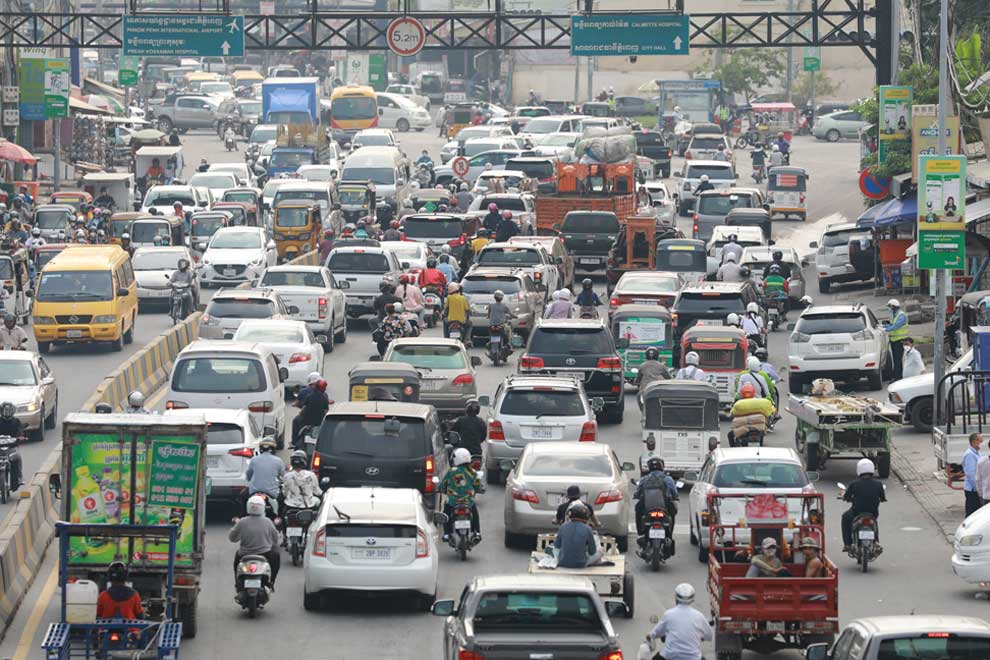
The Ministry Public Works and Transport agreed to a request to set up a standard central bus terminal outside of the city to reduce traffic congestion. The request was made last week by The Cambodia Bus Association (CAMBA) which made up of 17 member companies.
Last week, minister Sun Chanthol met with CAMBA chairman Chhem Chamnan to discuss the work at the ministry headquarters.
According to Department of Land Transport director-general Chhuon Vorn, the ministry, in cooperation with the private sector, is studying plans to set up a bus station outside the capital to avoid the traffic caused by large buses heading into the city.
“In fact, the ministry has been thinking of this for a long time and we have considered the issue of congestion. We aim to have a bus terminal outside of the capital.
“This is not a parking lot. It will be a standard terminal and so far some companies have made this request. The ministry is very supportive of the development of this sector and the idea for a bus terminal. We have to do it because we have a lot of congestion and the number of vehicles is increasing,” Vorn said.
After the meeting with Chanthol, CAMBA Secretary General Vibol Yoy said that setting up the bus terminal was very important for travellers to be able to park their cars in one place to make it easy to travel.
Yoy, who is also the general manager for MJQ Travel, said: “We do this to maintain order and we should look for a location with convenient access to roads to all provinces.”
He said that the previous parking lot arrangements were not successful because the locations were substandard and the transport company operators were losing resources with the establishment of many offices.
“We should have the same common parking lot as that at the airport where any company can come. Travel is limited by the time it takes for entering and departing by the companies. As for the location of their respective parking lots, it causes disorder and the state cannot control the transportation,” he added.
With the traditional transportation of taxi drivers in the markets and urban areas of the capital, Vibol said that the association had also asked Chanthol about this issue.
“We, as representatives for the companies and the associations, made the request for changes in trading transport vehicle number plates. Transporters of travellers have to use number plates registered by the ministry so that they will have the obligation to pay taxes like transport companies for fair trading competition,” he continued.
However, Vibol acknowledge that forcing traditional taxi drivers to implement the law was really hard and that it takes time for them to do so and the participation of some institutions to implement the plans is necessary.
“But at first, we need to have this joint bus station to be a place for transport vehicles to park before forcing them to respect the law,” he said.
He added that the association has made great efforts to develop the transportation sector by developing more modern vehicles.
But, Chhuon Vorn said that what he said about the parking lot referred only to the big buses, for taxi terminals it’s another story.
“We have stages to think about and before doing anything, we must think carefully and make sure that we do not cause problems. We need to have a clear study and have a means of public transport so that it is not difficult for our people to get to the city from the bus terminal,” he said.
Kim Pagna, country director of the Asia Injury Prevention Foundation (AIP), said that traffic congestion in Cambodia had some main causative factors – the number of people and vehicles and road infrastructure that failed to respond to the growth of vehicle use.
He added that the transport ministry has been studying bus terminal in Phnom Penh and he supported the study because this is part of reducing traffic in congested areas.
He said that due to congestion, the ministry should look into a number of other issues, such as removing unnecessary vehicles from the streets like road sweepers and garbage trucks and making proper schedules for when they can be deployed.
“In addition to building this bus terminal, the public should use public transport to reduce traffic congestion at congested destinations and there should be widespread publicity about the law and the use of roads by the people,” he said.