Cambodia’s push to modernise its agricultural sector is showing strong momentum, according to the Ministry of Agriculture, Forestry and Fisheries. The number of flagship modern agricultural communities (MACs) is expanding rapidly across the Kingdom and is and expected to reach 30 communities by the end of 2025, reported the ministry.
Ministry spokesperson Khim Finan said that 22 MACs have already been registered, with five more are in the process of registration, reflecting growing farmer confidence in the government’s drive to transform traditional farming into a competitive and sustainable agribusiness system.
Currently, around 3,000 households are part of the modern communities, cultivating approximately 20,000 hectares of land nationwide.
They primarily focus on rice, vegetables, pepper and cashew nuts, with each one connected to a guaranteed market through pre-planting sales contracts that ensure stable prices for farmers.
“Modern agricultural communities guarantee a set market and price before farmers produce. So, for every crop, whether vegetables, pepper, cashew nuts or rice, we all sign contracts in advance before we organize as a community,” Finan explained.
Transforming agriculture into agribusiness
Launched under the policy framework of the seventh-mandate government, MACs aim to restructure the agricultural sector from small-scale, family-based farming to well-organised, large-scale collective production.
Each community operates like an enterprise — with shared management, collective purchasing of inputs and coordinated production plans. Farmers receive technical training, market support and access to low-interest loans without the need to invest heavily upfront.
According to Finan, the ministry also assists communities through the provision of infrastructure, warehouses, drying machines and other modern equipment, often in partnership with development organisations.
“So far, farmers in modern agricultural communities have received discounts of between 15 and 20 per cent on agricultural inputs. This is the main advantage, and encourages more farmers to join,” he said.
Proven results across provinces
Several communities have already demonstrated significant progress.
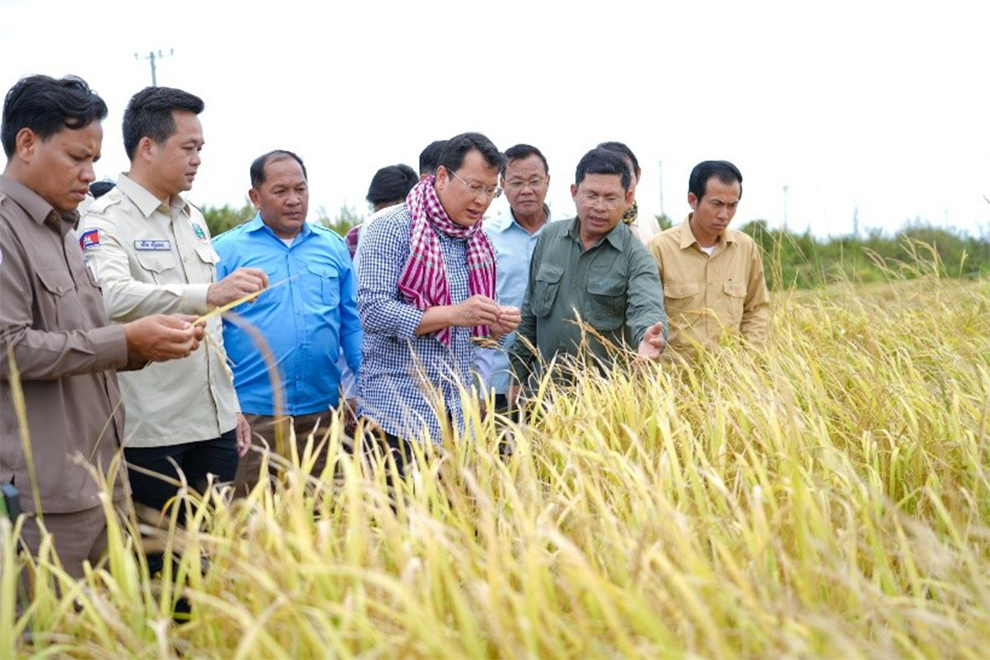
In Kampong Thom, a rice community that began with 500 to 600 hectares has now expanded to over 3,000 hectares, achieving higher yields and better prices than independent farmers.
“While general farmers sell paddy for 700 riel per kilogramme, farmers in the modern farming community get 950 — and Sen Kra Ob rice sells for 1,250,” Finan noted.
In Tbong Khmum, a pepper-growing community has doubled its membership, while a vegetable community in Tram Kak, Takeo province, has also expanded its production with more mesh greenhouses installed to increase productivity.
Future outlook: Toward large-scale, competitive farming
The ministry plans to continue scaling up the initiative, targeting the establishment of around 50 modern agricultural communities in the next few years.
The focus will be on larger, more efficient communities rather than a high number of smaller ones.
Finan emphasised that this transformation aims to achieve “economies of scale” — reducing production costs per hectare as output increases. This approach not only strengthens market competitiveness but also shields farmers from price volatility.
“What we are doing is economies of scale. This helps farmers effectively manage market risks, even if prices are not good, so they can maintain their income,” he said.
Changing mindsets still a challenge
Despite the success stories, Finan acknowledged that many citizens still misunderstand the concept of modern agricultural communities, often confusing them with older, less organised farming groups.
“A large number of people are still not clear about this policy. They still have a misconception with the old type of community, which were not modern farming. These communities have higher economic efficiency — the ultimate goal is that most of Cambodia’s agriculture will come from these communities,” he said.
He stressed that the traditional, scattered farming model makes it difficult for farmers to access markets, financing and infrastructure. By contrast, the MAC approach — built on cooperation and scale — is designed to turn Cambodian agriculture into a strong, market-oriented economic enterprise.
As the year draws to a close, the steady expansion of modern agricultural communities’ signals not just a shift in farming practices, but a strategic transformation of Cambodia’s agricultural economy — from subsistence production toward modern, organised and profitable agribusiness.