



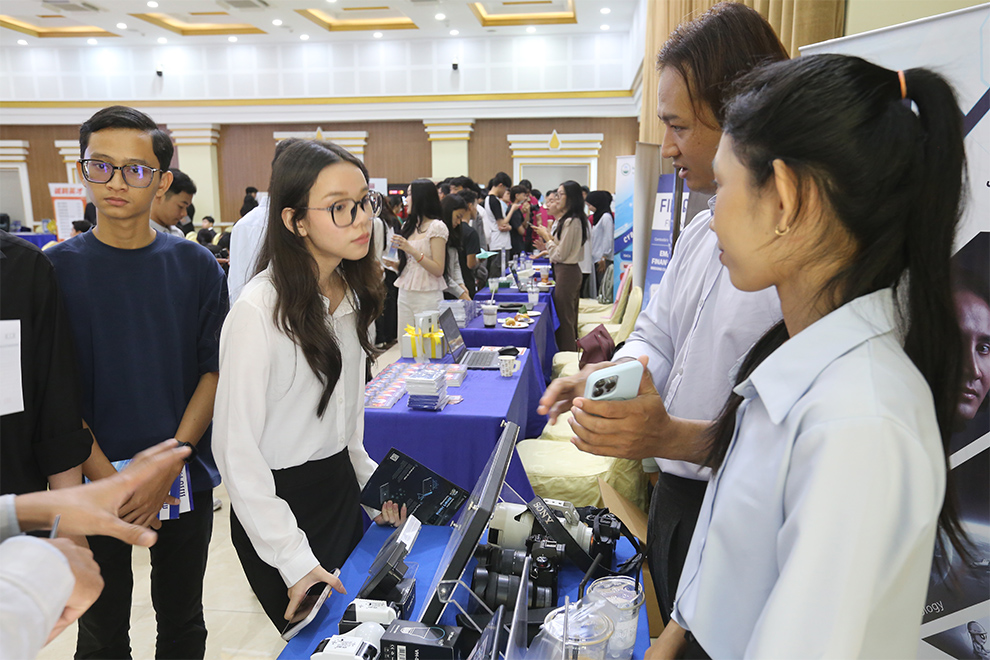
Students were urged to strengthen their technical and human-centred skills at an industry forum in Phnom Penh on November 19, where speakers warned that Cambodia’s future workforce must be prepared for an economy increasingly shaped by rapid digital transformation.
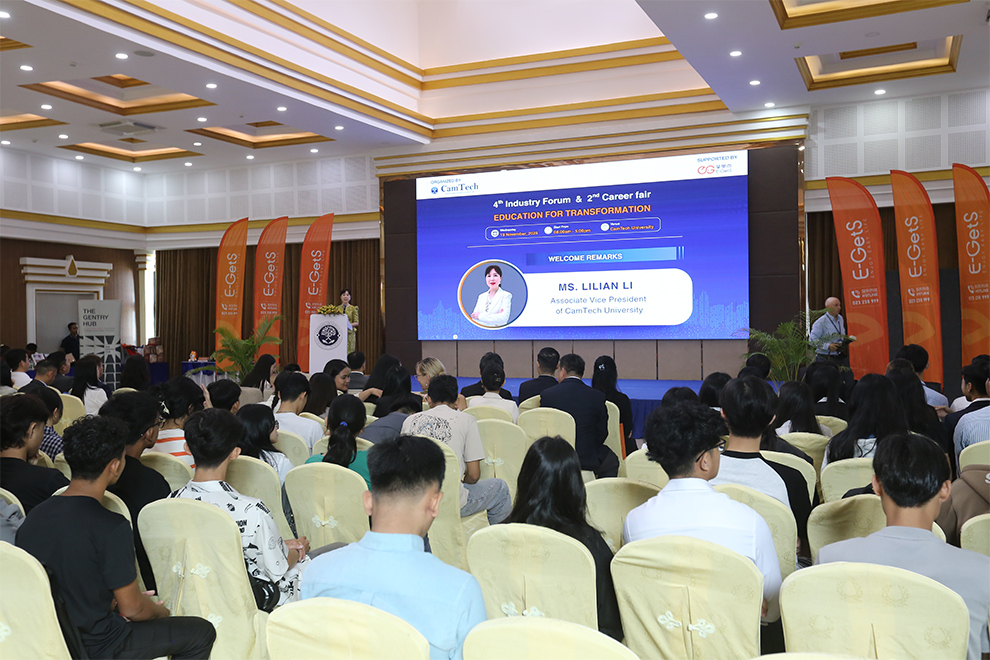
Speaking at the opening ceremony of the event, themed “Education for Transformation”, associate vice-president of CamTech University Lilian Li explained that the priority is to ensure students can translate classroom knowledge into practical impacts — an approach she said aligns with Cambodia’s Pentagonal Strategy on human capital development.
“We stand at the intersection of academia, industry and sustainable development — united by a shared mission to empower Cambodia’s youth, drive digital innovation and uphold a people-centric vision,” she said.
Li reminded students of Liang Qichao’s well-known message that a nation’s strength depends on the strength of its young people.
Li also announced four new partnerships sealed during the forum — with E-GetS, MR. Training and Jobs Center, Sunrise Institute and Codingate — to expand hands-on training opportunities.
“Your vision and support have steadied and extended the path of educational transformation,” she said.
Internships from year two
Krang Kanika, head of Student Recruitment and Public Relations at CamTech, said the university’s curriculum intentionally pushes students into the field early so they understand workplace expectations before their final year.
“Students from the second year have the opportunity to do a month-long internship at companies to learn about work patterns to prepare for the fourth year,” she said.
“By the time they reach the long internship — six months to a year — they already know how to observe, communicate and work within a company,” she added.
Banks, tech firms, software developers and architecture companies which were showcased at the forum also encouraged students to apply for internships.
Soft skills rising in importance
Companies repeatedly warned that technical skills alone are no longer enough.
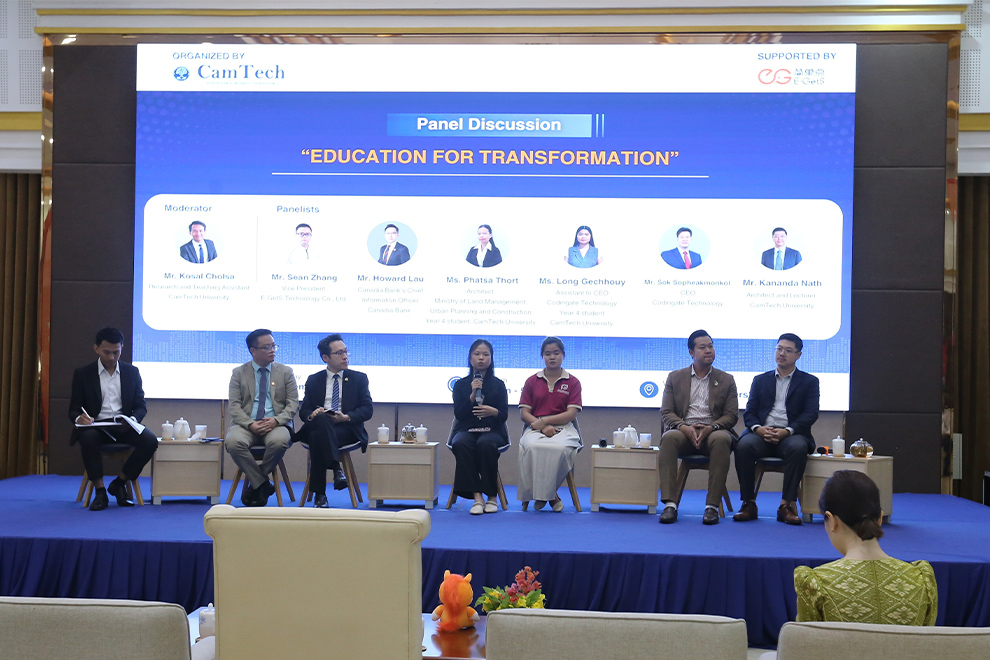
Sean Zhang, vice-president of E-GetS Technology, said even as AI tools become more powerful, human reasoning and emotional understanding remain essential.
“Even though ChatGPT is powerful, DeepSeek is convenient, logic is the big thing,” he explained.
“What is true? What is fake? How to think? AI can help us a lot, but AI cannot know humanity,” he added.
Howard Lau, chief information officer at Canadia Bank, echoed that point, saying trust and empathy shape long-term client relationships.
“Technology is transforming how we serve customers,” he said.
“But when a customer is under financial stress, empathy and ethical judgment build trust. Hard skills are engineering — soft skills are the direction that drives that engine,” he added.
Architecture sector: time, client negotiations
Architect lecturer Kananda Nath said real-world training teaches students to manage deadlines, budgets and shifting client needs — skills impossible to grasp through theory alone.
“In the real world, clients may change their demands at the last minute and students must adjust,” he said.
“Time management and understanding the client are just as important as design skills,” he continued.
Phatsa Thort, an architect from the Ministry of Land Management, said both hard and soft skills are essential for the sector, pointing to her work on projects in Phnom Penh and inside Angkor Park.
“You need to know 3D rendering and site analysis, but diplomacy and negotiation matter because you must communicate clearly to make people understand what you want,” she said.
Cambodia’s own AI tools encouraged
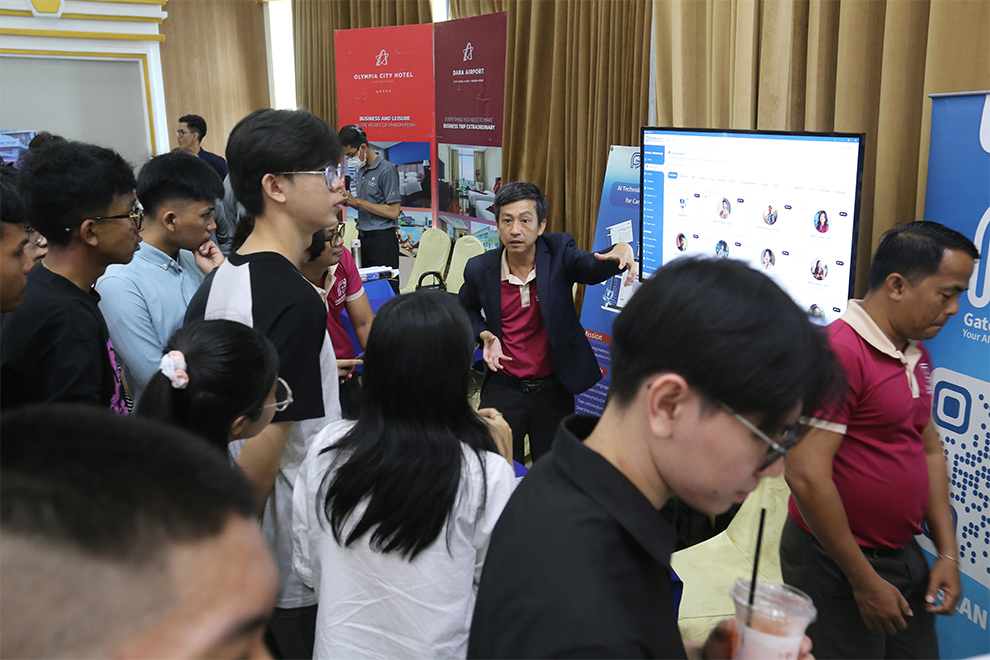
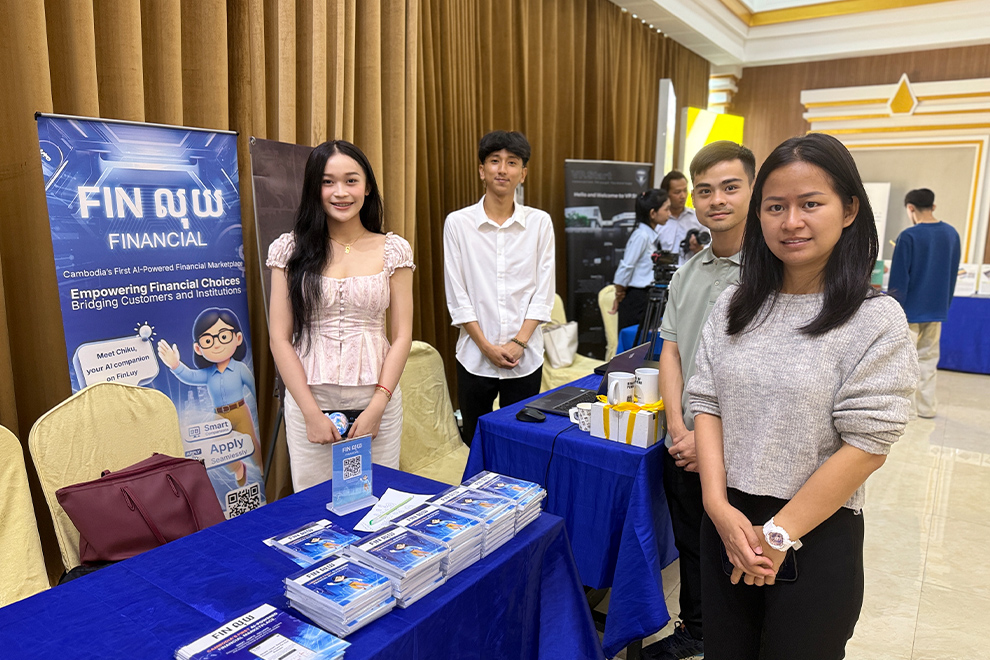
GateKhmer.ai — an AI language platform under Codingate — joined the event to show students how local technology tools are becoming more competitive.
“We want students to know that Cambodia has an AI platform that supports both Khmer and English,” said trainer Chan Pichey.
“It is an opportunity for technology students to intern with us and learn how AI can be developed in our own language,” he added.
Students feel the impact
Fourth-year student Long Gechhouy, now assisting the CEO of Codingate, said her internships had helped her to turn academic concepts into real solutions.
“What surprised me was not a specific skill, but the ability to apply the knowledge to solve a real problem,” she said.
Handling her first major project, she learned to translate client needs into programming language.
“Having hard skills is not enough — you must understand people and business, and know how your work impacts the company,” she explained.
Linking education to transformation
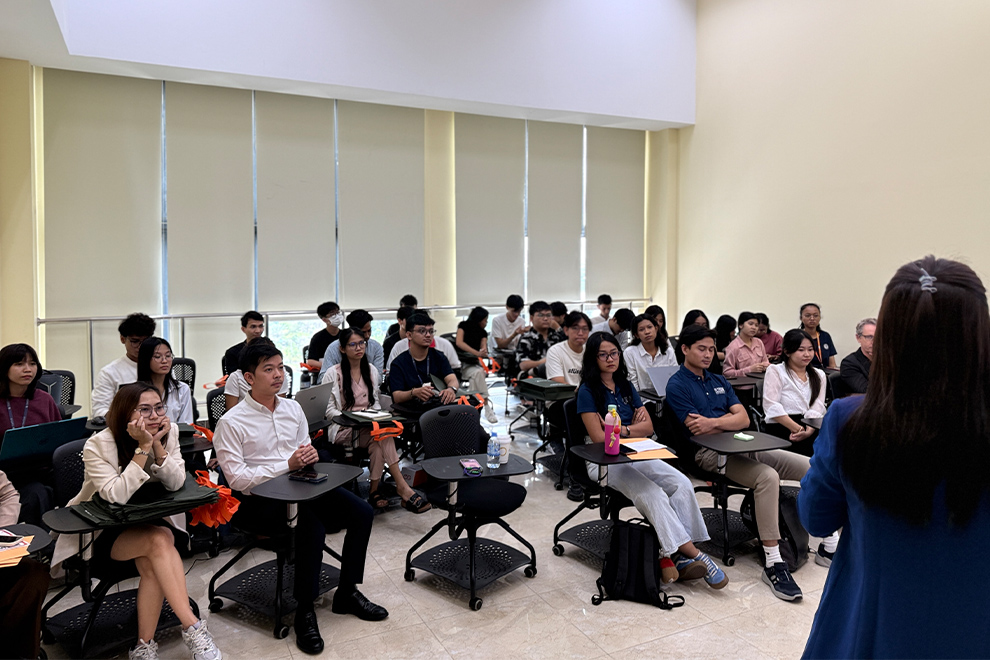
Across speeches, one message dominated: Cambodia’s workforce of the future will need logic, adaptability, communication, ethical decision-making and the confidence to handle real challenges — not just theory.
As the forum opened its exhibitions, hackathons and workshops, Li urged students and companies to use the event to forge deeper collaboration.
“Let this forum spark ideas, partnerships, and transformations that uplift our youth and our nation,” she said. “Let the transformation begin.”
