



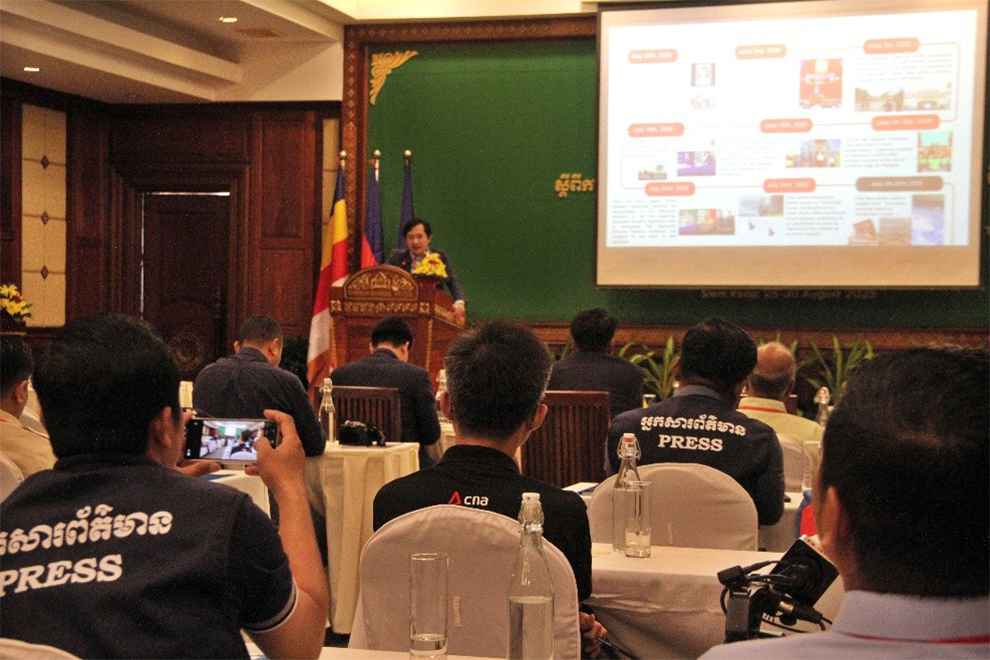
Thirty journalists from across Asia convened in Siem Reap on August 28 for a regional workshop which focused on safety and risk management in conflict reporting.
The initiative aimed at strengthening ethical standards and ensuring the security of media practitioners covering sensitive and high-risk situations.
Hosted by the Empress Angkor Resort and Spa, the workshop brought together media professionals to exchange experiences and discuss practical approaches to reporting in conflict zones, particularly along the contested border areas.
The program featured presentations from Cambodian officials, including Has Sam Ath, undersecretary of state at the Ministry of Information, who provided an overview of the itinerary and objectives.
Information ministry spokesperson Tep Asnarith delivered a briefing on the Cambodia–Thai border dispute, underlining the importance of accurate, balanced reporting on cross-border issues.
“Journalists have a vital role in ensuring that reports on sensitive border issues are accurate, balanced and responsible, because any misrepresentation can escalate tensions rather than promote understanding,” he noted.
Journalists from Indonesia, Malaysia, Singapore, Vietnam, China and Cambodia also engaged in a practical exchange session, sharing first-hand experiences from their respective countries on covering crises, border disputes and humanitarian challenges.
Following the workshop, journalists are scheduled to conduct field visits to conflict-affected areas in Preah Vihear, Oddar Meanchey and Banteay Meanchey provinces.
This will include visits to sites impacted by cluster munitions and airstrikes, displaced communities, and local health and education facilities, providing participants with ground-level perspectives to inform their reporting.
The four-day programme also includes cultural excursions to Angkor’s historic temples, aiming to foster cross-cultural exchange and solidarity among regional journalists.
The Ministry of Foreign Affairs and International Cooperation also provided the assembled journalists with an official timeline of the tensions, the resulting conflict and the ensuing ceasefire.
According to the ministry:
Tensions escalated from May 28, when Thai troops crossed into Cambodian territory in Preah Vihear province, killing a Cambodian soldier. Cambodia lodged a protest the following day, but received no response.
On June 2, Prime Minister Hun Manet announced Cambodia’s plan to bring longstanding border disputes, including the Mum Bei area and the Ta Mone Thom, Ta Mone Touch and Ta Krabey Temples, to the International Court of Justice (ICJ).
Amid rising tensions, Thailand unilateral closed border checkpoints on June 7, and the Joint Boundary Commission reconvened on June 14–15 after a 12-year hiatus.
Cambodia reaffirmed the 2000 MoU and pressed for ICJ adjudication, while on June 15 and 16, official letters were sent to the ICJ and foreign ministers worldwide.
On July 23, diplomatic ties were downgraded. The next day, Thai forces launched an assault, prompting Cambodia to defend itself.
Despite calls for restraint from Malaysia, the US and ASEAN, fighting continued until a ceasefire was reached in Putrajaya, Malaysia, on July 28.
The truce was fragile. On July 29, Thai forces captured 20 Cambodian soldiers, with only two released by August 1.
Cambodia repeatedly denied Thai accusations of ceasefire violations, and called for an ASEAN observer team to monitor the situation. Diplomatic efforts continued throughout August, with Cambodia engaging the UN, ASEAN, China and the US, while protesting further Thai encroachments.
As of late August 2025, Cambodia has maintained its push for international monitoring, humanitarian mine action, and respect for sovereignty, while stressing that the ceasefire remains fragile in light of Thai provocations, concluded the ministry.
