



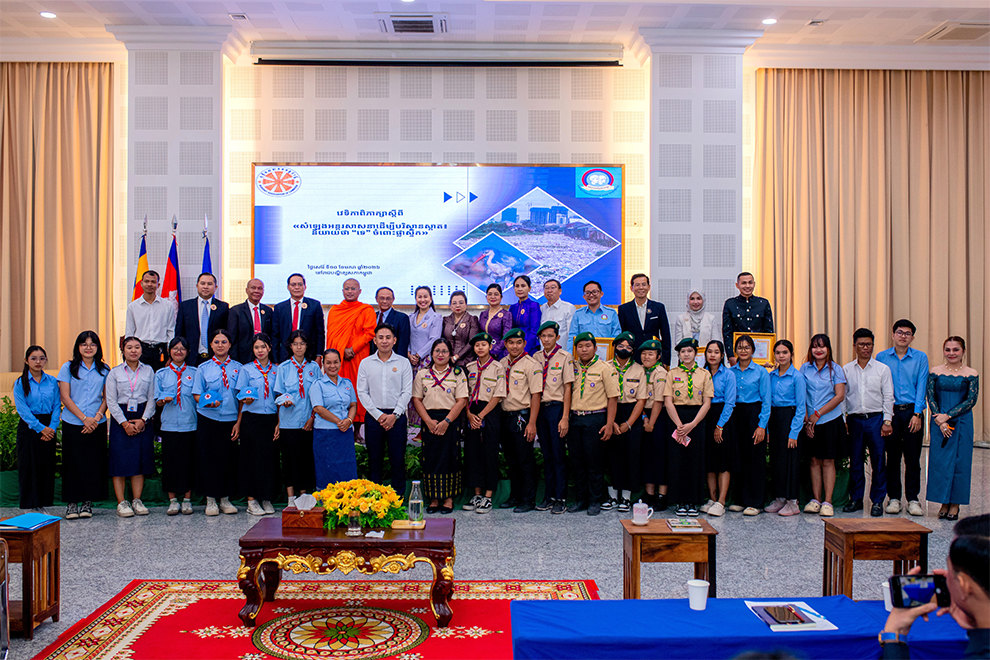
Leaders from Cambodia’s three major religious communities have called on the public to sharply reduce plastic use, warning that environmental degradation driven by plastic waste is not only damaging nature but reflects a deeper moral and social failure.
The message was delivered during an January 10 interfaith forum at the Royal Academy of Cambodia, where representatives of Buddhism, Christianity and Islam spoke to more than 200 participants about the role of faith in protecting the environment.
The event, titled “Interfaith Voices for a Clean Environment: Say ‘No’ to Plastic,” was organised by the Youth Committee of the Cambodian Buddhist Association in collaboration with the Union of Cambodian Youth Federations and was live streamed on social media.
Speakers stressed that religious teachings across faiths share common values of responsibility, moderation and care for future generations, principles they said must now be applied to daily behaviour, particularly in reducing reliance on single-use plastics.
Venerable Preah Seri Kousol Som Sokha, president of the Cambodian Buddhist Association, noted that environmental protection is inseparable from the practice of Dharma.
Polluting nature, he explained, creates suffering for both humans and animals, contradicting the core moral teachings shared by all religions.
“All religions teach morality, responsibility and sustainable living,” he said, adding that harming the environment ultimately harms society itself.
The forum highlighted the scale of the plastic problem both globally and locally. Keo Piseth, also known as Sam, a member of the association’s youth committee, cited research showing that several Asian countries rank among the world’s largest contributors to ocean plastic pollution, including the Philippines, India, Malaysia, China and Indonesia.
He said the UN estimates global plastic production at around 430 million tonnes annually, a figure that continues to rise. In Cambodia, the problem is already visible, particularly in urban areas.
“Phnom Penh alone uses about 10 million plastic bags every day, according to the Ministry of Environment,” Keo Piseth said. “If we do not change our behaviour now, the problem will only get worse.”
Experts have warned that without effective prevention measures, plastic waste in the oceans could triple in the coming years, posing serious threats to human health, marine ecosystems and wildlife.
Ith Praang, vice-president and secretary-general of the Cambodian Buddhist Association, said environmental challenges should not be seen purely as technical or policy issues.
“Plastic waste is a moral, cultural and collective responsibility,” he said. “All religions teach people to care for nature, to use resources wisely and to think about the impact on others and future generations.”
He expressed hopes that the forum’s message would extend beyond the conference hall, spreading through monasteries, schools, religious institutions and youth networks nationwide.
Practical steps, he said, could include reducing daily plastic consumption, choosing environmentally friendly alternatives and actively participating in conservation efforts.
Organisers said the interfaith approach was intended to show that environmental protection is a shared responsibility that transcends religious boundaries, reinforcing the idea that nature is a common heritage of humanity.
By encouraging monks, young people and community members to lead by example, Praang said environmental protection could become part of Cambodia’s living culture rather than a one-off campaign.
“The change must start with small actions,” he said, “but it must start now.”
