



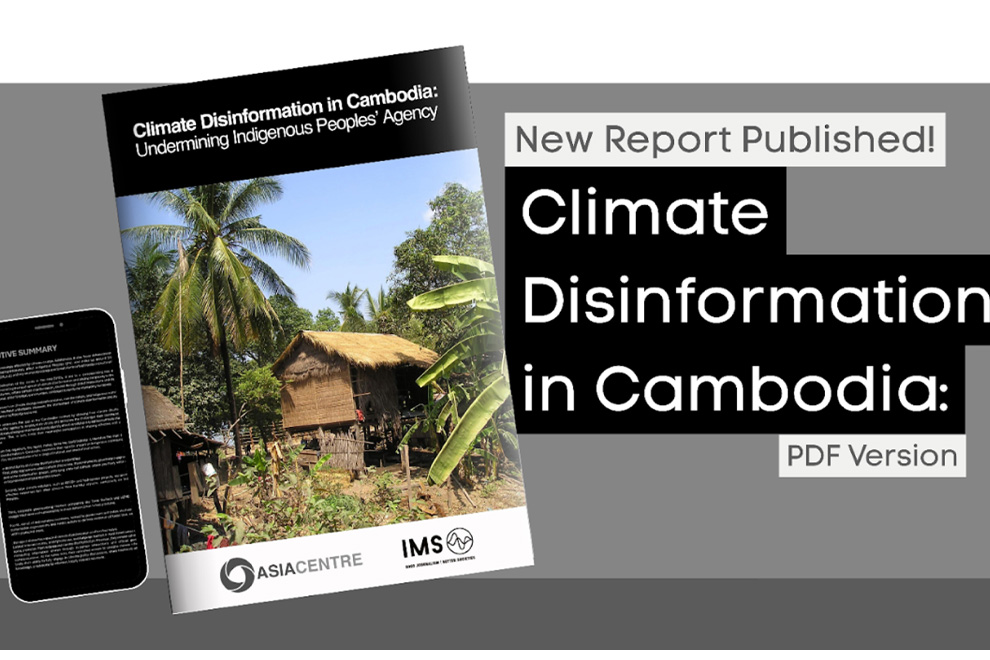
A new report, released earlier this month, has raised alarm over the spread of climate disinformation in Cambodia, warning that it is undermining indigenous peoples’ rights and voices in the fight against climate change and deforestation.
Launched by Asia Centre in partnership with International Media Support (IMS), the study, Climate Disinformation in Cambodia: Undermining Indigenous Peoples’ Agency, found that false and distorted climate narratives are increasingly shaping public perception, obscuring environmental harm and silencing communities most affected by forest loss.
“Climate disinformation must not be normalised in Cambodian society,” said Dr. James Gomez, regional director of Asia Centre, during a national meeting held on August 8, ahead of International Day of the World’s Indigenous Peoples.
“If left unchecked, it will continue to strip Indigenous communities of their agency to act against climate change,” he added.
The 120-page report suggested four possible forms of climate disinformation in Cambodia: one-sided state-aligned discourses portraying government climate policies in a positive light; promotion of climate solutions such as REDD+ and hydropower projects; corporate greenwashing by companies linked to deforestation; and denial of deforestation narratives spread by authorities and aligned media.
Researchers stressed that these narratives could have severe impacts on Indigenous Peoples (IPs), who make up about 3 per cent of Cambodia’s population.
The report details how climate disinformation excludes IPs from climate discussions, legitimises forced displacement from ancestral lands, intimidates communities into silence and enables the criminalisation of environmental defenders.
During the event, Asia Centre researcher Wen-Ling (Amy) Lai said the findings show how Cambodia’s rapid digital transformation has accelerated disinformation.
“Climate disinformation reflects broader dynamics in which official messaging obscures the environmental and social consequences of development projects, suppresses critical debate and sidelines Indigenous voices,” she told participants.
Journalists and civil society leaders at the meeting confirmed the report’s observations.
Seoung Nimol, a journalist, said disinformation is often used “as a tactic deployed against journalists to deter them from reporting on Indigenous issues”.
Yatt Malai, another journalist added that during her field reporting, “company owners and local-level authorities prevented access to the other side of the story”, effectively silencing community perspectives.
The study urged action from a wide range of stakeholders, including the Cambodian government, UN bodies, INGOs, civil society, the media and technology companies.
Among its recommendations were expanding fact-checking, improving Indigenous access to climate information in their own languages, strengthening community-led environmental advocacy and holding corporations accountable for misleading claims.
Kuy Suyheang, executive director of Women Peace Makers, warned that climate disinformation harms not only Indigenous groups but also the wider Cambodian public.
“It takes away the agency of all Cambodians to act on this issue,” she said.
Asia Centre concluded that combating climate disinformation is essential for protecting Indigenous rights and ensuring evidence-based climate governance.
“This is not just about forests and carbon,” Gomez said. “It is about justice, diversity and the full recognition of Indigenous self-determination.”
A Ministry of Environment spokesperson was unavailable for comment.
