



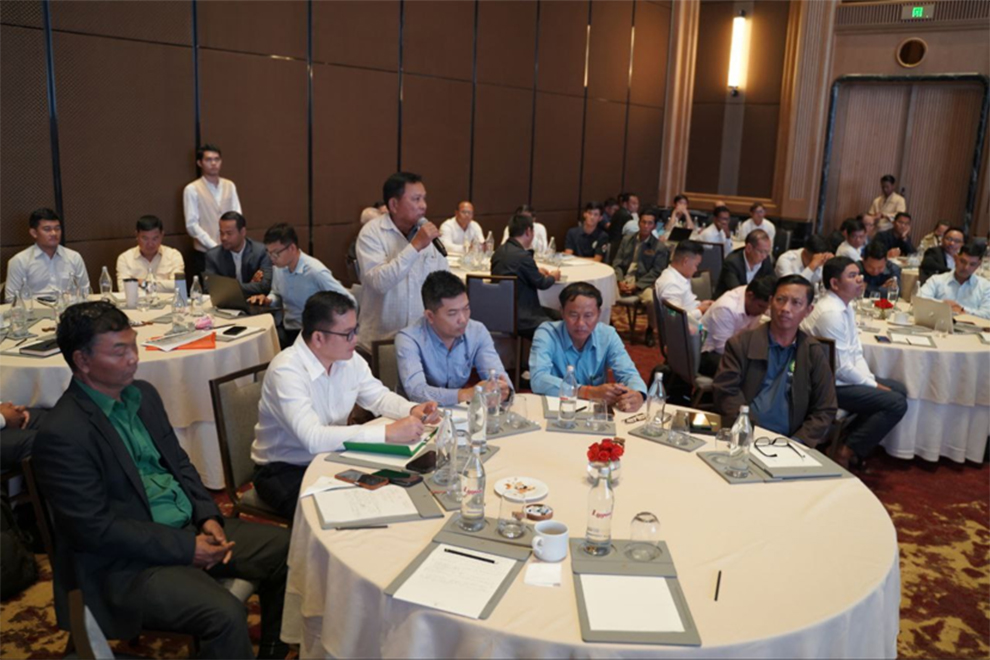
The Ministry of Commerce demonstrated its support for stronger partnerships between public institutions, the private sector and producers by organising a workshop on fragrant rice value chain development, held under the Accelerating Inclusive Markets for Smallholders (AIMS) project.
The November 24 workshop aimed to provide an opportunity for stakeholders to meet, discuss, share experiences and strengthen production and market access, with the participation of officials from relevant institutions and organisations, according to a press release.
Tekreth Kamrang, ministry secretary of state, explained that the forum played a major role in strengthening and developing the rice and spice value chain markets. She noted that this will lead to setting common goals for the future to improve the development value chains.
She added that health standards, food safety and ensuring sustainability in production and markets are necessary, but demand the close attention of all stakeholders. They must work together to find appropriate solutions, especially in the face of climate change.
“Participation from all partners, backed by systematic support from the Royal Government, investment from the private sector and the commitment of producer groups, is essential to create new market opportunities and develop the efficient, effective value chains, as well as to ensure consumers receive safe products,” she said.
Long Kemvichet, director-general of International Trade and AIMS’s deputy project director, encouraged stakeholders to share responsibilities, resources, knowledge, benefits and risks, and to participate in solving problems through coordination to develop an inclusive market.
“This forum is an opportunity to open cooperation between stakeholders in the agricultural value chain and can increase investment and business initiatives in high-quality or premium product chains. Furthermore, we are able to define strategic activities for the next steps as well,” he said.
The programme also saw participation from farmers from various provinces, as well as several private companies.
Chheng Chandy, president of the Ponleu Prey Touch Agricultural Community in Battambang province, noted that the forum was important in helping him meet partners to trade the premium rice products of the farmer producer clusters.
Phoan Yeang, president of the Samaki Meanchey Community in Tboung Khmum province, said he attended the forum because he wanted to meet with technical officials and rice milling enterprises to negotiate the sale of farmers’ rice.
“I have met trading partners, but will continue to negotiate on price and rice varieties to align with the needs of their rice mills,” he said.
Ton Ponnaray, supply chain manager of Signature Rice Co., Ltd., stated that his company orders rice from farmers in Battambang, Banteay Meanchey, Siem Reap, Oddar Meanchey and Preah Vihear provinces, purchasing both wet-season and dry-season paddy.
“Regarding the quantity of paddy our company collects, it is between 20,000 to 30,000 tonnes per year. Our company plans to start consider purchasing more premium paddy to supply the current market,” he clarified.
AIMS is a joint project between the government and the International Fund for Agricultural Development (IFAD). The project is implemented by the commerce ministry, under the guidance of a Project Steering Committee led by the Ministry of Economy and Finance, according to the press release.
The objective of the project is to promote inclusive growth in high-value markets and local cluster development where poor smallholder farmer producer groups can receive mutual benefits.
At provincial level, the project is implemented by the Provincial Departments of Commerce in 18 target provinces, including Battambang, Kampong Thom, Preah Vihear, Kratie, Stung Treng, Siem Reap, Banteay Meanchey, Pailin, Kep, Kandal, Takeo, Kampot, Kampong Speu, Prey Veng, Tboung Khmum, Ratanakiri and Mondulkiri.
