Sweden has long styled itself as a global defender of human rights, peace and international law. But this week, that carefully curated image collapsed under the weight of its own contradictions.
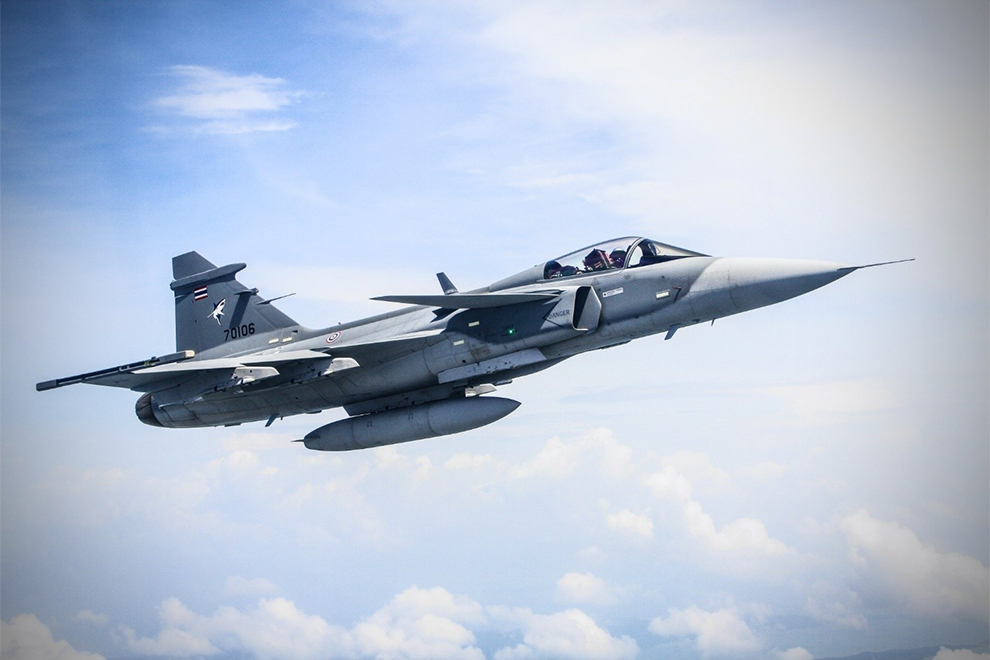
On Monday, Sweden confirmed the sale of four additional Gripen fighter jets — manufactured by its defence giant Saab to Thailand. At face value, it may appear like just another defence contract. But to Cambodians, this sale is a slap in the face. It is a deeply offensive reminder that Sweden’s proclaimed concern for human rights conveniently vanishes when economic or geopolitical interests are involved.
Let us be clear: These are not just theoretical weapons of war. From July 24 to 28, during a five-day military confrontation between Cambodia and Thailand, Gripen fighter jets were deployed in combat for the first time, and they were used against Cambodia. Not only did these jets cross into Cambodian territory, but they reportedly struck civilian infrastructure and even a UNESCO World Heritage site, a blatant violation of international norms.
Sweden cannot claim ignorance. The use of its weapons in direct combat against civilians and cultural sites is on record. Yet, barely days after this aggression, Sweden finalised a deal to supply more jets to Thailand. Is this what a “human rights–conscious” country looks like?
Even more troubling are the questions that no one seems to be asking out loud.
Is Thailand currently ruled by a civilian democratic government, or by the military under the King’s command? Is Sweden comfortable selling advanced weaponry to a country where democratic accountability is, at best, questionable?
And what about Sweden’s justification for closing its embassy in Cambodia in 2021, citing concerns over human rights? If human rights were the standard, then why has Sweden maintained an embassy in North Korea since 1975 — a country consistently ranked among the worst human rights violators on Earth? Does Sweden truly believe North Korea respects human rights more than Cambodia does?
If not, then the inconsistency reeks of geopolitical convenience, not principle.
This double standard has not gone unnoticed. The Cambodian public is outraged, and rightly so. Saab’s continued business with Thailand, especially after its jets were used to bomb Cambodian civilians and historical sites, is more than irresponsible — it is morally bankrupt.
Sweden can no longer hide behind its reputation as a peaceful, human rights-loving nation while it supplies weapons to those who use them to terrorise their neighbours. If it truly cares about human rights, it must explain why it rewards regimes that use its arms for aggression, while punishing smaller nations like Cambodia with diplomatic isolation.
Until then, Sweden’s human rights rhetoric rings hollow — exposed as selective, conditional and deeply compromised. You cannot claim moral high ground while fuelling regional conflict. You cannot preach justice while profiting from violence. And you cannot talk about human dignity while turning your back on innocent civilians who were bombed by jets bearing your flag.
If Sweden continues to arm a government that attacks its neighbours and suppresses dissent, then it is no longer just a bystander — it becomes an enabler of aggression. And no amount of diplomatic spin can hide that reality from the Cambodian people, or from the world.
Cambodia deserves better. Humanity deserves better. And Sweden must decide what it truly stands for: a world order based on justice and human rights, or one where values are sacrificed for weapons contracts and political convenience.
Until Sweden chooses the former, its words will remain empty, and its legacy forever stained by the blood spilled from its silence.
Neang Sopheap is a Phnom Penh-based independent journalist. The views and opinions expressed are his own.