The head of a prominent Cambodian think tank has acknowledged how humans are destroying the environment through waste disposal and deforestation, while highlighting that the world’s major powers—who are the greatest destroyers of the global environment — have also created and tested nuclear weapons.
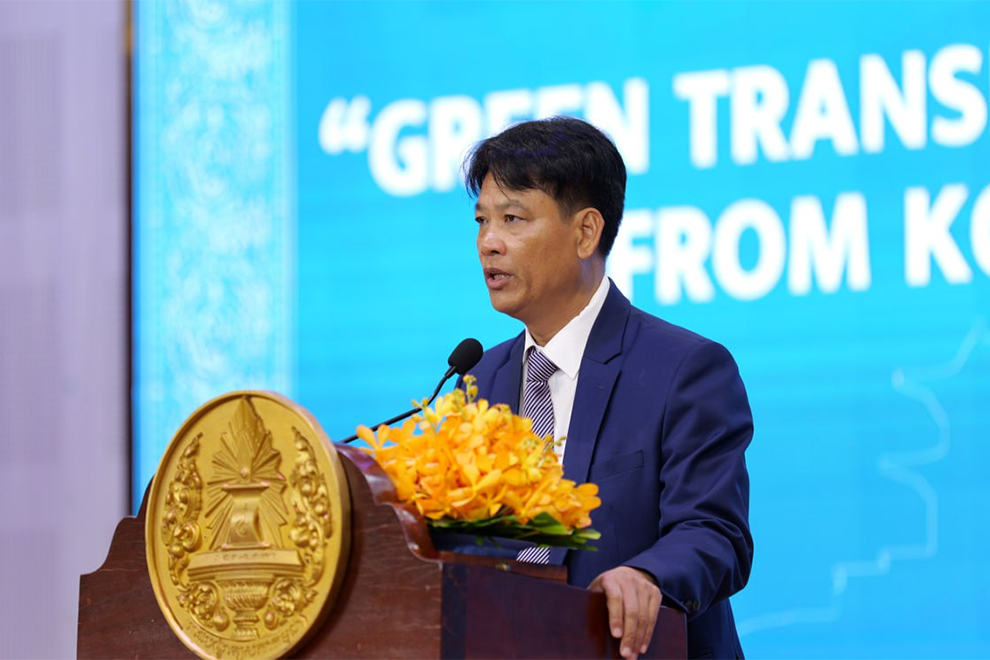
Sok Touch, president of the Royal Academy of Cambodia (RAC), raised these points as he addressed the 12th International Conference on “Green Transition in Cambodia, Laos and Vietnam: Lessons Learned from the Experiences and Perspectives of Korea”, held in Phnom Penh on September 30.
Speaking to nearly 300 participants, Touch stated that although the world has advanced into the era of Artificial Intelligence (AI), AI cannot protect the global environment without active human involvement.
He explained that humans are destroying the environment in five main ways. They include disposing of waste into the environment, contributing collectively to deforestation — meaning each person should plant at least one tree in their lifetime, major powers destroying the environment through the creation and testing of nuclear weapons, wars that damage the environment and extracting excessive natural resources.
“To address climate change and protect the environment, there must be strong will and commitment from world leaders — especially the leaders of major powers, who are the greatest destroyers of the global environment — and they must take responsibility for the future of humanity,” he said.
Minister of Environment Eang Sophalleth also addressed the event. He noted that environmental issues are not limited to Cambodia alone — they are global challenges. All countries are facing common problems like climate change, as well as increased floods, droughts and natural disasters.
The minister pointed out six causes identified by the UN as key contributors to climate change: Industry, energy, agriculture, forestry, chemicals and waste.
“These six factors have pushed the world into a period of facing climate change and ongoing global warming,” he warned.
Sophalleth also asked the international participants to reflect on a critical question.
“Should we solve environmental issues one sector at a time to address the larger problem? The answer is no. We must instead identify the true root causes of the problem and create action plans that address challenges effectively, reducing current impacts,” he said.
The Royal Academy of Cambodia, which organised the conference, announced on October 1 that the event focused on three key discussion topics. They are “Innovative Policies for Green Transition: Adapting Korea’s Environmental Strategies in Cambodia, Laos and Vietnam”; “Promoting Sustainable Development through the Circular Economy and Green Growth Initiatives” and “Enhancing Regional Cooperation for Green Development: Lessons from Korea and Future Directions for Cambodia, Laos and Vietnam”.
The conference was attended by researchers, government officials, and experts from the RAC, the Korea Environment Institute, the Laos Academy of Social and Economic Sciences and the Vietnamese Academy of Social Sciences.