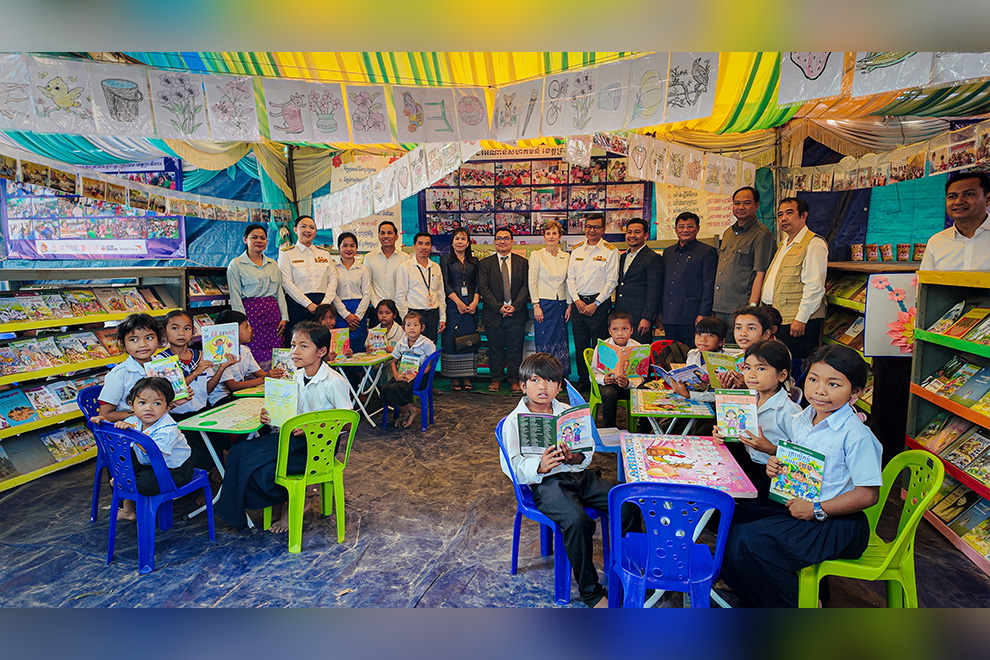
Five newly constructed school buildings in some of Cambodia’s most remote and conflict-affected areas were officially inaugurated on March 26, marking a major step in restoring access to education for hundreds of children whose learning was disrupted by the recent border clashes.
The new facilities, comprising 21 classrooms across five primary schools in Kulen, Choam Ksant and Rovieng districts, are expected to serve more than 500 children from five villages, including families affected by displacement and instability.
The project, implemented through a partnership between World Vision International in Cambodia, Action Education International and the Ministry of Education, Youth and Sport, aims to rebuild learning opportunities in underserved communities while strengthening long-term education resilience.
Speaking at the inauguration ceremony, Minister of Education, Youth and Sports Hang Chuon Naron said the new schools respond directly to the urgent needs of local communities while aligning with the government’s broader education reform agenda.
“This achievement reflects the real needs of the community and demonstrates a shared commitment to implementing the four key measures set out by Prime Minister Hun Manet, particularly strengthening the quality of public schools from preschool to secondary education,” he said.
He highlighted in particular the fourth key measure, which promotes greater engagement from parents, guardians and communities in education under the principle of “state-community partnership for education”.
The minister added that the education ministry is currently accelerating the rollout of early grade reading and mathematics programmes at the primary level, alongside teacher training initiatives targeting Grades 1 to 3.
“These programmes are essential to improving teacher qualifications and strengthening the effectiveness of teaching and learning, ensuring that Cambodian children can read, write and perform basic mathematics,” he said.
Naron also issued four recommendations to improve primary education quality, including strengthening networks of capable teachers and school principals at sub-national levels, promoting broader stakeholder participation, enhancing incentive systems for educators and prioritising development in border schools through stronger institutional partnerships.
World Vision Cambodia national director Janes Immanuel Ginting described the schools as a critical intervention for vulnerable children.
“These school buildings, located in remote and hard-to-reach areas, are a lifeline for children,” he said.
“Together with our partners, we are ensuring that every child has a safe place to learn, recover and build a better future. This is not only an investment in infrastructure, but in hope, resilience and life transformation,” he added.
Preah Vihear provincial governor Kim Rithy underscored the importance of education in post-conflict recovery, particularly for children in remote communities.
“For children and families in these remote and conflict-affected areas, access to education is essential for recovery and long-term development,” he said.
“We deeply appreciate the strong collaboration between the education ministry and our development partners in making these new schools a reality for our communities,” he said.
The newly built schools are designed to provide safe, child-friendly learning environments, equipped with solar power systems and sanitation facilities to improve both access and quality of education.
Officials say such improvements are expected to increase school attendance, reduce dropout rates and enhance overall learning outcomes.
The initiative forms part of the Cambodia Consortium for Out of School Children, which seeks to expand access to education, strengthen teaching capacity and encourage community involvement across various provinces.
Vorn Samphors, country director of Action Education International in Cambodia, said the partnership demonstrates how coordinated efforts can respond effectively to education disruptions in difficult contexts.
“By building schools in remote areas, we are helping ensure continuity of learning, protect education, and promote inclusive education for all,” he said.
Aligned with pase one of the seventh-mandate government’s Pentagonal Strategy and the Education Strategic Plan, the project reflects a broader push to build an inclusive and resilient education system.
For communities in Preah Vihear’s hard-to-reach areas, Thursday’s inauguration represents more than the opening of new classrooms.
It signals a return to stability and opportunity for children whose education has been interrupted — offering a renewed foundation for lifelong learning.
More than 500 children a year from five villages, including children affected by displacement and instability, will study at new school buildings in Preah Vihear province. Supplied