



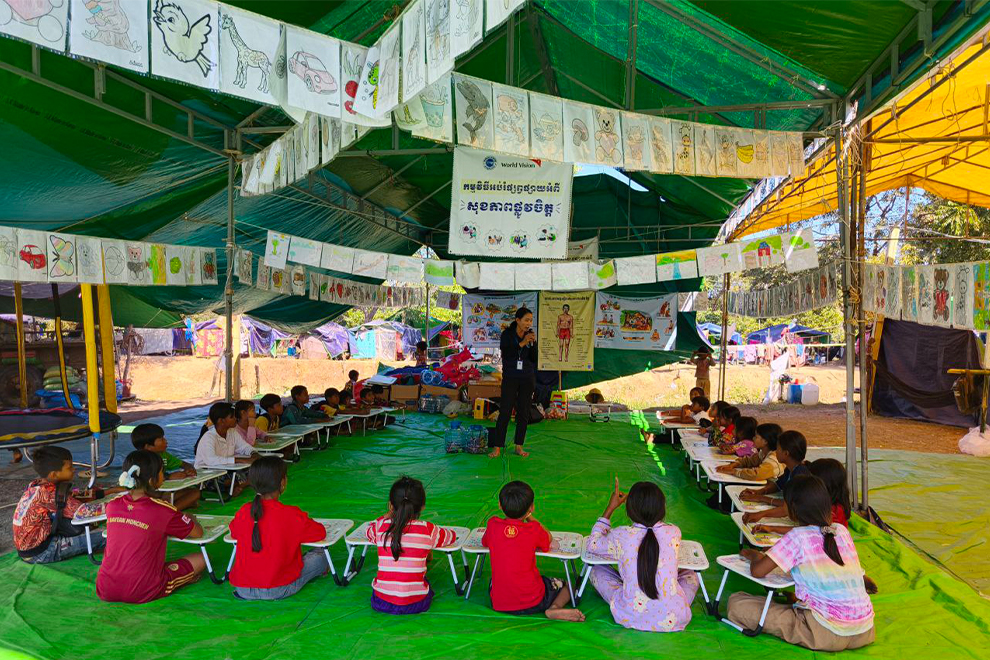
Thousands of internally displaced people (IDPs) affected by the Cambodia–Thailand border conflict have received psychosocial care and financial assistance through a joint humanitarian response led by the Swiss Agency for Development and Cooperation (SDC) in partnership with World Vision International in Cambodia.
More than 14,470 displaced persons in Preah Vihear and Oddar Meanchey provinces were provided with psychosocial support services, with the programme prioritising vulnerable groups, including over 2,200 women and 11,400 children who have faced trauma linked to violence, displacement and prolonged uncertainty.
In addition, 1,300 IDPs received multi-purpose cash assistance, allowing families to address urgent needs such as food, medicine and basic shelter materials based on their own priorities.
“The Government and people of Switzerland stand in solidarity with the thousands of vulnerable women, men and children who have been displaced from their homes,” said Reto Grueninger, director of the Swiss Cooperation Office and Consular Agency in Cambodia.
“Through our partnership with World Vision, we are able to deliver timely, people-centred assistance that addresses urgent needs and supports psychosocial wellbeing,” he added.
He explained that the approach ensures women and children receive protection, care and support as they navigate the ongoing crisis.
Janes Imanuel Ginting, national director of World Vision International in Cambodia, described psychosocial care and cash assistance as “life-saving interventions”, noting that the support is critical to helping families begin rebuilding their lives after the severe humanitarian consequences of the border tensions.
The response has been implemented across multiple safety centres in Preah Vihear, Siem Reap and Oddar Meanchey provinces, with a strong focus on safeguarding children, women, persons with disabilities and the elderly.
Psychosocial services were delivered in collaboration with specialised partners, including the Transcultural Psychosocial Organization (TPO), alongside local authorities to ensure culturally appropriate and trauma-informed care.
Authorities said the selection of households for cash assistance was carried out in close coordination with local administrations to maintain transparency and fairness.
“Our priority was to ensure assistance reached those who needed it most — families with children, elderly members and persons with disabilities,” said Yim Panh Nha, deputy governor of Preah Vihear province.
“Through careful assessment and strong coordination with partners, we were able to support displaced families in a timely manner while respecting their dignity,” he continued.
With displacement figures continuing to fluctuate and place added strain on local services and host communities, World Vision and its partners reaffirmed their commitment to delivering timely humanitarian support aimed at strengthening resilience, recovery and hope for families impacted by the conflict.
