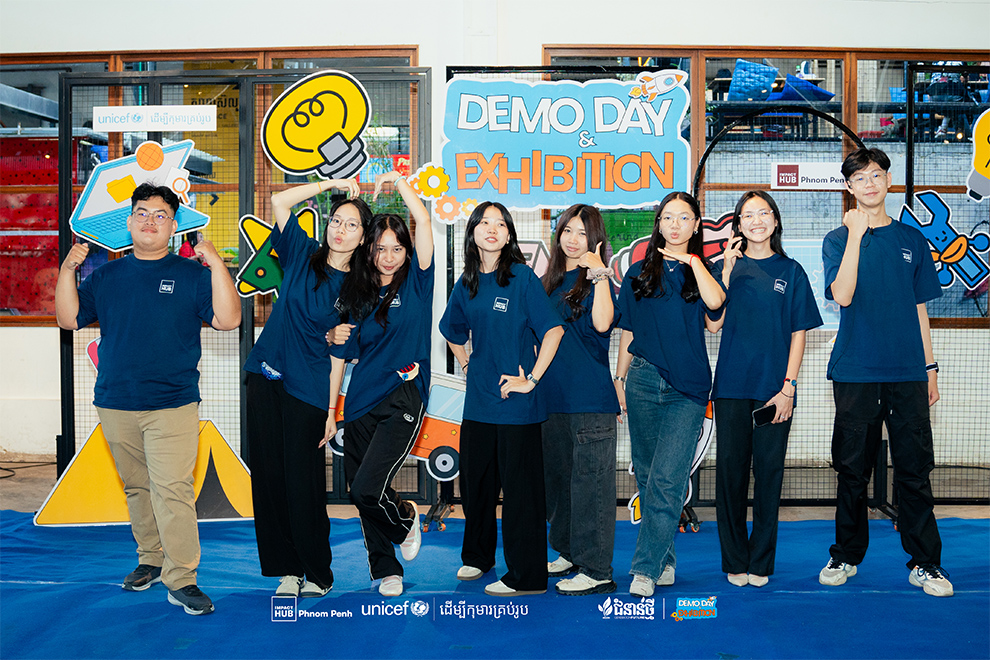
Three youth-led teams were awarded seed funding on Friday as UNICEF Cambodia and Impact Hub Phnom Penh showcased more than 100 young innovators at the Generation Future 2025 Demo Day and Exhibition, marking a renewed push to elevate youth-led social solutions nationwide.
The November 29 event brought together the latest cohort of young changemakers from Phnom Penh and Siem Reap who have spent the past six months developing solutions to pressing social challenges — from STEM access for girls to maternal mental health and tools that support emotional well-being.
Fifteen teams pitched their projects following months of training and fieldwork, with Empower Girls, Super Mom and Hyper Healer selected as the three standout initiatives to receive $1,000 each to further refine and scale their prototypes.
Empower Girls aims to cultivate interest in science and technology among young girls through a STEM guidebook and a hands-on “tech box” designed to build practical skills.
Super Mom focuses on maternal mental health by offering a “nine-month, ten-day” calendar that helps mothers track their emotions and learn key nutritional practices during pregnancy.
Hyper Healer seeks to reduce daily mental load through uplifting flashcards used to motivate, spark conversation and support peer-to-peer reflection.
“I feel so inspired by the remarkable ideas, determination and actions of this Generation Future cohort, who show us how when young people are empowered to lead and innovate, they can drive a more inclusive, resilient and sustainable Cambodia,” said Will Parks, UNICEF Cambodia representative.
“Their courage and creativity are shaping a brighter future for themselves, their communities and their country,” he said.
The programme’s return this year, following a two-year hiatus, underscored UNICEF’s renewed commitment to expanding opportunities for young people who often face limited access to skills development and civic participation.
For the 2025 cohort, UNICEF partnered with Impact Hub Phnom Penh, a youth-focused innovation institution.
Thon Rithysochen, innovation and education programme manager at Impact Hub Phnom Penh, said the transformation of participants throughout the programme was a powerful reminder of the importance of giving young people room to experiment and lead.
“Walking alongside our project teams has shown me how powerful youth can be when they are given the space to innovate,” he said.
“What started as an opportunity to explore and unlock their potential became a catalyst that brought their ideas to life in meaningful and tangible ways.”
Generation Future 2025 began with two intensive social hackathons in Phnom Penh and Siem Reap that attracted more than 150 young participants. From these, 105 were selected and formed into 15 seven-member teams.
Over six months, the teams received entrepreneurship training, mentoring from industry professionals, masterclasses, field visits and start-up funding to test their prototypes.
This year’s project themes ranged widely, covering menstrual hygiene, climate action, digital education, mental health, domestic violence prevention, youth civic engagement, and other priority issues affecting children and young people.
By focusing on underserved youth and embedding practical, hands-on learning, UNICEF hopes the programme will become a turning point — enabling young Cambodians not only to imagine solutions but to build them, lead them and scale them.
The winning teams will continue refining their solutions over the coming months, with the aim of further strengthening their projects and expanding their impact within local communities.