



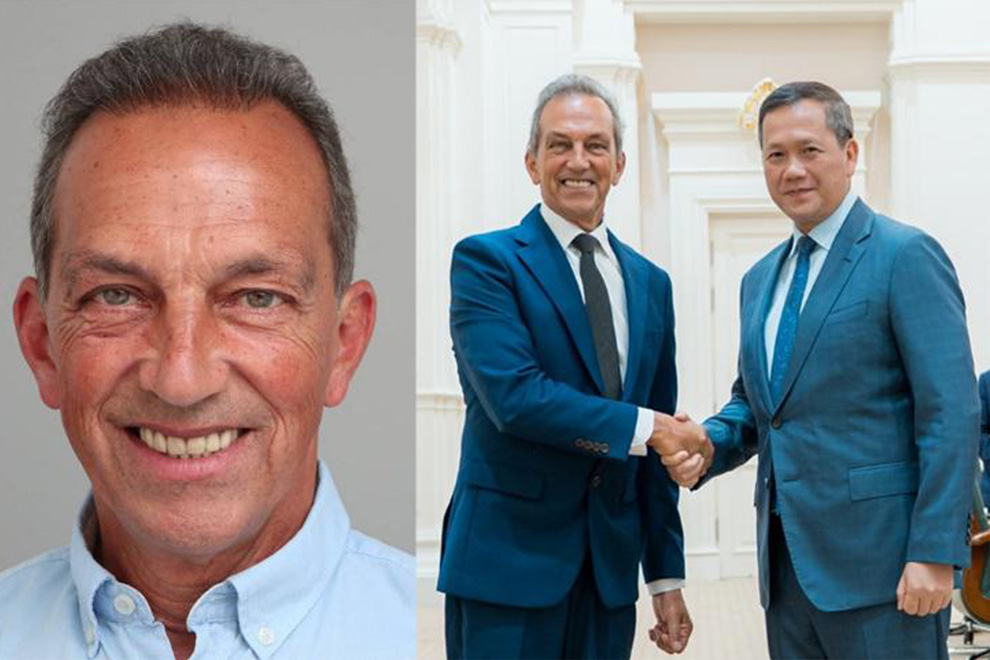
At the Sorbonne Law School in Paris, Jean-Marc Sorel’s office is a sanctuary of legal scholarship, lined with shelves of heavy tomes on international law and legal proceedings at the International Court of Justice (ICJ).
A professor and director of the IREDIES (Research Institute of International and European Law at the Sorbonne), Sorel’s journey from a young scholar with a passion for public law to a pivotal figure in resolving international border disputes is a tale of intellect, dedication and a quiet resolve to uphold justice on the global stage.
Sorel pursued a graduate degree in public law and political science, followed by a doctorate that cemented his reputation as a meticulous legal thinker. At the Sorbonne he taught courses on general international law, international litigation, territorial and maritime conflicts, and the intricate world of international monetary and financial relations.
Yet, Sorel was no mere academic; his expertise extended beyond the classroom, into the high-stakes arena of the ICJ in The Hague. In 2011, his life took a decisive turn when he was called upon to join Cambodia’s legal team in a landmark case at the ICJ: the Request for Interpretation of the Judgment of 15 June 1962 in the Case Concerning the Temple of Preah Vihear (Cambodia v. Thailand).
The dispute centred on the 11th-century Preah Vihear Temple, perched atop the Dangrek Mountains, a site of cultural and historical significance. The ICJ’s 1962 ruling had awarded the temple to Cambodia, relying on a 1907 French map that Thailand had acquiesced to for decades. However, Thailand late claimed the surrounding territory, leading to renewed tensions which culminated in deadly clashes in 2008 and 2011.
Cambodia sought clarification at the ICJ, and Sorel, with his deep knowledge of international law and territorial disputes, became a cornerstone of their legal strategy. During the April 15 to 19, 2013 public hearings, Sorel stood before the ICJ’s judges and argued Cambodia’s case.
He dissected the 1962 judgment, emphasising that the Annex I map, accepted by Thailand, clearly placed the temple and its vicinity within Cambodian territory. Sorel countered Thailand’s objections, which claimed Cambodia was misinterpreting the judgment’s reasoning. When the ICJ delivered its unanimous ruling in November 2013, affirming Cambodia’s sovereignty over the entire Preah Vihear promontory and ordering Thailand to withdraw its forces, Sorel’s contribution was undeniable.
It is his expertise and experiences, with deep knowledge of Cambodian history, that led to Sorel being called upon again. Cambodia faces a new chapter in its border disputes with Thailand concerning the Mum Bei area (also known as the Emerald Triangle), along with the ancient temples of Ta Moan Thom, Ta Moan Tauch and Ta Krabei, flashpoints of tension which led to a deadly clash on May 28 which resulted in the death of a Cambodian soldier.
On June 15, which coincided with the 63rd anniversary of the 1962 Preah Vihear ruling, Cambodia submitted a letter to the ICJ, seeking resolution over these four contested areas, a move described as reflecting Cambodia’s commitment to international law over military confrontation.
After meeting with Sorel on July 1, Prime Minister Hun Manet described the professor’s pivotal role in shaping Cambodia’s legal strategy.
“Professor Jean-Marc Sorel was an important member of the legal advisory team which helped Cambodia win the case of the interpretation of the ICJ’s 1962 decision regarding Preah Vihear Temple in 2013,” he said.
Kin Phea, director of the International Relations Institute at the Royal Academy of Cambodia, acknowledged the significant role Sorel will play in this case, noting that what is even more important are the legal documents left by France which were used to help Cambodia win the 1962 case, as well as other legal and historical documents.
“The combination of legal and historical documents and the annexed Franco-Siamese maps of 1904 and 1907, along with outstanding legal experts who have been selected mean our expectations are high. I want to make it clear that our high expectations rely on our righteousness and historical fact. We have not hired strong legal experts to take another nation’s land, but to protect the territory of Cambodia, a legacy from the colonial era,” he said.
He added that the hiring of international legal specialists is a testament of Cambodian’s choice to seek a peaceful means of resolving border dispute based on law, not on force.
“This reflects Cambodia choice to not use force or military action to demarcate the border. Borders between nations cannot be drawn at gunpoint, no matter in what circumstances. We must draw a border line that leads to stability and peace, prosperity, cooperation and friendship,” Phea said.
