Private-sector leaders, government officials and gender-equality advocates have called for stronger action from businesses to remove barriers to women’s leadership in Cambodia, stressing that workplace policies and corporate culture must translate gender-equality commitments into tangible opportunities.
The March 6 EuroCham Cambodia and UN Women Cambodia, with support from the Australian Government, co‑hosted an International Women’s Day business engagement event today under the global 2026 theme “Rights. Justice. Action. For ALL Women and Girls.”
It brought together private-sector leaders, government representatives and development partners to examine the organisational barriers that continue to limit women’s advancement to leadership roles, while exploring practical steps companies can take to promote equality in the workplace.
Opening the event, Sophea Khun, country programme coordinator of UN Women Cambodia, emphasised that gender equality is both a fundamental human rights issue and a key driver of inclusive economic development.
“International Women’s Day is a powerful moment to reflect on progress and accelerate action towards gender equality,” she said.
“For businesses in Cambodia, it is important to look at how workplace policies, leadership decisions and supply chains can create real opportunities for women and strengthen inclusive economic growth,” she added.
Chhun Hak, director-general of the Ministry of Women’s Affairs, echoed the call, encouraging companies to go beyond symbolic support and implement concrete measures that help women progress into decision-making roles.
During the forum, representatives from UN Women introduced the Women’s Empowerment Principles (WEPs) — a global framework guiding companies on promoting gender equality in the workplace, marketplace and community.
The initiative is supported by tools such as the Gender Action Lab and the “We Rise Together” programme, which aim to strengthen leadership accountability and gender-responsive business practices.
A presentation by legal expert Raksa Chan of DFDL highlighted legal and organisational factors affecting women’s participation in the workforce, noting that compliance with labour regulations alone is insufficient to close persistent gender gaps.
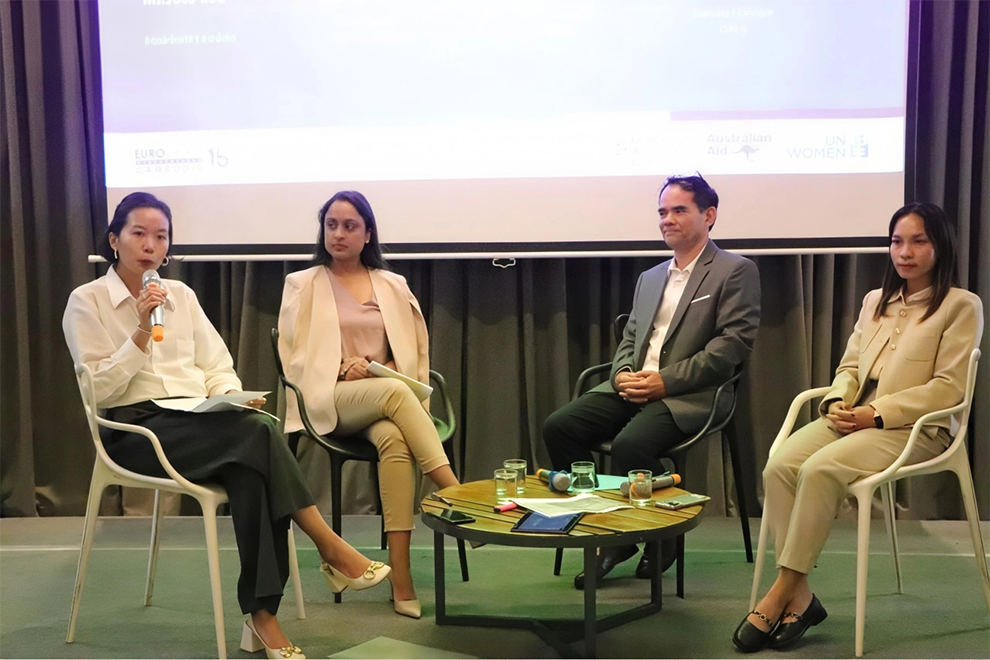
The event’s central panel discussion, moderated by Julie Keo of EuroCham and head of the Cambodia EU desk at DFDL, featured leaders from COVA Cambodia, GAEA and SuDrain, who shared insights on the challenges women face in traditionally male-dominated industries.
Leila Rostom, country leader of COVA Cambodia, pointed to informal workplace culture as a major obstacle to women reaching senior positions.
“Hidden workplace culture is a challenge in itself—it’s a major issue,” she said.
“While the law may address the pay gap, it does not determine who ultimately reaches leadership positions. We have to move beyond that norm and break the cycle,” she continued.
She added that companies must rethink how leadership pipelines are structured to ensure equal opportunities.
“It shouldn’t be a boys’ club or a women’s club — it should be a space where we all work together,” she said.
Other speakers emphasised that inclusive governance and collaborative decision-making can help organisations create more equitable work environments.
Chanvirak, general manager of GAEA (Global Action for Environment Awareness), noted that his company prioritises collective decision-making and non-discriminatory hiring practices.
“As long as someone can perform the job, we welcome them — we do not discriminate,” he said.
Meanwhile, SuDrain founder and CEO Thary Vorn highlighted the value of women’s perspectives in shaping more inclusive business solutions.
“Women often bring a unique perspective. We think about how solutions affect people around us — whether it’s inclusion, disability or children — and we incorporate those concerns into professional solutions,” she said.
The event also featured a signing ceremony for the Women’s Empowerment Principles, welcoming 16 new companies into the Cambodia WEPs community and signalling growing private-sector support for gender-responsive business practices.
Closing the event, Martin Brisson, executive director of EuroCham Cambodia, reaffirmed the chamber’s commitment to supporting responsible and inclusive business.
He said women’s leadership plays an important role in driving innovation and long-term economic resilience, encouraging companies to continue engaging with UN Women initiatives to accelerate progress.
Founded in 2011 by European business associations, EuroCham Cambodia represents more than 400 members from 23 European countries and works with the Cambodian government and private sector to promote a more competitive and sustainable business environment.
The event concluded with a networking session, allowing participants to exchange experiences and explore partnerships aimed at advancing women’s rights and leadership opportunities across Cambodia’s business community.