



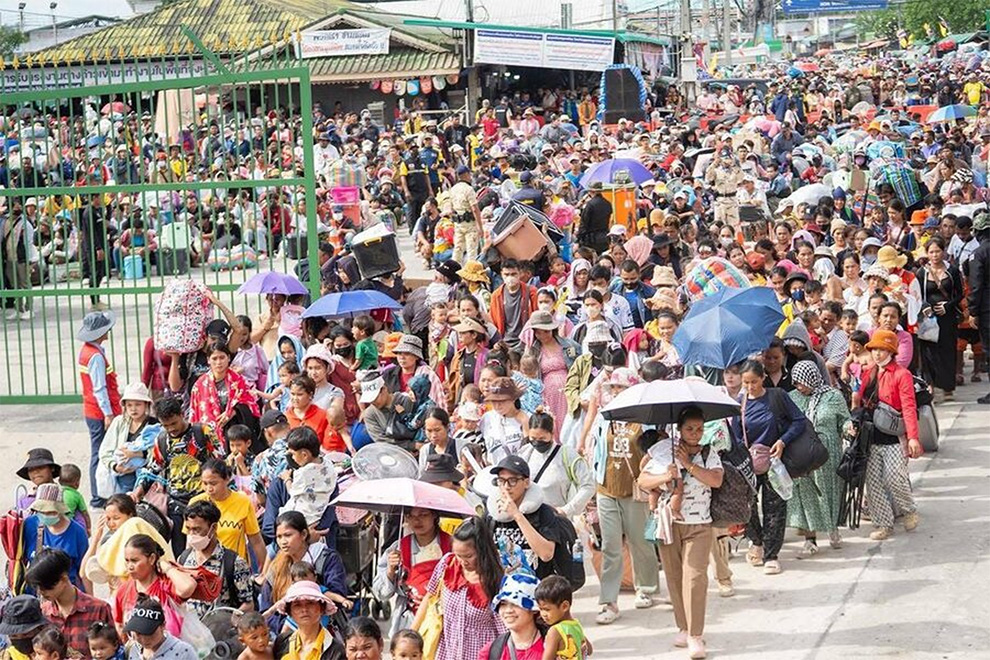
The recent clashes along the Thailand-Cambodia border have triggered not only a security crisis but also a severe economic shock which has reverberated across Cambodian society. While much attention centres on diplomatic negotiations and military movements, the economic impact on ordinary Cambodians — particularly those living and working near the border — demands serious attention.
The immediate effect has been the disruption of vital cross-border trade and labour. Thousands of Cambodian migrant workers, who form the backbone of many families’ finances, have been forced to return home overnight. The loss of their remittances — a crucial lifeline for rural communities — means less money for food, education and health care. With border markets shuttered, small businesses and farmers lose access to buyers, suppliers and essential goods, bringing local economies to a standstill.
This situation exposes Cambodia’s heavy reliance on its neighbour for employment and trade. When borders close, entire provinces suffer. The challenge is especially acute for the most vulnerable: the displaced, small-scale traders and daily wage earners with no savings to buffer sudden shocks. Local governments now face mounting pressure to create jobs, provide aid and rebuild shattered livelihoods.
Still, there is opportunity beneath the crisis. The forced return of a skilled migrant workforce — if supported by targeted policies, vocational training and investment — could help drive innovation and diversification in Cambodia’s domestic economy. International aid, sparked by global attention, can be directed to infrastructure, microfinance and small enterprise support in affected regions. Such steps can reduce future economic vulnerability and foster more self-reliant border communities.
This conflict should serve as a wake-up call. For Cambodia to weather not just this crisis but future ones, it must build an economy less dependent on external factors and more inclusive for its border populations. Policymakers in Phnom Penh, with support from the international community, need to seize this challenging moment to accelerate long-term economic reforms and sustainable development.
In the fog of conflict, the world must pay as much attention to the economic casualties as to the political ones. The livelihoods and futures of Cambodian families depend on it.
Vichana Sar is a researcher based at the Royal Academy of Cambodia. The views and opinions expressed are his own.
