



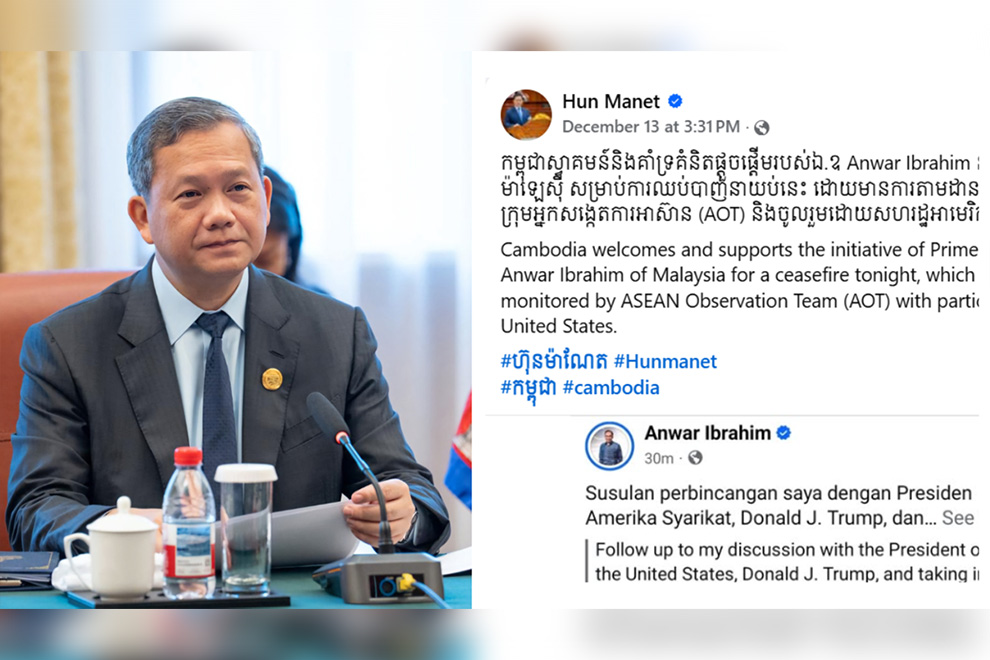
Thailand claims it seeks peace in the ongoing border conflict — but only if Cambodia admits it is the “aggressor”. Let’s be clear: Cambodia is not the aggressor. Thailand is.
No neutral international body — not ASEAN, not the UN, not any impartial observer — has ever concluded that Cambodia initiated hostilities. Cambodia acts in self-defence, protecting its sovereignty and its people from repeated Thai incursions. Demanding that Cambodia admit guilt before a ceasefire is not diplomacy; it is coercion. It is Thailand attempting to rewrite reality, shift blame and delay genuine peace.
A ceasefire is mutual by definition. History and international practice make this clear: Effective ceasefires are unconditional, simultaneous and verifiable. They do not require one side to surrender its narrative or dignity. Thailand’s insistence on unilateral compliance is a transparent attempt to maintain political and military advantage. Peace cannot be built on coercion; it requires respect, accountability and trust.
Thailand’s “three conditions” are telling. First, the demand for a continuous ceasefire sounds reasonable — but Cambodia has repeatedly offered to halt hostilities, provided Thailand reciprocates. The problem is Thailand’s refusal to accept neutral monitoring. Independent verification, through ASEAN or the UN, is not a concession; it is standard international practice. Without it, Thailand’s call for “continuity” is meaningless.
Second, linking a ceasefire to landmine removal is cynical and morally indefensible. Cambodia is one of the world’s most mine-affected countries, yet it has also been a global leader in humanitarian demining. Using life-saving humanitarian work as leverage in negotiations is a distortion of morality. Peace cannot come at the expense of human safety.
Third, the timing and venue of Thailand’s proposal reveal its true intent. Thailand offers to present these conditions at the ASEAN Foreign Ministers’ Meeting only “if requested”, signaling a preference for private pressure over transparent multilateral accountability. ASEAN’s credibility depends on dialogue conducted in good faith, not ultimatums disguised as peace proposals.
Cambodia does not reject peace. Cambodia rejects distortion. Cambodia does not oppose a ceasefire; it opposes a ceasefire written solely on Thailand’s terms. The path forward is simple: an immediate mutual ceasefire, independent verification, and negotiations conducted without preloaded accusations. Anything less is not peace; it is delay masquerading as diplomacy.
The world must see the truth: Cambodia defends, Thailand invades. Thailand’s narrative is false. Its conditions are excuses. Its ultimatums are coercion. True peace will never come while Thailand frames Cambodia as the aggressor. International audiences and ASEAN partners must recognise this reality.
Peace cannot be built on lies, intimidation or moral manipulation. It can only come when facts, sovereignty and justice guide the process. Cambodia will continue to defend its people, its territory, and its dignity — and the world must recognise where responsibility truly lies.
Roth Santepheap is a geopolitical analyst based in Phnom Penh. The views and opinions expressed are his own.
