As a Cambodian scholar, I wish to express my deep and serious concern regarding the continued distortion, misrepresentation and politicisation of Cambodian cultural heritage and other sensitive issues by certain Thai domestic media outlets and social media platforms.
Of particular concern is the exploitation of the cultural sector by some Thai media platforms to advance politically motivated and unfounded claims. Such actions not only mislead the public and distort historical facts, but also risk undermining the spirit of mutual respect, good faith and regional cooperation that ASEAN member states are obliged to uphold.
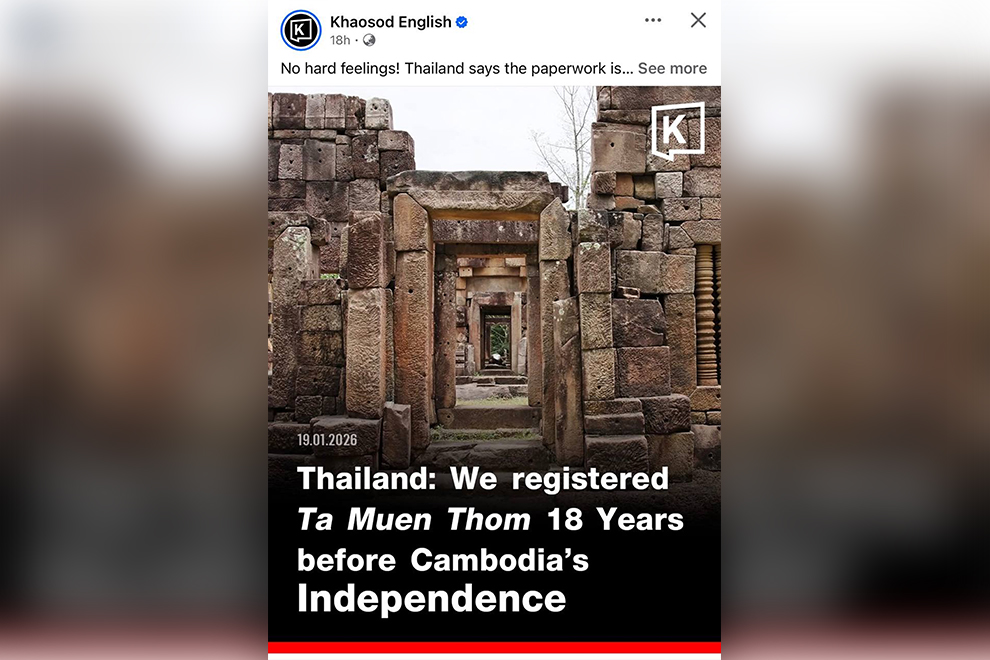
I wish to offer my scholarly opinion in response to recent reporting by Khaosod English concerning the Ta Mone Temple Complex, as follows:
1. Historical Background: The Franco–Siamese Treaty of 1907
The foundation of territorial demarcation between Cambodia and Thailand (formerly Siam) is the Franco–Siamese Treaty of 1907. This treaty, negotiated and signed by the French Protectorate of Cambodia and the Kingdom of Siam, clearly defined the international boundary between the two parties.
The treaty delineated borders through precise descriptions and officially recognized maps, including the area in which the Ta Mone Temple Complex is located. As an internationally binding agreement, the treaty remains a cornerstone of the modern boundary between Cambodia and Thailand.
Consequently, Thailand’s registration of the Ta Mone Temple in 1935 was unlawful and contrary to the provisions of the treaty. Even assuming, arguendo, that such registration had occurred prior to 1907, the treaty would supersede and render that registration legally ineffective.
2. Cartographic Evidence: Legal Validity of Official Maps
Territorial sovereignty is inseparable from cartographic evidence. In this regard, two maps are frequently referenced but must not be conflated.
The 1:200,000-scale map, complete with legends and jointly recognized by France and Siam at the time of the 1907 treaty, clearly situates the Ta Mone Temple Complex within Cambodian territory. This map possesses full legal validity under international law.
By contrast, the 1:50,000-scale map recently cited by the Thai side was produced unilaterally and lacks any international recognition or legal standing. Established principles of international law and diplomatic practice affirm that mutually agreed official maps prevail over unilateral or retrospectively produced cartographic materials.
3. Inclusion in Cambodia’s National Heritage Inventory
The Royal Government of Cambodia has formally registered the Ta Mone Temple Complex in its National Inventory of Cultural Heritage. This registration reflects Cambodia’s lawful exercise of sovereignty and its responsibility to safeguard cultural heritage.
Such inclusion follows a rigorous legal and administrative process under Cambodia’s national heritage framework and further confirms Cambodia’s recognised jurisdiction, management and protection of the site.
4. Relevant Principles of International Law
International law places paramount importance on respect for established borders and the peaceful resolution of disputes. Unilateral territorial claims based on unofficial maps run counter to:
- The principle of uti possidetis juris, which preserves administrative boundaries at the time of independence; and
- The binding obligation to respect international treaties, including the Franco–Siamese Treaty of 1907.
Cambodia’s position is firmly grounded in these well-established legal principles, which serve to protect both territorial sovereignty and cultural heritage.
In light of historical treaties, authoritative cartographic evidence, official heritage registration and fundamental principles of international law, the Ta Mone Temple Complex is unequivocally located within the territory of the Kingdom of Cambodia.
In a July 4, 2025 press release, the Cambodian Ministry of Culture and Fine Arts called upon all parties, particularly the Ministry of Culture of Thailand, to respect these established facts and uphold international law, stating:
“The Ministry of Culture and Fine Arts of Cambodia wishes to clarify that any registration, at any time or in any place, conducted unilaterally by the Thai side through the use of the 1:50,000 scale map has no legal validity whatsoever in relation to the lawful framework of the 1907 Franco–Siamese Treaty and the 1:200,000 scale delimitation map, which were jointly recognized by France and Siam and remain fully in force.
The ministry further affirms that the Ta Mone Temple Complex is located within the territory under the sovereignty of the Kingdom of Cambodia, as an archaeological site situated in Oddar Meanchey Province, in accordance with the 1907 Franco–Siamese Treaty and the 1:200,000 scale map. The temple complex has also been duly registered in the National Inventory of Cultural Heritage of Cambodia.
The ministry therefore calls upon the Ministry of Culture of Thailand to respect prevailing principles of international law, in order to uphold the dignity and professionalism that cultural institutions of all countries are obliged to observe.”
Finally, as a lawful and civilised nation, Thailand is expected to act in full conformity with its obligations under international law and to demonstrate responsible and constructive conduct in the cultural and heritage domain.
The reliance on unilateral maps and the forceful occupation of territory stand in direct contradiction to these principles and warrant international legal scrutiny and condemnation.
In order to resolve any differing views regarding border issues in a peaceful and lawful manner, Thailand should agree with Cambodia and submit all outstanding disputes to the International Court of Justice, the only competent judicial body that can provide a definitive and binding resolution, in accordance with international law.
Roth Serei is a Cambodian scholar based in Phnom Penh. The views and opinions expressed are his own.