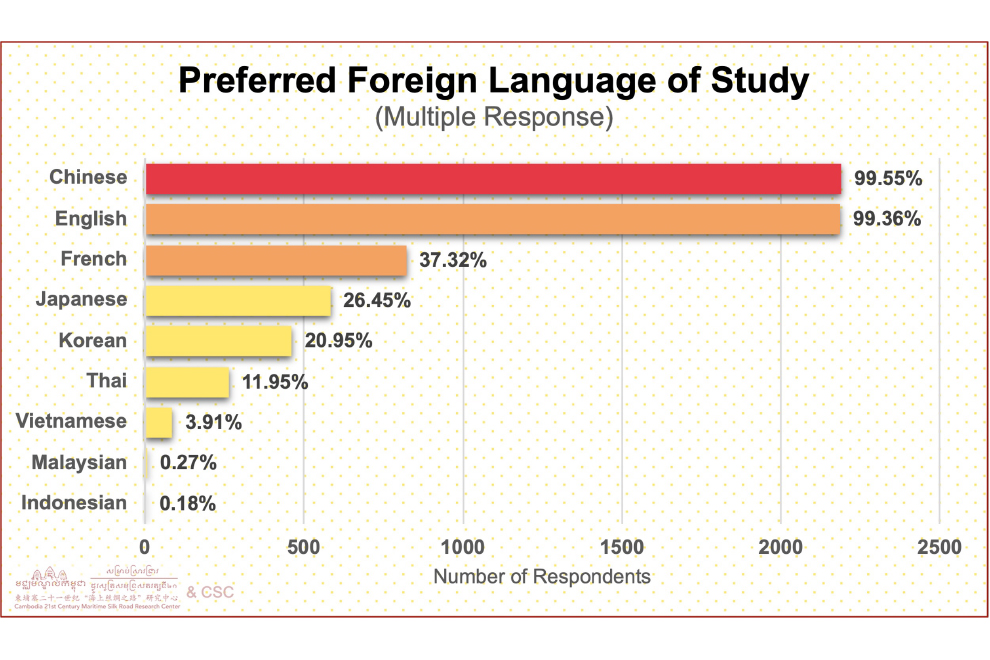
In the heart of Southeast Asia, Cambodia’s youth are dreaming big. They see education as the key to unlocking a brighter future, and China as a gateway to global opportunities. A recent survey of 2,200 Cambodian generation Z youth, administered by the 21st Century Maritime Silk Road Research Center at the Royal University of Phnom Penh and the Center for Cambodian Studies at Beijing Foreign Studies University, painted a vivid picture of their aspirations, challenges, and the pivotal role of education and language in shaping their careers.
The Language Advantage: Chinese as a Career Catalyst
For Cambodian youth, language is more than a means of communication — it’s a strategic asset. Nearly all respondents (99.55%) view Chinese as the most promising language for career advancement, closely followed by English (99.36%). This dual focus reflects the realities of a globalised world. English remains the lingua franca of international business and technology, while Chinese has surged in importance due to China’s economic rise and its deepening ties with Cambodia through initiatives like the Belt and Road Initiative (BRI).
However, mastering the language is no small feat. While urban youth have access to language schools and online resources, those in rural areas often struggle with limited infrastructure and financial constraints. This disparity highlights the need for systemic interventions to ensure that all Cambodian youth, regardless of their background, can acquire the language skills needed to compete in a globalised job market.
China: The dream destination for higher education
When it comes to higher education, China stands out as the top choice for Cambodian youth, with 84.55% of respondents expressing a desire to study there. This preference is driven by several factors. First, China offers a wide range of scholarships that make higher education more accessible to students from developing countries. Second, Chinese universities are increasingly recognised for their academic excellence, particularly in fields like international relations, economics and education — areas that align closely with Cambodia’s development priorities.
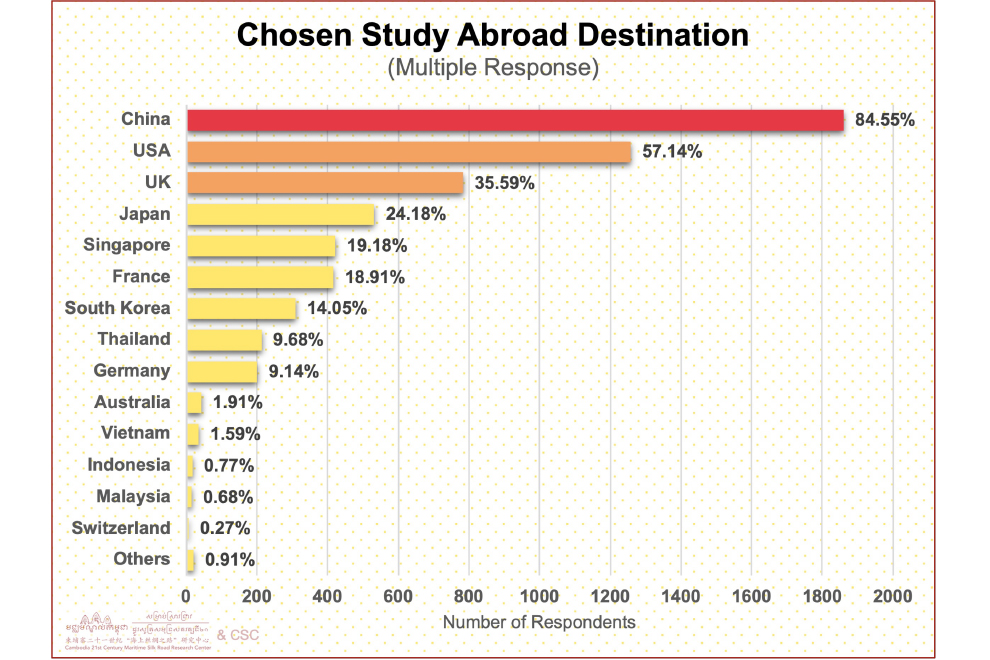

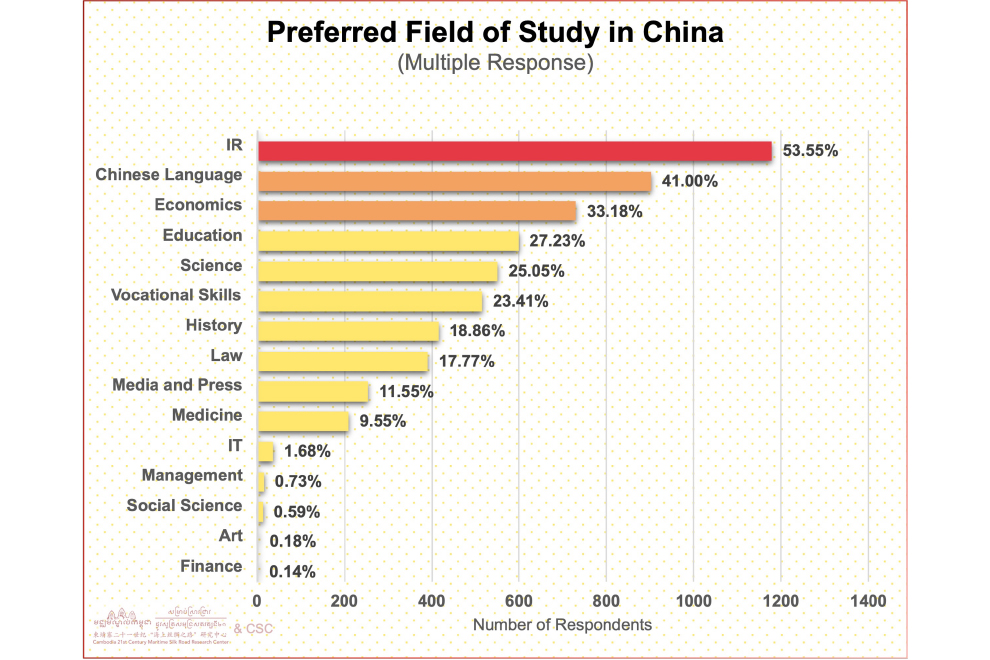
Despite this enthusiasm, significant challenges remain. Many students face difficulties accessing accurate information about application procedures, scholarship deadlines and university rankings. Furthermore, there is a prevailing perception that degrees from Chinese universities are less prestigious compared to those from Western institutions. To address these issues, both Cambodian and Chinese governments must work together to improve access to information and elevate the global reputation of Chinese higher education.
Overcoming barriers: Language, finance and information
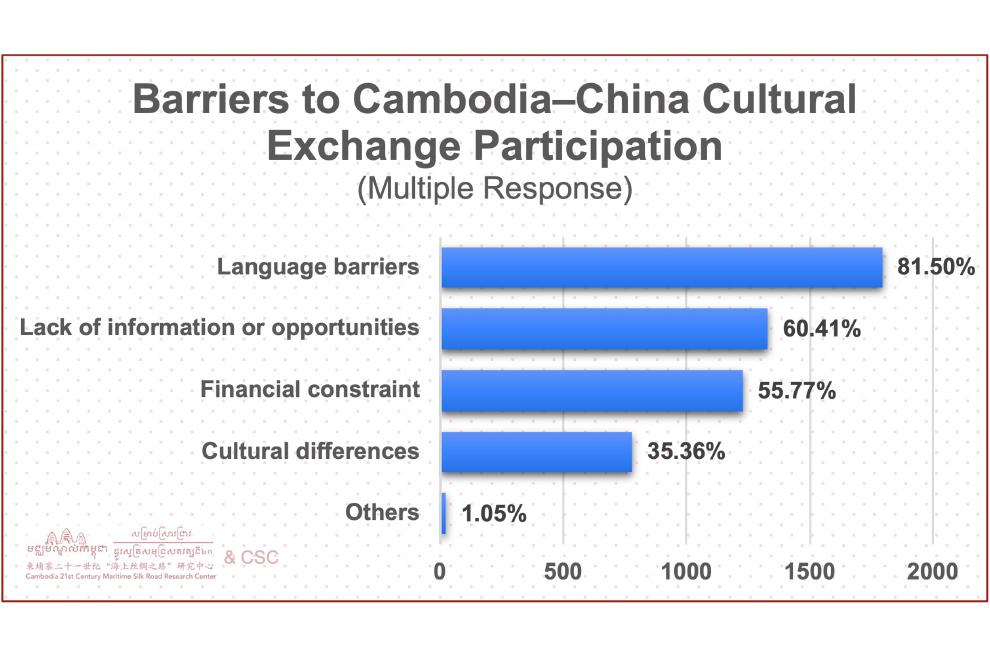
The survey revealed three major barriers that hinder Cambodian youth from fully realising their educational aspirations: language proficiency, financial constraints and lack of information. Language barriers, cited by 81.5% of respondents, are particularly daunting, as many students struggle to meet the Mandarin proficiency requirements for scholarships. Financial constraints (55.8%) also pose a significant challenge, with airfare, living costs and hidden fees deterring low-income students. Meanwhile, 60.4% of respondents cited a lack of information about opportunities, especially in rural areas where access to digital platforms is limited.
These barriers have far-reaching implications. Without intervention, educational mobility risks becoming exclusive to urban elites, exacerbating inequality and limiting Cambodia’s potential to harness the talents of its entire population. Addressing these issues requires innovative solutions and strong collaboration between Cambodia and China.
A shared vision: Recommendations for Cambodia and China
To unlock the full potential of Cambodian youth, both governments must take proactive steps to address the challenges identified in the survey. For Cambodia, this means integrating Mandarin and English dual-track programmes into the national curriculum, starting from secondary education. Establishing a national advisory office to guide students on applying to Chinese universities and simplifying visa procedures for scholarship recipients would also go a long way in reducing barriers to educational mobility.
For China, expanding funding for Confucius Institutes in Cambodia and focusing on practical business Mandarin rather than just cultural education would enhance language learning outcomes. Introducing need-based travel grants and showcasing success stories of Cambodian graduates in high-impact fields like renewable energy and AI would further boost the appeal of Chinese education.
Perhaps most importantly, both countries should establish a Cambodia-China Education Council to coordinate policy, monitor outcomes and resolve bottlenecks. This bilateral task force could serve as a platform for piloting innovative models, such as online dual-degree programmes and corporate-sponsored scholarships, before scaling them up.
Building a Brighter Future Together
The aspirations of Cambodian youth are a testament to the transformative power of education. By investing in language training, equitable access and workforce development, Cambodia and China can create a shared future built on knowledge and mutual growth. This is not just about empowering individuals — it’s about strengthening bilateral ties, fostering regional stability and unlocking the full potential of a generation that holds the key to Cambodia’s future.
As the sun rises over the Mekong River, it illuminates a path forward — one where education bridges divides, language opens doors, and collaboration paves the way for a brighter tomorrow for Cambodia and China.
Neak Chandarith is an associate professor and director of the Institute for International Studies and Public Policy (IISPP) and the Cambodia 21st Century Maritime Silk Road Research Center (CMSRRC), Royal University of Phnom Penh (RUPP).
Gu Jiayun is an associate professor and vice-dean at the School of Asian Studies and Director of Center for Cambodian Studies at Beijing Foreign Studies University (BFSU).
The views and opinions expressed are their own.